
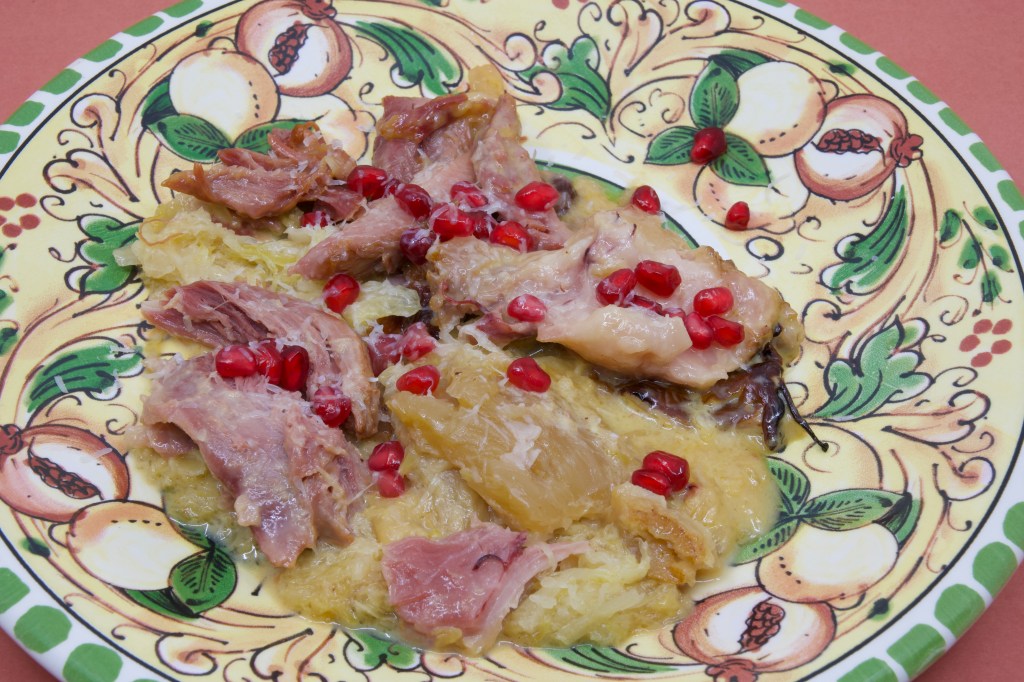
This meal brings together a smoked pork hock, fennel bulb, brown onion, salt, and mixed mammal liquor in the pressure cooker. It is simple food with an appetite behind it: smoky pork, sweet anise-like fennel, savoury onion, and a rich cooking liquor that becomes more than the sum of its parts.
Jump to the recipe.
Why pork and fennel work so well.
Pork and fennel are a classic pairing because they balance each other. Pork hock is rich, smoky, salty, gelatinous, and deeply savoury. Fennel brings sweetness, freshness, and a gentle anise flavour. When cooked under pressure, the fennel collapses into the liquor, softening the heaviness of the meat while also perfuming the dish.
This is the same sort of logic behind pork and apple, beef and onion, lamb and rosemary, chicken and leek, or fish and lemon. Meat gives fat, protein, and depth. Vegetables, herbs, and fruit bring water, acid, sweetness, bitterness, or aroma. Good combinations keep the mouth interested.
About pork hocks
A pork hock is the lower part of the pig’s leg, close to the ankle joint. It contains bone, skin, connective tissue, fat, and hard-working muscle. That means it can be tough if rushed, but it becomes tender and succulent when cooked long enough for the collagen to soften into gelatine. A smoked pork hock adds another layer: salt, smoke, and cured-pork flavour.
I have written before about pork hock and pork knuckle on Yummy Lummy. The Hahndorf Inn pork hock was a generous Bavarian-style meal with crunchy crackling, sauerkraut, mashed potato, mustard, and gravy. I also mentioned pork knuckle in a Queensland Day post, where the knuckle was cooked slowly, chilled, and then finished in an air fryer. See Crispy skin pork hock at the Hahndorf Inn and Queensland Day.
About fennel
Fennel bulb is crisp when raw, with a fresh anise aroma. Once cooked, it softens and becomes sweet, mild, and silky. In this dish, fennel works as both a vegetable and an aromatic. It does not dominate the pork; it lifts it.
Fennel also suits pressure cooking. The bulb breaks down enough to flavour the liquor, while some pieces remain recognisable if cut thickly. The result is a sauce-like vegetable base rather than a separate side dish.
Ingredients
- 1 smoked pork hock
- 1 fennel bulb trimmed and quartered.
- 1 brown onion, peeled and quartered.
- Salt, used carefully because the pork hock is already smoked and cured.
- Mixed mammal liquor, enough to cover the base of the pressure cooker.
- Greek-style yoghurt, to serve.
- Pickled pomegranate arils, to serve.
- Polish sauerkraut, to serve.
Method
- Place the quartered fennel and brown onion in the base of the pressure cooker.
- Sit the smoked pork hock on top of the vegetables.
- Add the mixed mammal liquor. Do not overfill the cooker.
- Add only a little salt, if needed.
- Seal the pressure cooker and cook on high pressure for 40 minutes.
- Allow the cooker to vent naturally. This matters because a natural release helps the meat stay succulent and reduces the risk of drying the hock.
- Open the cooker carefully, remove the pork hock, and let it rest briefly.
- Pull the meat from the bone or serve the hock whole, depending on appetite and presentation.
- Spoon over some of the fennel, onion, and cooking liquor.
Serving
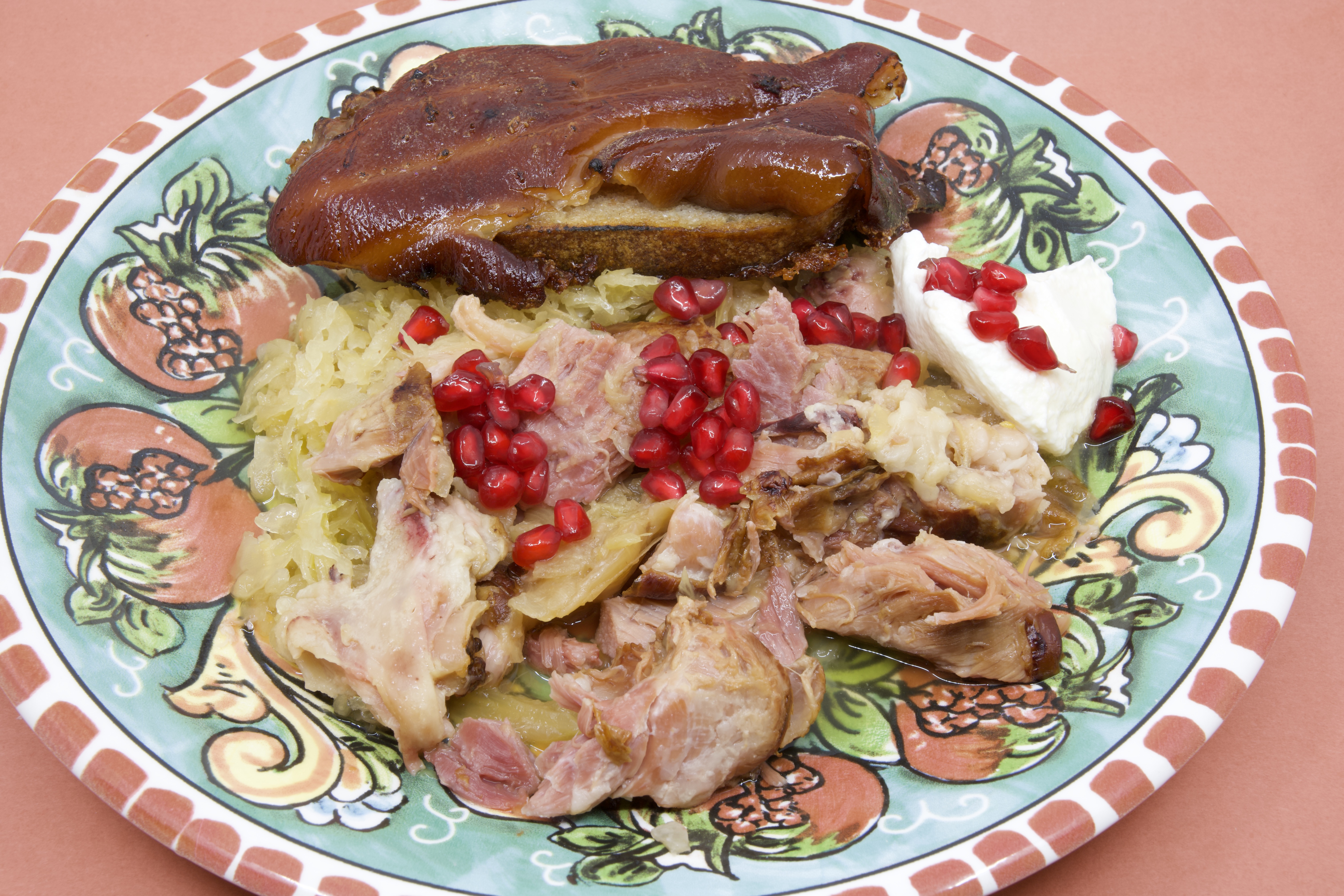
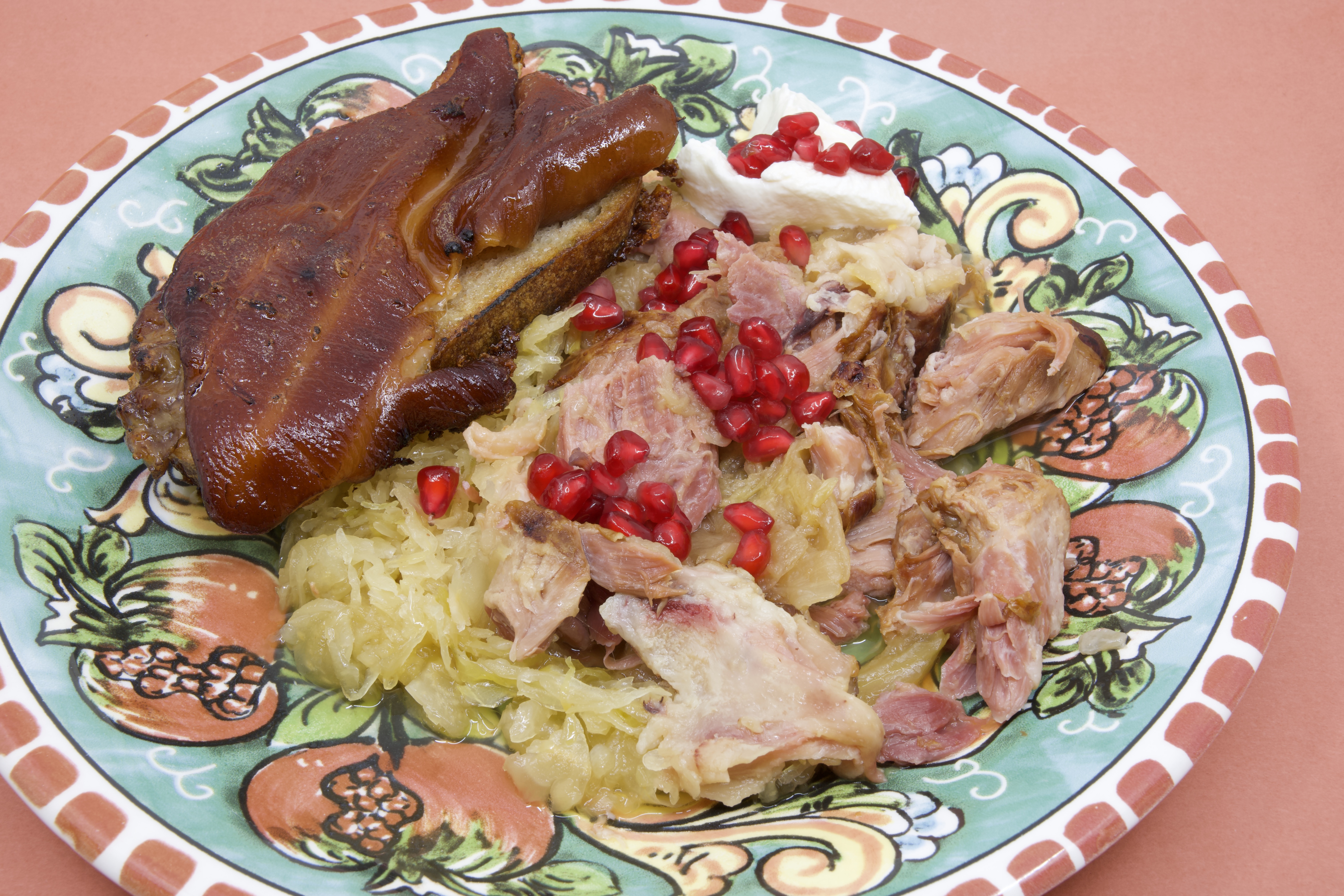
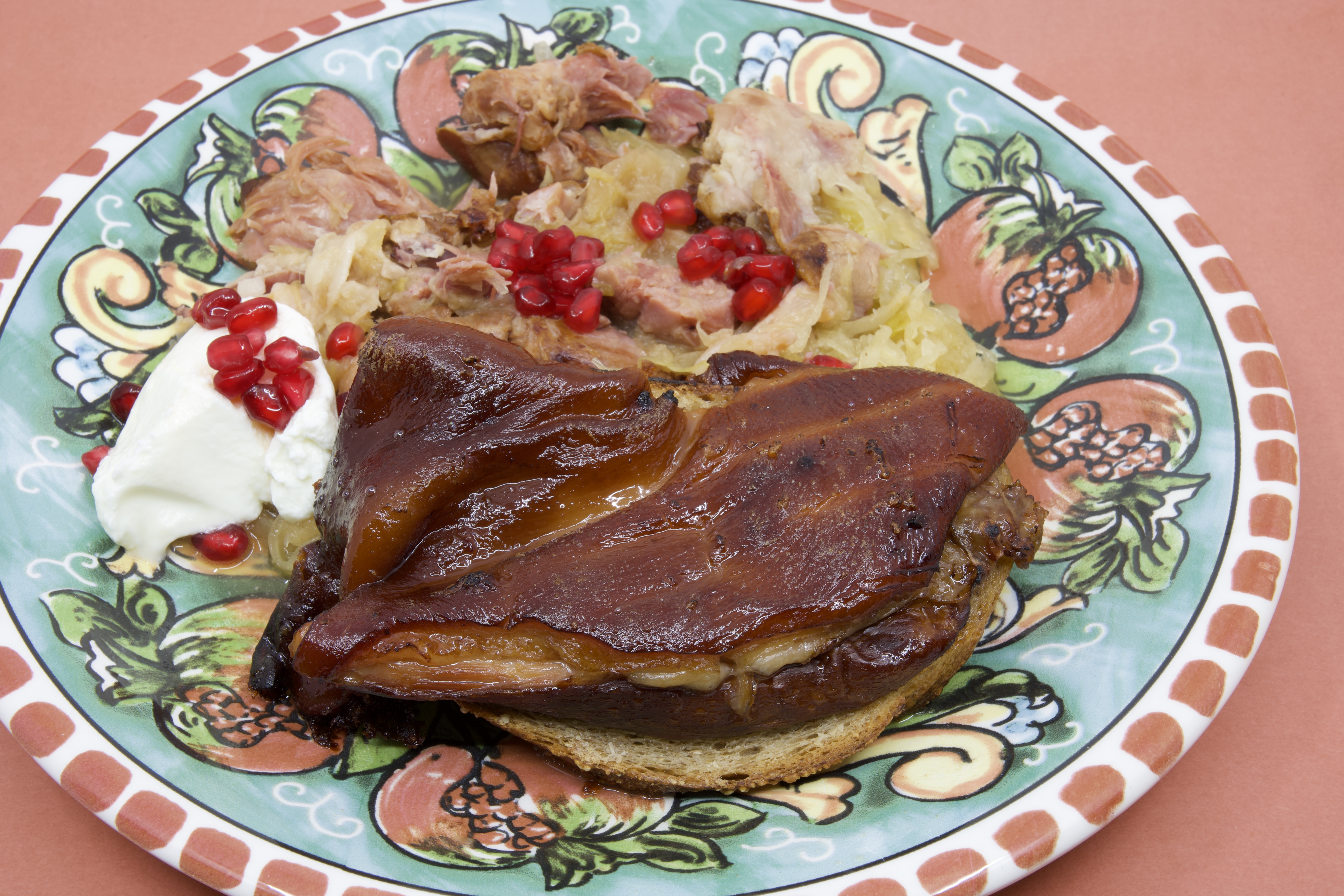
Serve the pork and fennel with Greek-style yoghurt, pickled pomegranate arils, and Polish sauerkraut. The yoghurt cools the meat. The pomegranate arils add vivid tartness and colour. The sauerkraut brings crunch, acidity, and a pleasing fermented edge.
This is a meal for eating with a spoon and fork.
Cook’s notes
- Smoked pork hock can be salty, so season cautiously.
- Natural pressure release is worth the wait because the meat remains moist and relaxed.
- If the liquor tastes too salty, dilute it with water or unsalted stock before serving.
- Leftover pork can be folded through sauerkraut, added to soup, or eaten cold with yoghurt and pickles.
Final thoughts
Pork and fennel is a combination that makes sense. The hock gives smoke, salt, fat, and gelatin. The fennel provides sweetness and fragrance. The onion rounds everything out. The yoghurt, pomegranate, and sauerkraut make the plate lively rather than heavy.
References and notes
- Yummy Lummy. 2026. “Crispy skin pork hock at the Hahndorf Inn.” Notes: describes a Bavarian-style pork hock meal with sauerkraut, mustard, mashed potato, gravy, tender meat, and crisp crackling.
- Yummy Lummy. 2026. “Queensland Day.” Notes: includes pork knuckle served with sauerkraut and peas, finished in an air fryer after slow cooking and chilling.
- Pressure cooking note. A high-pressure cook followed by natural release is commonly used for collagen-rich pork hock because it helps produce tender, gelatinous meat.

Microsoft Copilot was exploited to assist in creating this blog post.
TyreFix
I woke up this morning and started going for a drive. Discovered that there was low tyre pressure in one of my tyres. Fortunately, there was a servo nearby, so I was able to re-inflate the tyre. I went online to find a tyre repair service open on a Saturday morning. TyreFix came up as a 24-hour-a-day, seven-day-a-week service at very affordable prices. The best thing about TyreFix is that they come to you. It’s a mobile service. I called the mobile telephone number and provided my address and tyre details. The owner arrived at my place within 30 minutes. He repaired the tyre within 15 minutes. I was able to pay with a credit card on the spot. After the repair, there is a three-month warranty. This is a fantastic service. The person who answered the telephone was very friendly and very helpful. The person who came out, the company owner, was a delightful gentleman. He was very informative and very helpful. I highly recommend TyreFix.


Can a Humidifier Change the Way a Gas Stove Burns?
I started using a new humidifier this week. Within a day, I noticed the flames on my gas stove top were yellow rather than blue. I was worried about a supply problem, which could mean a carbon monoxide danger. I was prepared to contact a plumber but thought I would search for answers on the likely causes of yellow gas stove flames. I wanted to know about the temporal relationship between using a humidifier and the change in gas flame colour.
A portable humidifier seems like a simple household appliance: it adds moisture to dry indoor air. But when a humidifier is operated in a home—particularly in a closed room—it raises an interesting question: can increasing indoor humidity change the combustion of a gas stovetop burner?
Ultrasonic and cool-mist humidifiers are commonly used to increase indoor humidity. However, unlike evaporative humidifiers, they can do more than add moisture to the air: they can aerosolise minerals dissolved in the water.
This raises an interesting question for homes with gas cooking: can these mineral aerosols enter a gas-stove flame and alter combustion?
It’s more than just water vapour
An ultrasonic humidifier uses high-frequency vibrations to produce microscopic water droplets. As these droplets evaporate, dissolved minerals remain suspended as airborne particles. Depending on the water source, these can include calcium, magnesium, sodium, and potassium.
This phenomenon is responsible for the familiar “white dust” that can accumulate around ultrasonic humidifiers. Experimental studies have demonstrated that ultrasonic humidifiers can substantially increase airborne concentrations of minerals when operated with mineral-rich tap water.
Low-mineral or distilled water should be used in ultrasonic humidifiers when possible, and the reservoir should be cleaned regularly.
What happens when mineral aerosol reaches a gas flame?
A natural-gas cooktop burns predominantly methane:
CH₄ + 2O₂ → CO₂ + 2H₂O + heat
The flame operates at temperatures high enough to transform mineral particles entering the combustion zone.
Of particular interest are sodium and potassium, both alkali metals. Sodium and potassium originating from particles can enter methane flames and produce characteristic optical emissions. This is the same basic phenomenon responsible for the familiar yellow colour of a sodium flame.
Alkali-metal compounds can also interact with combustion chemistry. Potassium-containing compounds can influence methane and LPG flames, including inhibiting flame reactions at sufficiently high concentrations.
But does a household humidifier significantly change gas combustion?
While a visible yellow or orange gas flame should not automatically be attributed to a humidifier, burner contamination, blocked ports, incorrect gas pressure, inadequate primary-air mixing, or burner-cap misalignment are much more likely explanations and should be investigated.
However, when I stopped using the humidifier, opened all the doors and windows, and flushed my home with fresh air, the gas stove-top burners burned blue rather than yellow.
Humidity and mineral aerosol are different issues
It is important to distinguish two potential effects.
Water vapour can influence combustion at sufficiently high concentrations by diluting the combustion gases and altering flame temperature and reaction kinetics.
Mineral aerosol, however, introduces actual chemical elements and compounds into the combustion zone. Sodium, potassium, and other minerals can undergo high-temperature transformations and interact with flame chemistry.
Therefore, the potential association is not simply:
humidifier → increased humidity → changed combustion
It is more accurately:
ultrasonic humidifier → aerosolised mineral-containing droplets → airborne mineral particles → possible transport into gas flame → potential interaction with combustion chemistry
The bottom line
There is a genuine scientific association between ultrasonic humidifiers, aerosolised minerals and gas-flame chemistry. Mineral-containing particles can be generated by ultrasonic humidifiers, and sodium- and potassium-containing material can interact with methane flames.
The prudent approach is therefore simple: control humidity, minimise mineral aerosolisation, maintain the humidifier properly, and ensure that gas cooking is adequately ventilated.
