

The Dolphins won against the Sharks yesterday evening.

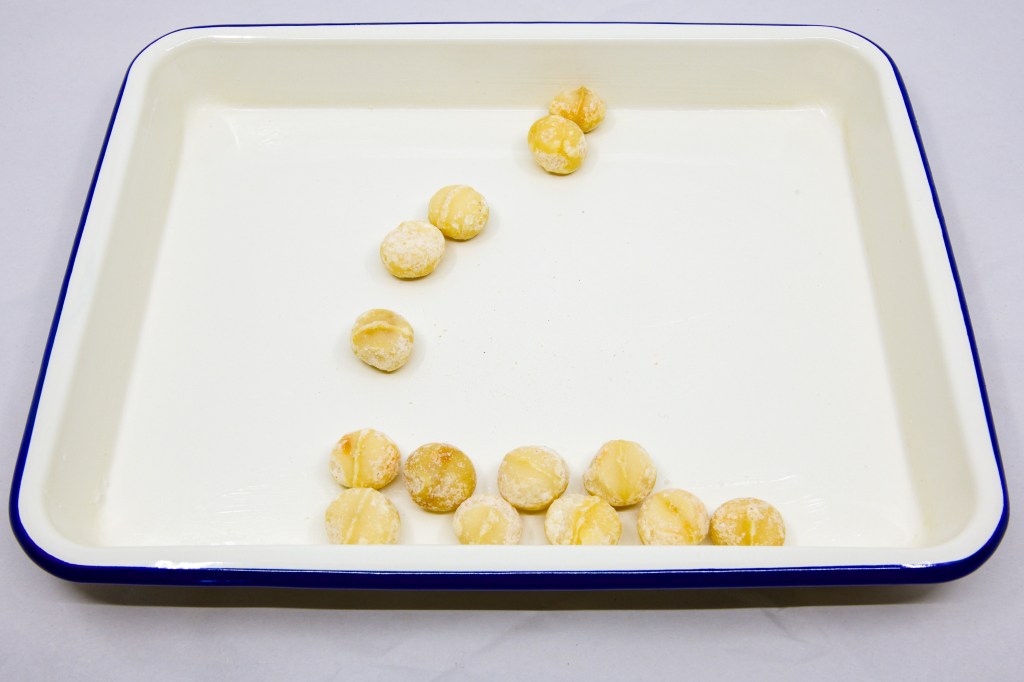
During the game, I enjoyed munching on some of my Queensland nuts. I noticed my nuts were a little stale.
Queensland nuts can be “revived” because the nuts have a high fat content, which responds to gentle heat. The stale flavour and texture result from oxidised surface fats and absorbed moisture. The oxidation cannot be reversed, but the crispness, aroma, and flavour can be restored.
Method 1: gentle dry-roasting to refresh texture and flavour.
This approach works for salted, previously roasted Queensland nuts.
How to do it
- Preheat the oven to 120–140°C (low–moderate heat).
- Spread the nuts in a single layer on a baking tray.
- Roast for 8–12 minutes, shaking once or twice.
- Remove when they smell fragrant and feel slightly firmer when you handle your nuts. Handle them carefully while they are hot.
- Let your nuts cool completely—they will crisp as they cool.
Top tip: Warm salty nuts also taste good and have a good mouthfeel.
Why this works
- The heat drives off absorbed moisture, restoring crunch.
- The heat melts and redistributes the fats, improving flavour.
- Low heat prevents the already-roasted nuts from burning.
If they were heavily salted, the salt will remain; if they were lightly salted, the flavour may actually improve because the heat reactivates the salt crystals on the surface.
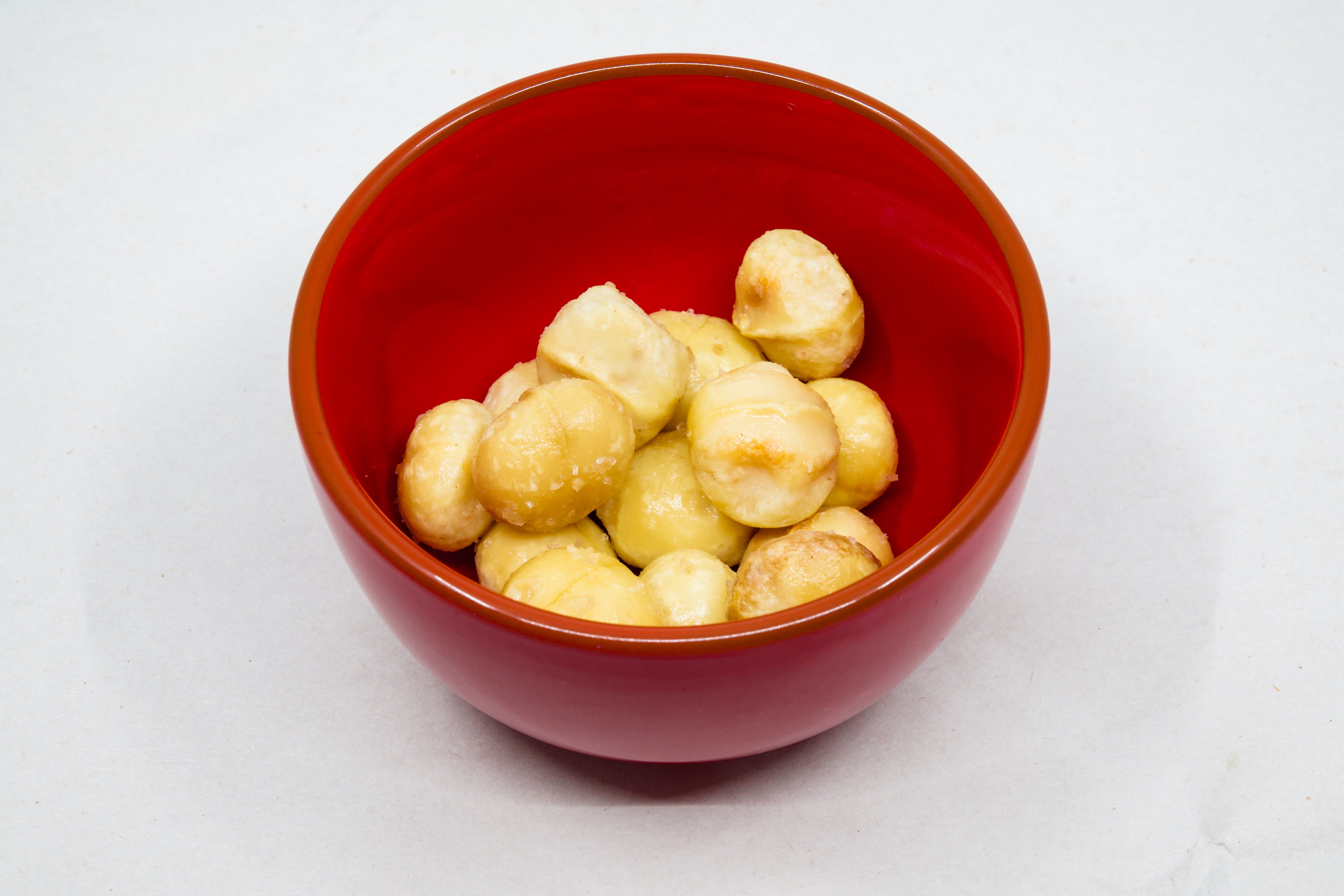
Method 2: stovetop refresh (quick but riskier)
If you don’t want to heat the oven:
- Place your nuts in a dry frypan over low heat.
- Stir constantly for 3–5 minutes.
- Remove as soon as they smell toasty.
This works, but Queensland nuts scorch easily because of their high fat content, so watch them closely.
Optional: re-seasoning
If the nuts taste flat even after crisping:
- Toss them while warm with a tiny amount of coconut oil (½ teaspoon per cup).
- Add fresh salt.
- Let them cool fully before storing.
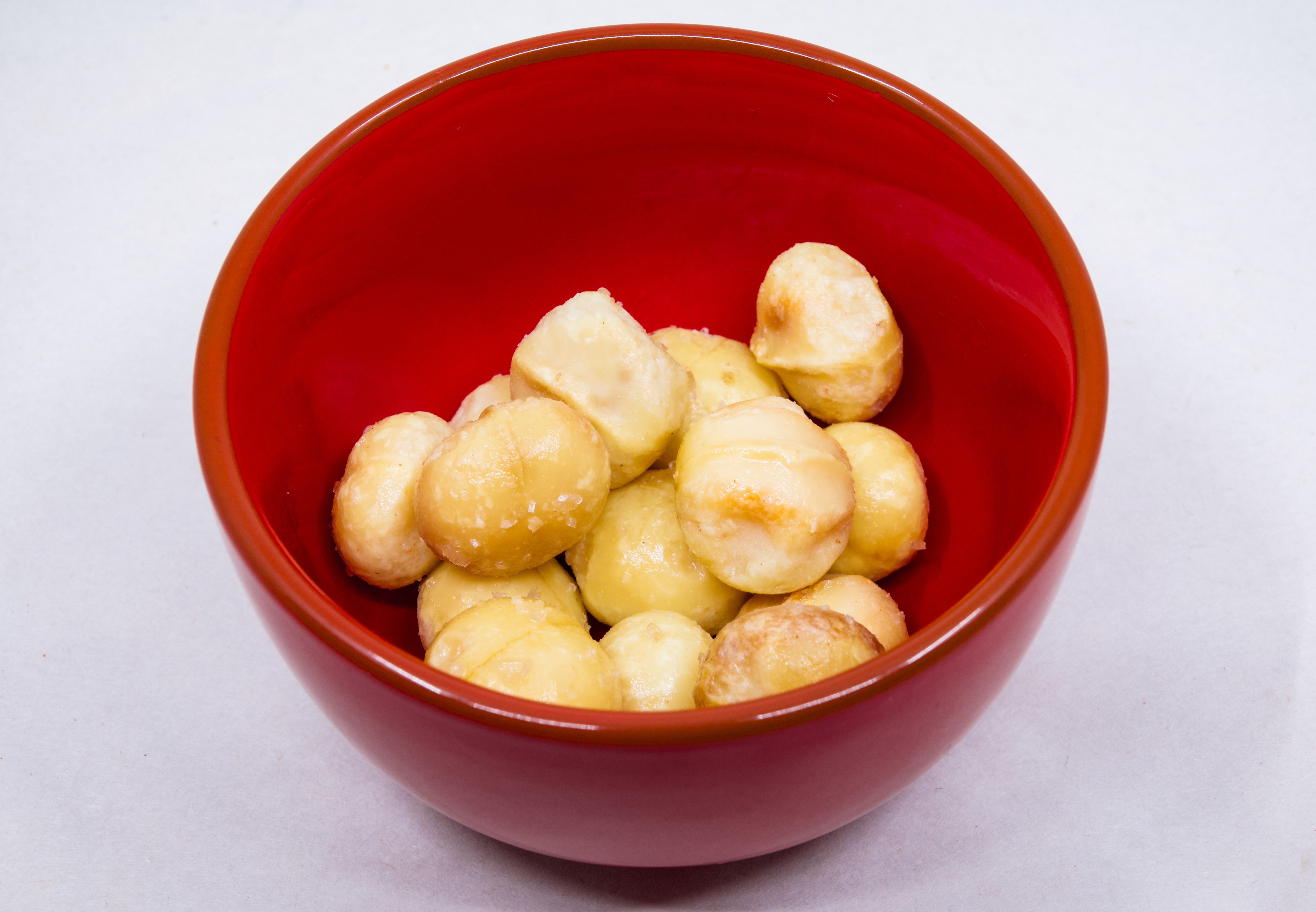
Storage to prevent future loss of freshness.
Queensland nuts keep best:
- In an airtight container, and
- In the refrigerator or freezer (their fats oxidise slowly at low temperatures).
Queensland nuts thaw quickly and don’t clump.
Taxonomy of Macadamia (Queensland nuts)
Macadamias belong to the family Proteaceae and comprise four recognised species, all native to eastern Australia. Two species—M. integrifolia and M. tetraphylla—produce the edible nuts commonly sold as “Queensland nuts” or “macadamia nuts.”
Scientific Classification
| Rank | Taxon |
| Kingdom | Plantae |
| Clade | Tracheophytes → Angiosperms → Eudicots |
| Order | Proteales |
| Family | Proteaceae |
| Subfamily | Grevilleoideae |
| Tribe | Macadamieae |
| Subtribe | Macadamiinae |
| Genus | Macadamia F. Muell. (1857) |
Recognised Species
The genus Macadamia currently includes four species:
| Species | Common Name | Distribution | Notes |
| Macadamia integrifolia | Queensland nut tree | SE Queensland; N NSW | Primary commercial species; edible nuts. |
| Macadamia tetraphylla | Rough-shelled macadamia | SE Queensland; N NSW | Also commercially grown; edible nuts. |
| Macadamia ternifolia | Gympie nut | Queensland | Contains cyanogenic glycosides; not used commercially. |
| Macadamia jansenii | Bulburin nut | Central Queensland | Critically endangered; contains cyanogenic glycosides. |
Nomenclature and Common Names
“Queensland nut” is one of several traditional and commercial names for Macadamia species:
- Queensland nut
- Bush nut
- Maroochi nut
- Bauple nut
- Macadamia nut
These names reflect both Indigenous use and early European settlement history in Queensland.
The genus name Macadamia honours John Macadam[i], a Scottish Australian chemist, politician, and medical teacher.
Origin and Distribution
All Macadamia species are endemic to Australia, specifically:
- Central and Southeastern Queensland
- Northeastern New South Wales
Commercial production began in Australia but expanded globally—most notably to Hawaii in the 1880s. Today, the Republic of South Africa is the largest producer.
Key Biological Notes
- Macadamias are evergreen trees reaching 2–12 m in height.
- The fruit is a hard, woody follicle containing 1–2 seeds (the “nuts”).
- The shell is exceptionally tough, requiring ~2000 N of force to crack.
- Only M. integrifolia and M. tetraphylla produce nuts safe for human consumption; the other species contain cyanogenic glycosides.
| Nutrient | Amount (per 30 g) | Amount (per 100 g) |
| Energy | 906 kj | 3020 kj |
| Protein | 3 g | 10 g |
| Total Fat | 22.2 g | 74 g |
| Saturated Fat | 3.0 g | 10 g |
| Monounsaturated Fat | 17.9 g | 59.7 g |
| Polyunsaturated Fat | 0.34 g | 1.13 g |
| Omega‑3 (ALA) | 60 mg | 200 mg |
| Trans Fat | 0 g | 0 g |
| Carbohydrate (total) | 1.4 g | 4.7 g |
| Sugars | 1.4 g | 4.7 g |
| Dietary Fibre | 1.9 g | 6.3 g |
| Micronutrient | Amount (per 30 g) | % of Australian RDI |
| Manganese | 1.53 mg | 31% |
| Thiamine (B1) | 0.09 mg | 8% |
| Copper | 0.36 mg | 12% |
| Magnesium | 28 mg | 9% |
| Iron | 0.54 mg | 4.5% |
| Zinc | 0.4 mg | 3% |
| Potassium | 123 mg | 3% |
| Calcium | 14 mg | 2% |
| Vitamin B6 | 0.08 mg | 5% |
| Vitamin E | 0.42 mg | 4.2% |
| Folate | 3.3 µg | 2% |
| Selenium | 3 µg | 4.3% |
[i] John Macadam (1827–1865) was a Scottish Australian analytical chemist, medical practitioner, university lecturer, politician, and a key scientific administrator in colonial Victoria. He is remembered because botanist Ferdinand von Mueller named the genus Macadamia in his honour.


Leave a reply to Gary Cancel reply