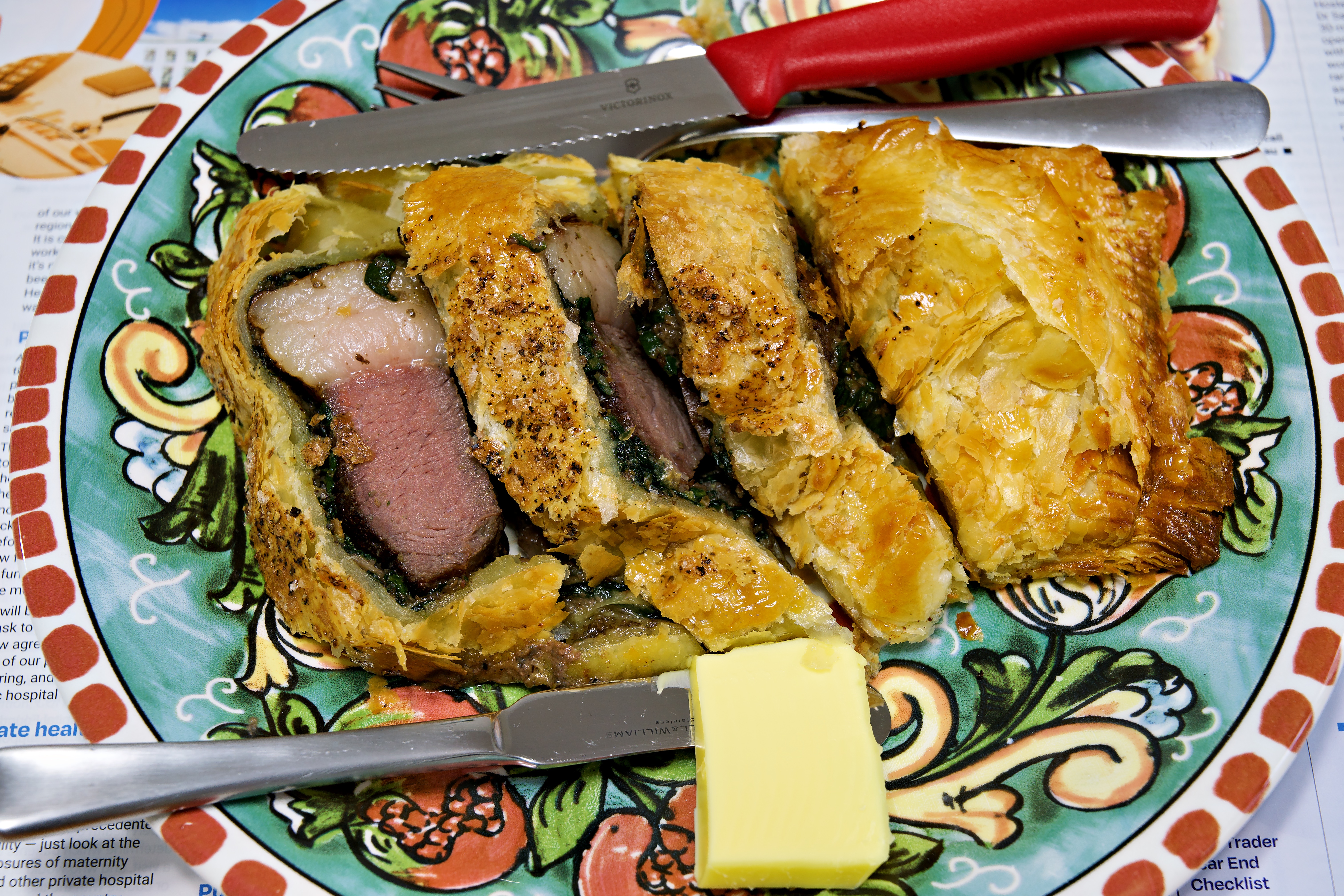
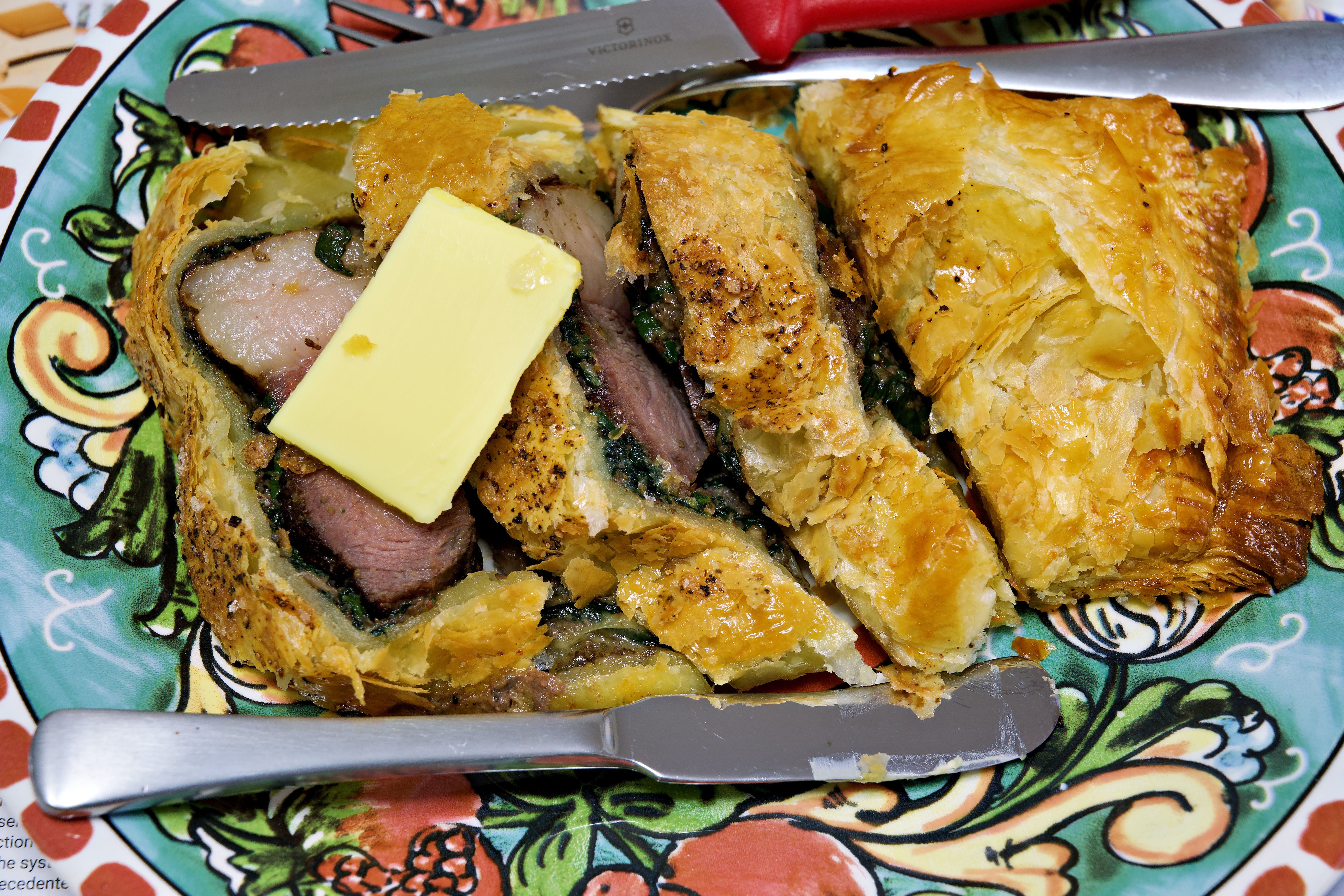
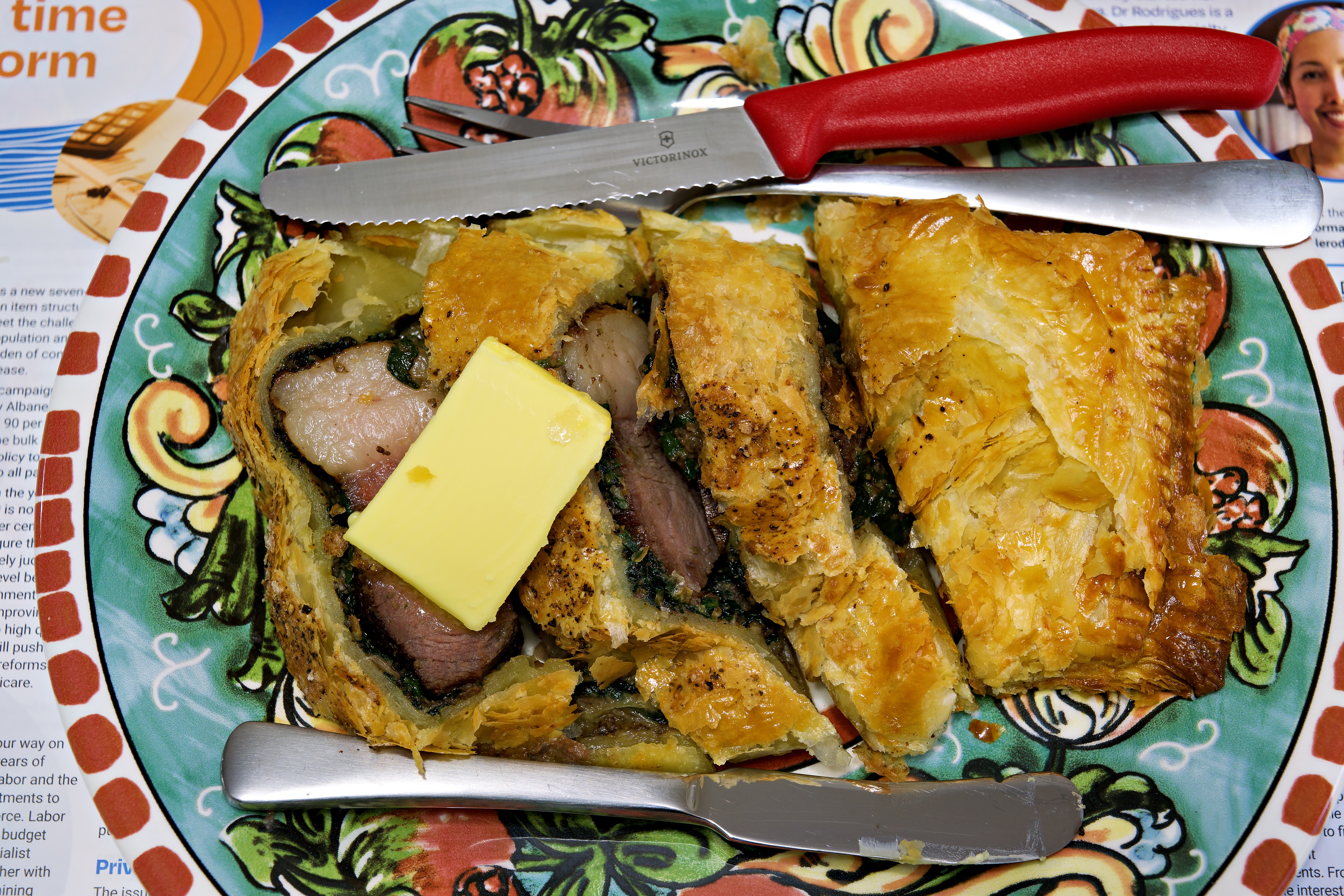
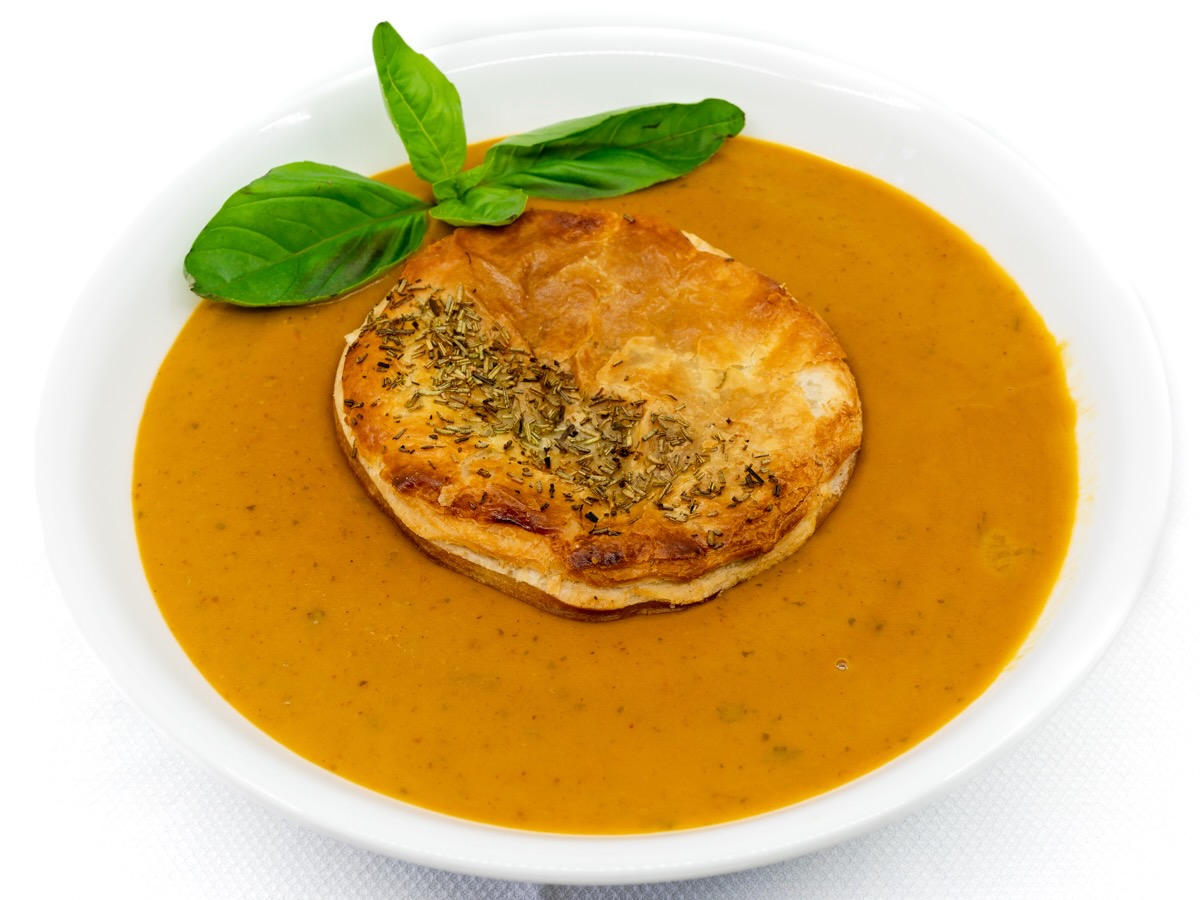
There’s been a lot reported recently on Beef Wellington and mushrooms. This post has nothing to do with that. That said, the reporting about the Beef Wellington got me thinking about cooking something a little more “fancy” than I usually cook.
If this intrigues you, go to a search engine and type something like, “Australia, Beef Wellington, death cap mushrooms.”
Recipe
Ingredients
Puff pastry
Rump cap
Mushrooms
Spinach
Butter
Cream
Pâté
Blue cheese
Egg
Equipment
Water bath
Precision cooker
Oven
Barbecue grill
Gas torch
Frypan
Small saucepan
Instructions
The meat
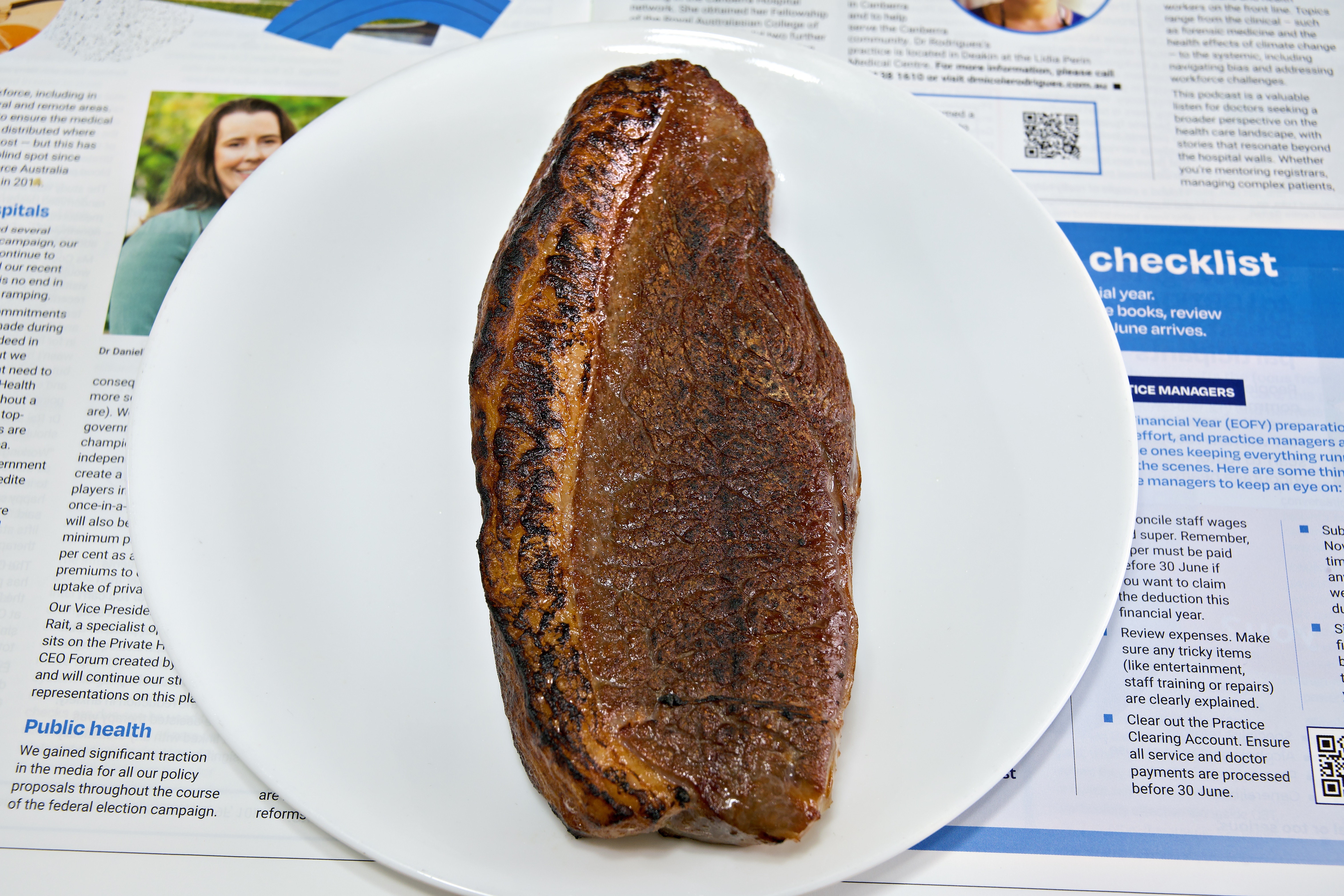
Dry brine the rump cap for about 24 hours.
Cook the rump cap for approximately 3 hours at 57 °C.
Sear the steak on a barbecue grill along with a gas torch.
Allow the meat to cool before wrapping it in the puff pastry.
While I use this term, this meal is not a Beef Wellington.
Finely dice or process the mushrooms.
Sauté the mushrooms in beef fat and set them aside.
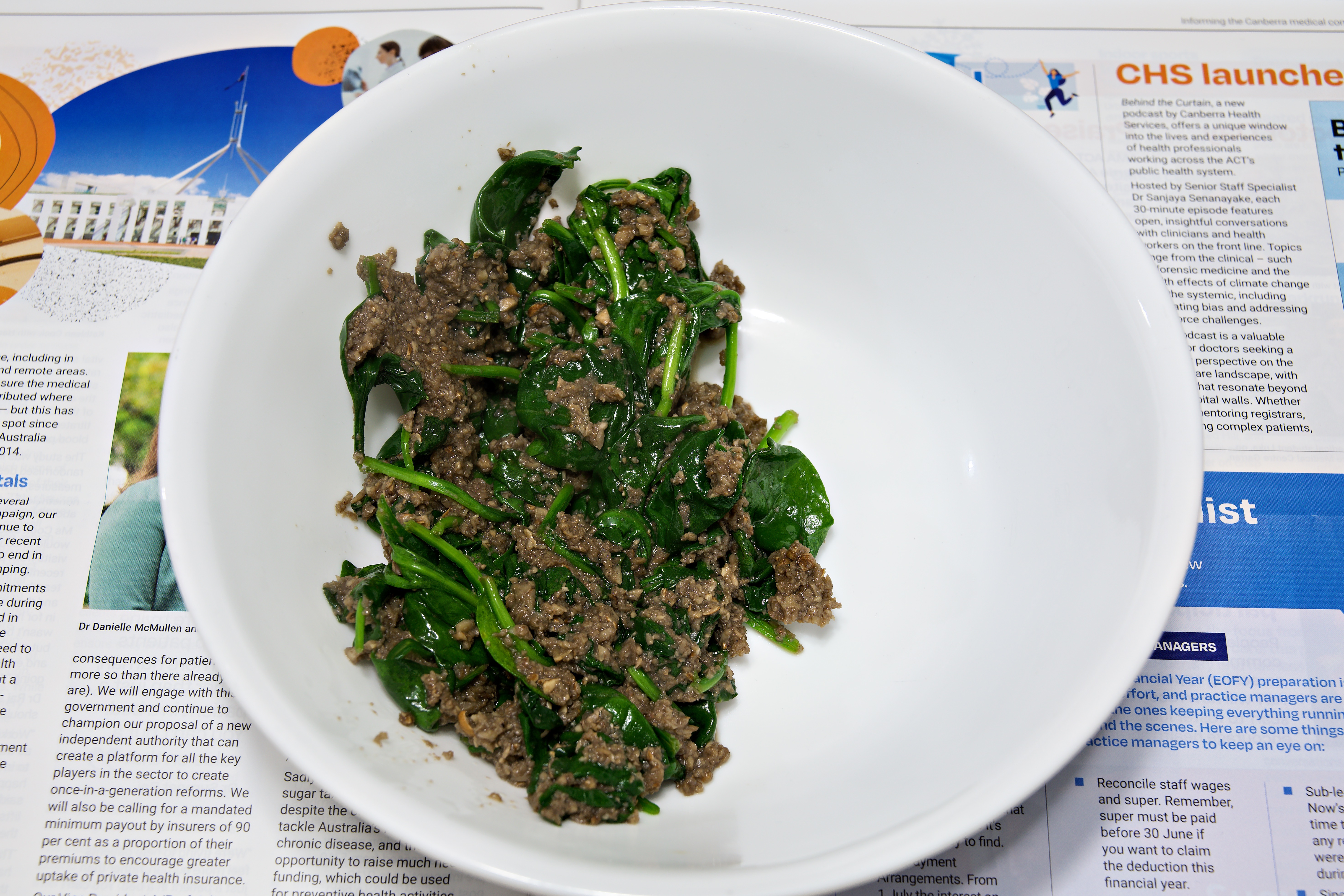
Wilt the spinach in beef fat and set aside.
In a small saucepan, gently heat a dash of cream and a small nob of butter.
Crumble in some blue cheese and then gently stir in the wilted spinach leaves.
Allow the mixture to cool.
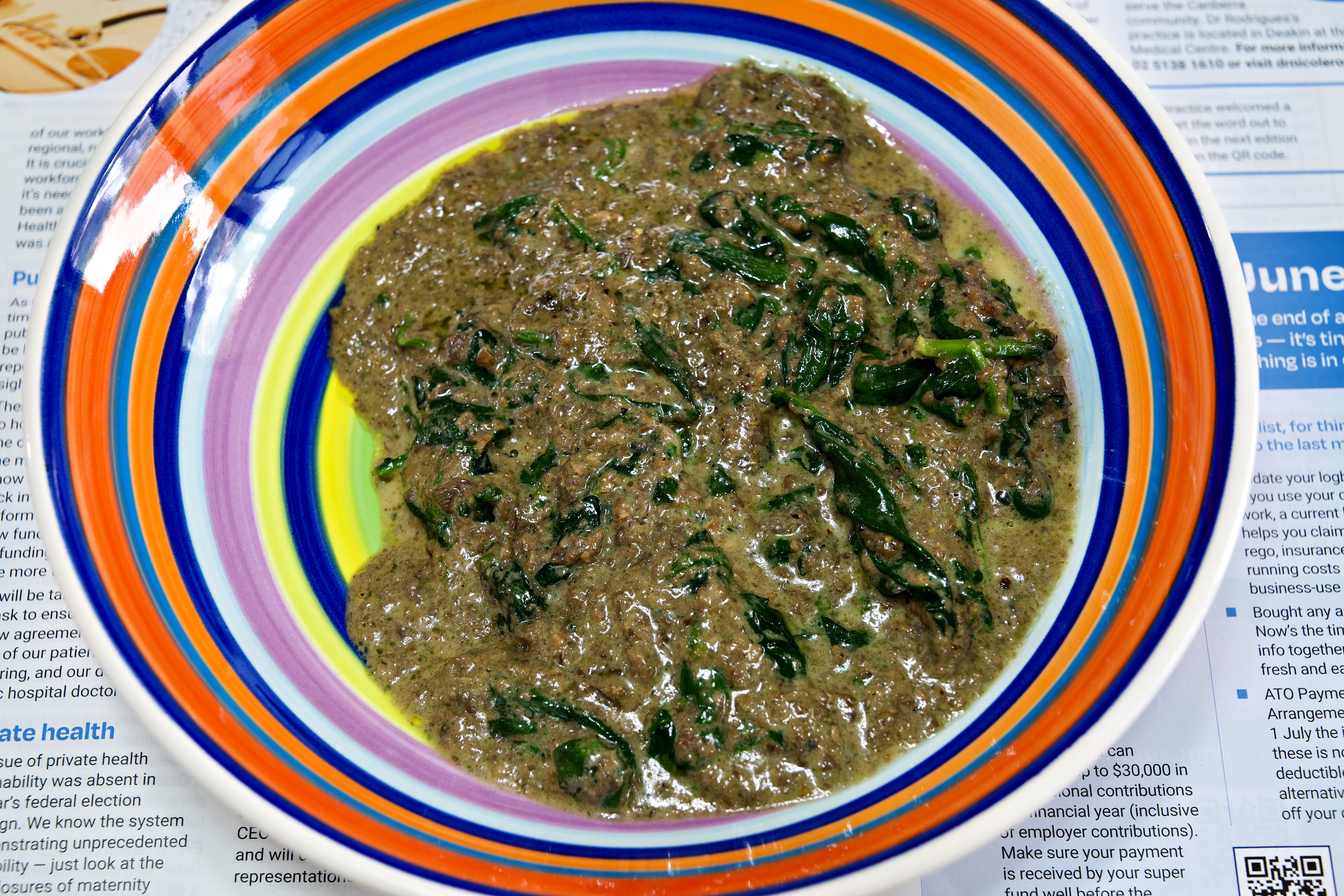
Combine the cooled mushrooms and creamy spinach.
Assembly of the pastry creation (aka “Beef Adelaide”)
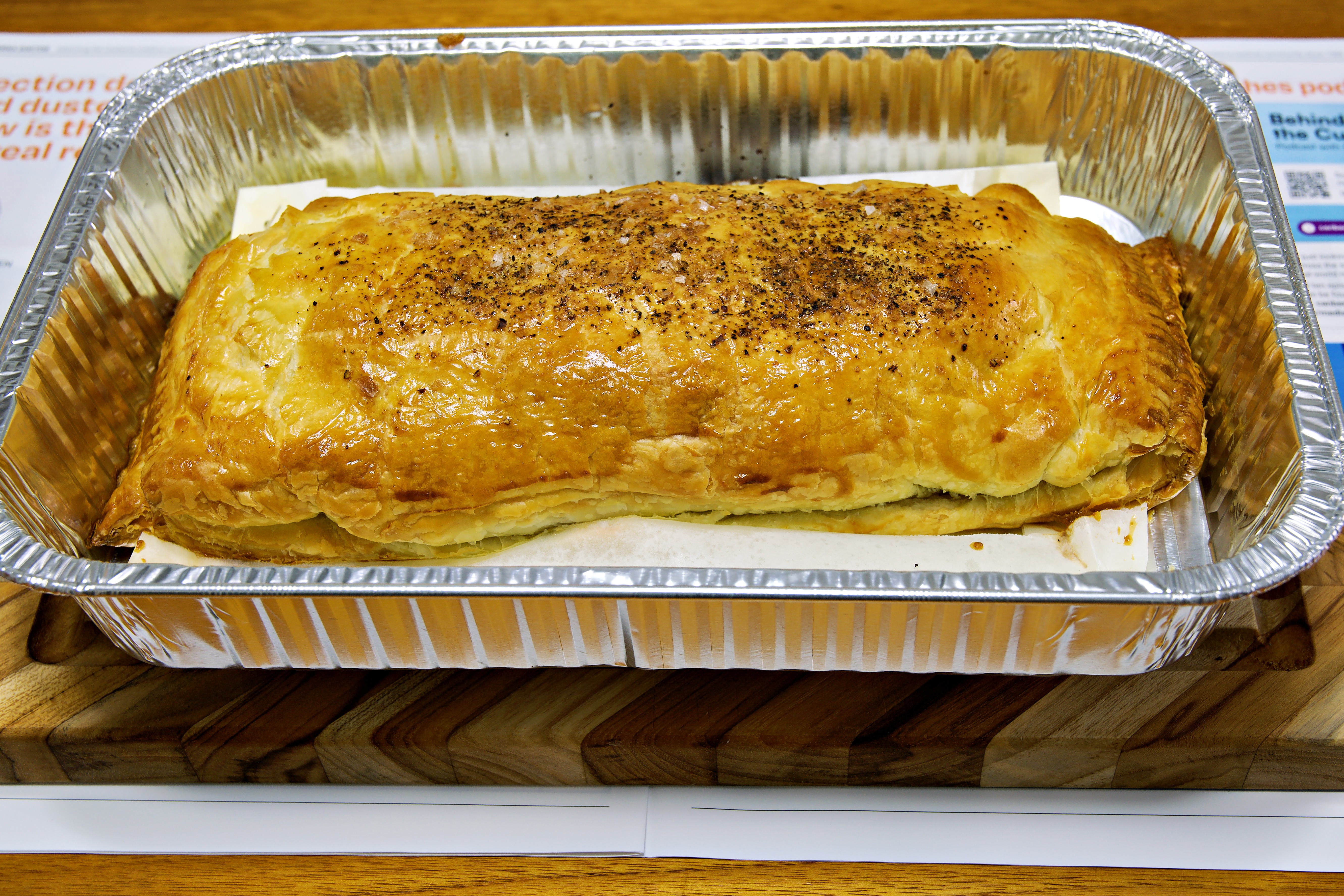
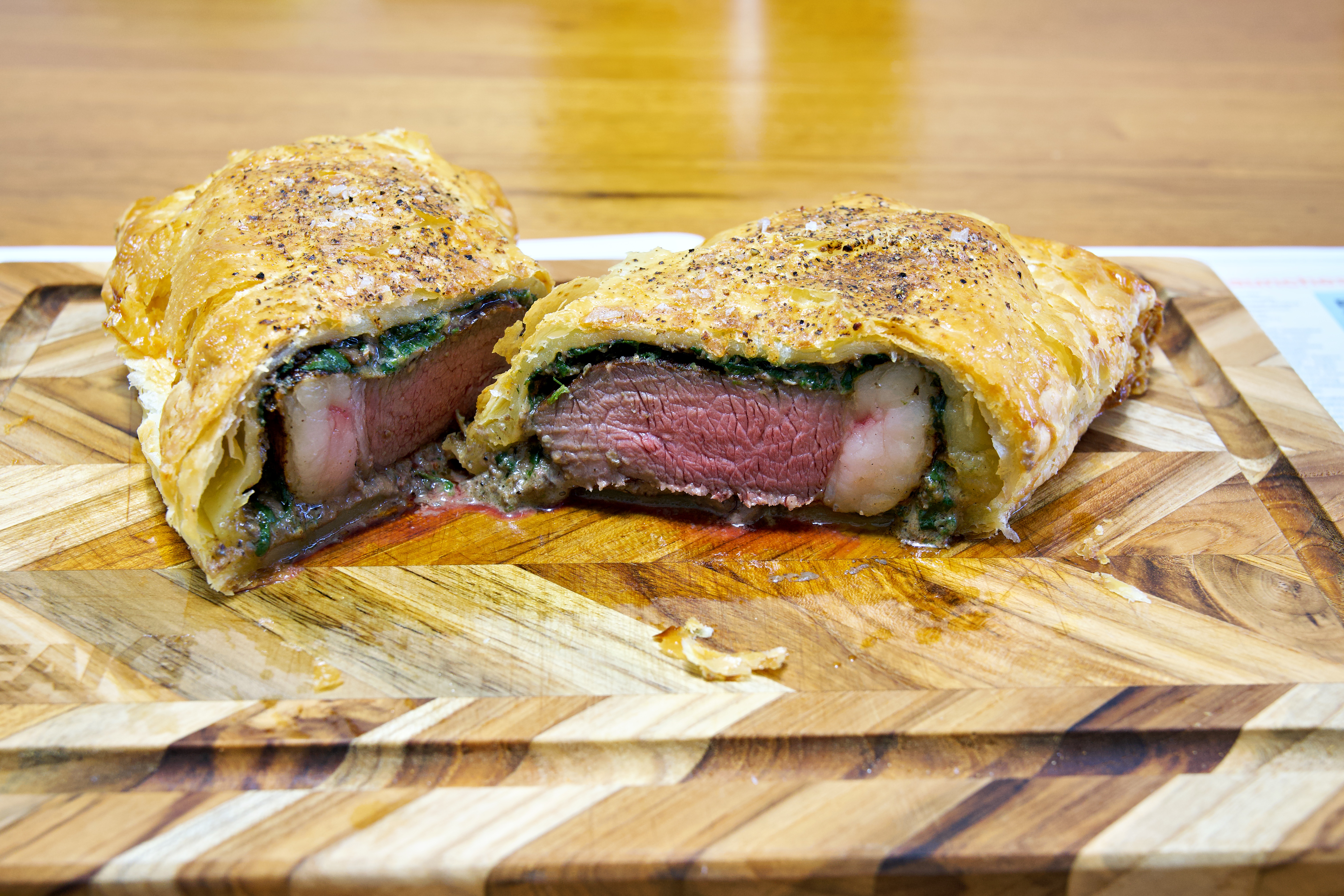
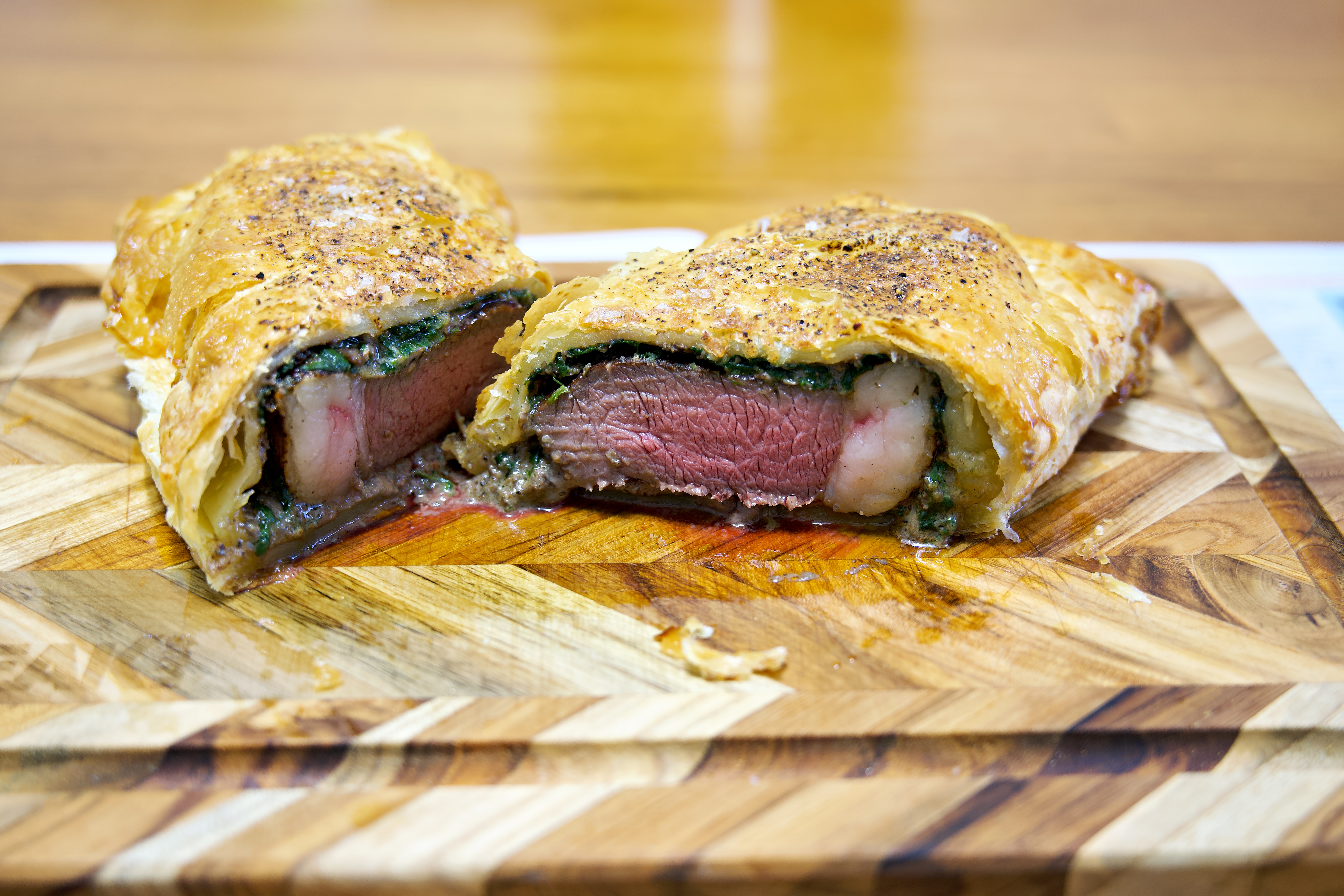
I’m going to call this dish “Beef Adelaide” because I live in Adelaide, and the meat is Coorong Black Angus.
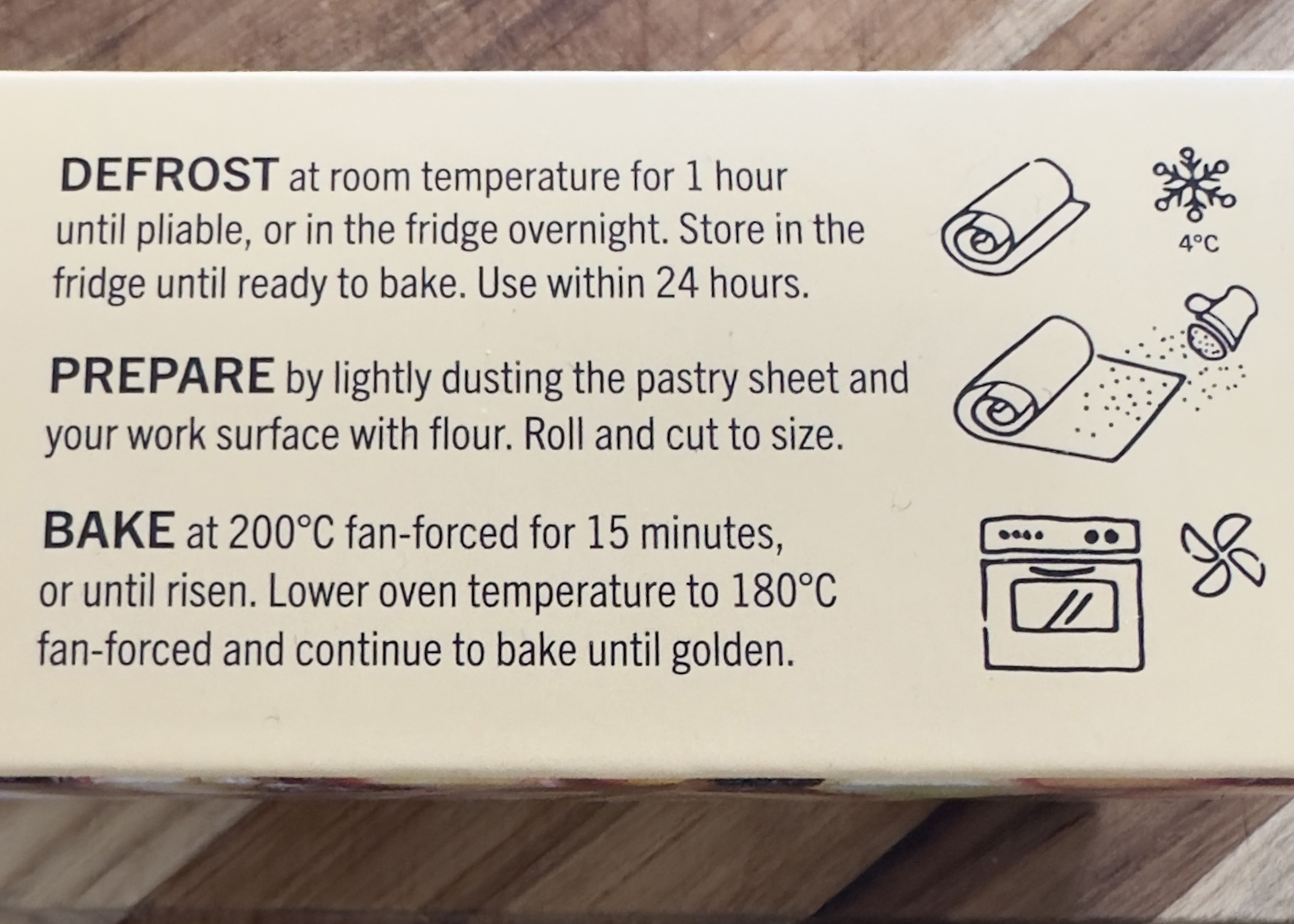
Open the packet of puff pastry according to the instructions for use (IFU).
Spread some pâté over the pastry.
Scoop and spread the “duxelles” on the pastry.
Place the meat on the pastry.
Wrap the pastry around the meat and “duxelles.”
Apply an egg wash.
Cook the pastry “Beef Adelaide” in an oven set at about 180 °C until the pastry is golden brown.
Serving suggestions
You can serve this dish on its own.
You could serve it with some vegetables.
You could slice it and present it neatly on a plate and then pour burnt butter over it.
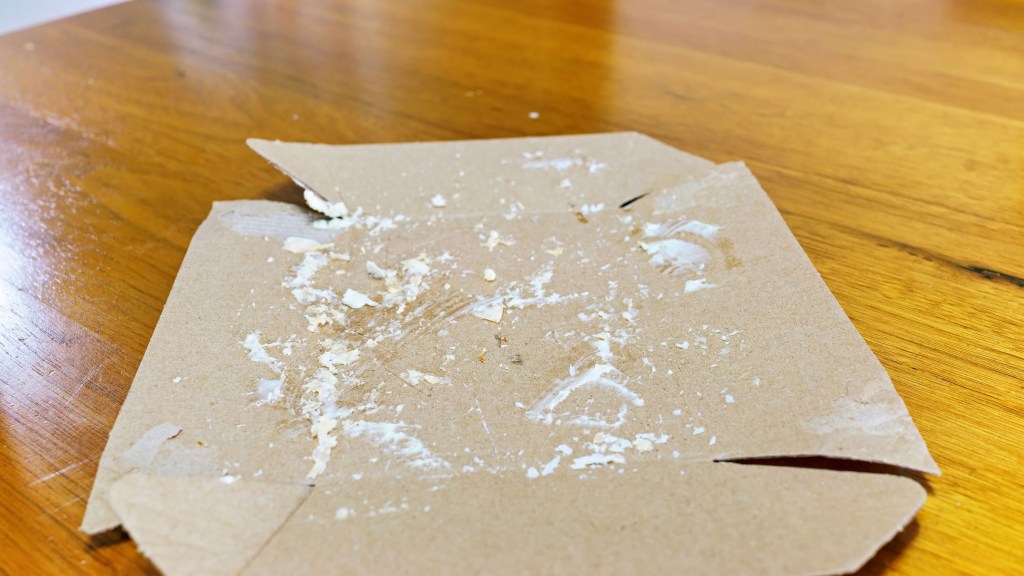
I chose to eat it on a plate by itself and used a serrated steak knife, so that bits of puff pastry would fly all over the dining table and onto the floor, as well as my lap, leaving grease marks on my strides.
Photographs
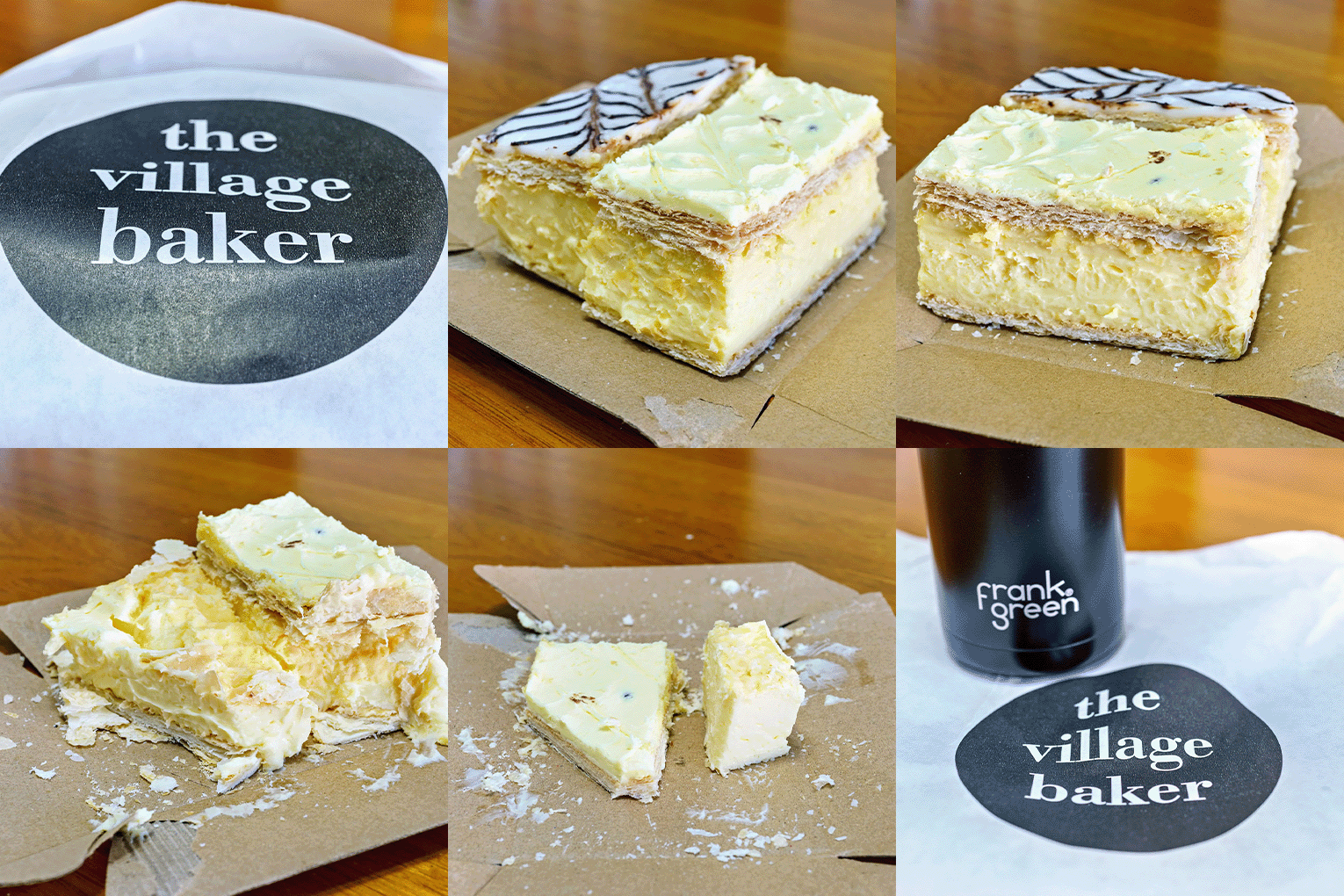
This is a gallery of photographs. Click on one and scroll through them to see a larger version with more detail.
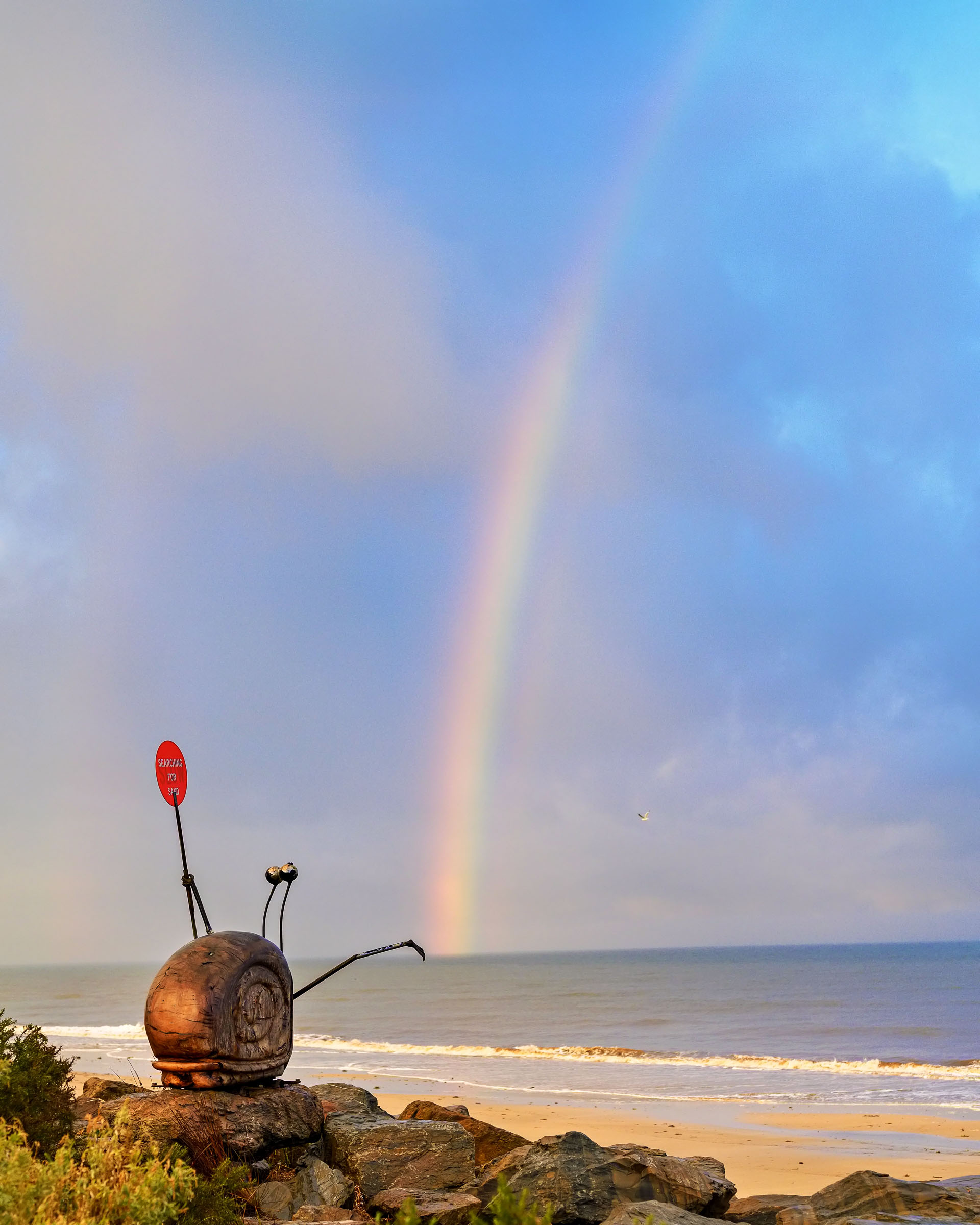
Today had weather suited to this meal.
Thoughts on the meal
I was pleased with how the meal turned out.
I’ve made Beef Wellington many times, and in my opinion, it’s Not worth the effort to do it traditionally.
My “Beef Adelaide” is a good cheat.
Questions
Have you made Beef Wellington?
Do you like wrapping meat in pastry?
What do you like about meat in pastry?
[1] Noun [mass noun] a preparation of mushrooms sautéed with onions, shallots, garlic, and parsley and used to make stuffing or sauce.
I was participating in a Microsoft Teams chat with some colleagues, and the subject of “butter making everything better” came up (again). Friends at work know I’m fond of butter.
One friend (BC) said she feels the same way about cheese. I agreed and mentioned how I like a soft cheese with steak.
Another friend (ER) queried the combination, to which BC specified blue cheese (also BC) with steak.
As much as I’m happy to place a hunk of blue cheese next to a steak, tonight I thought I’d go a step further and make a blue cheese sauce with cream (also known as pre-butter) plus actual butter.
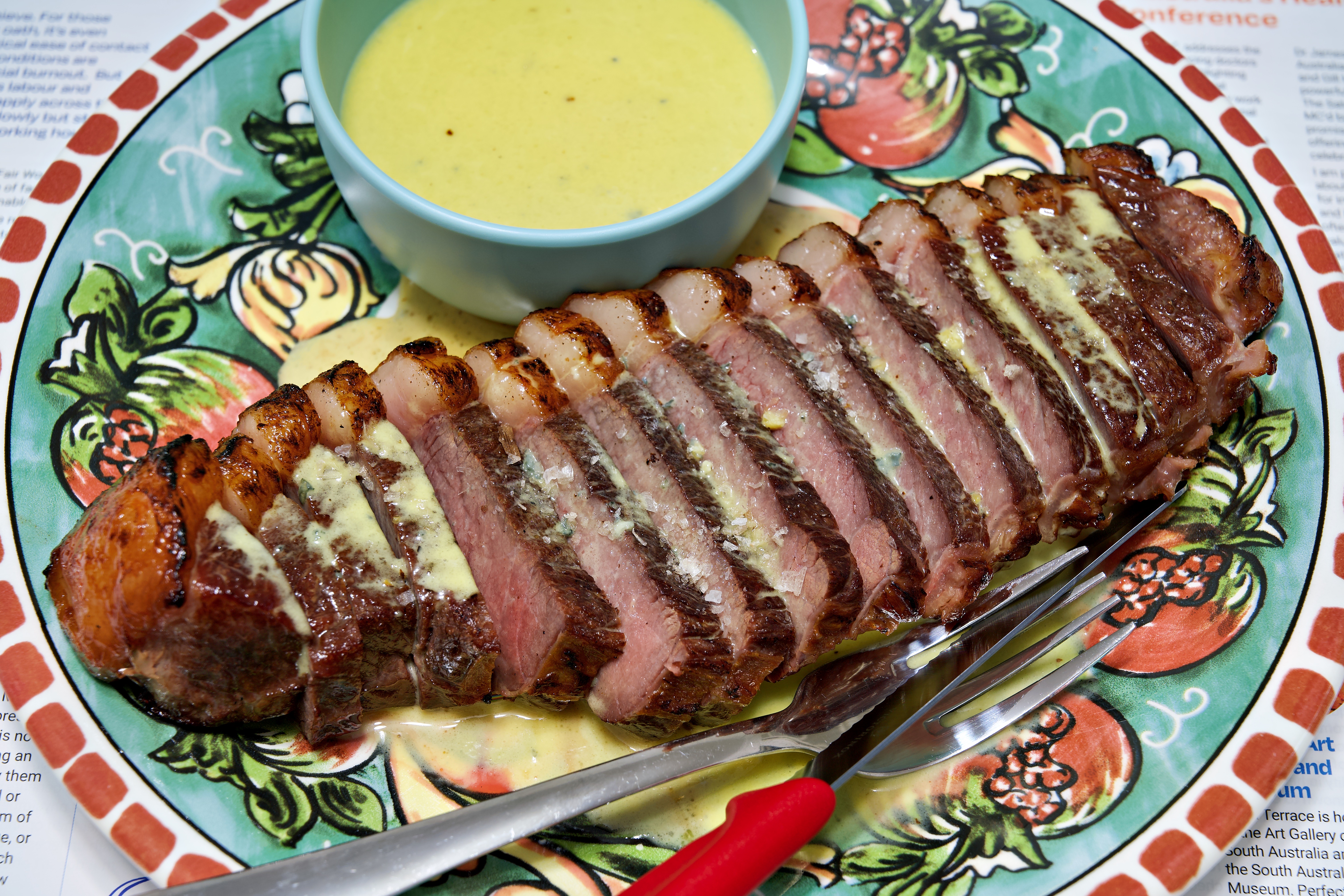
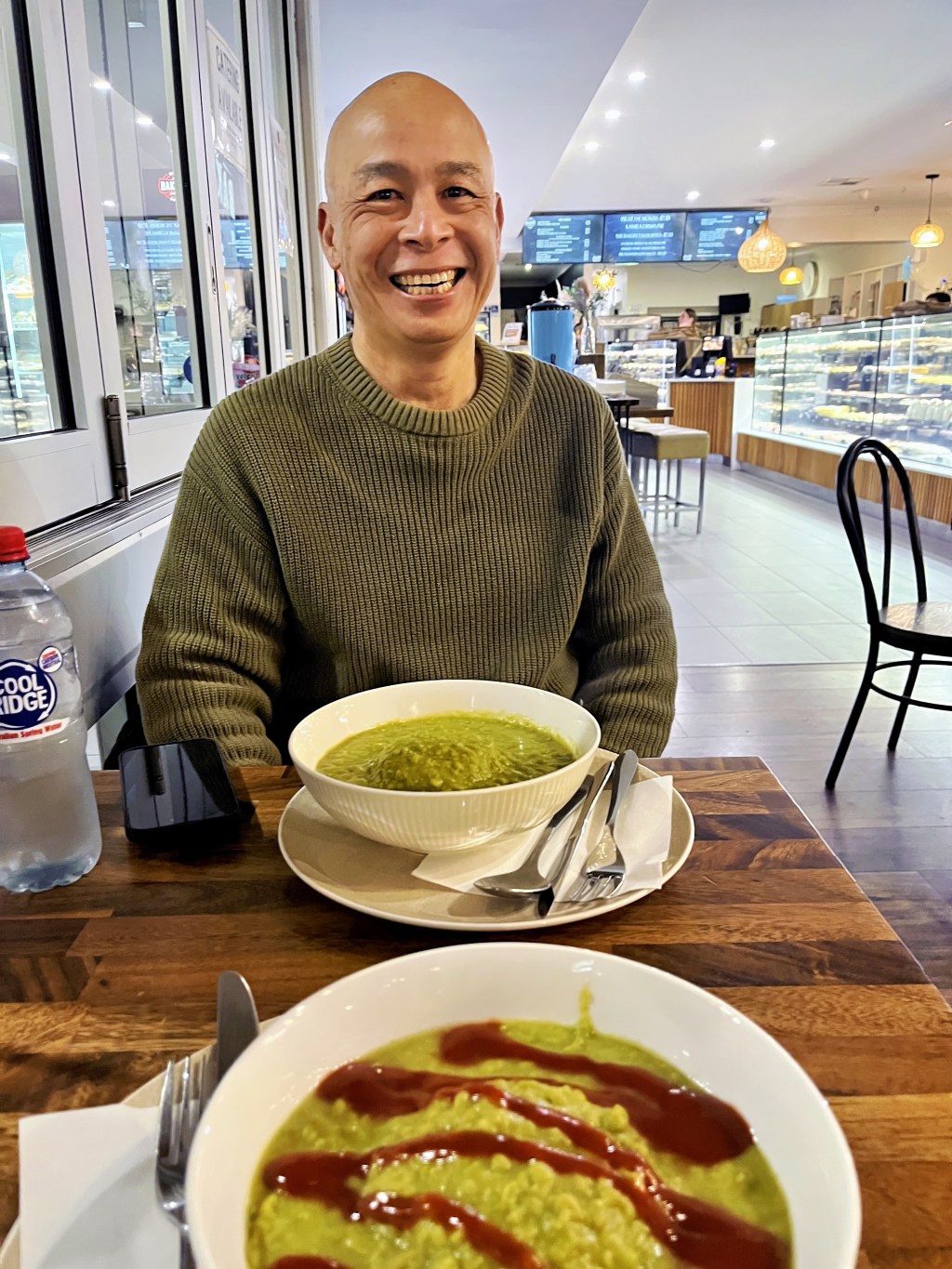
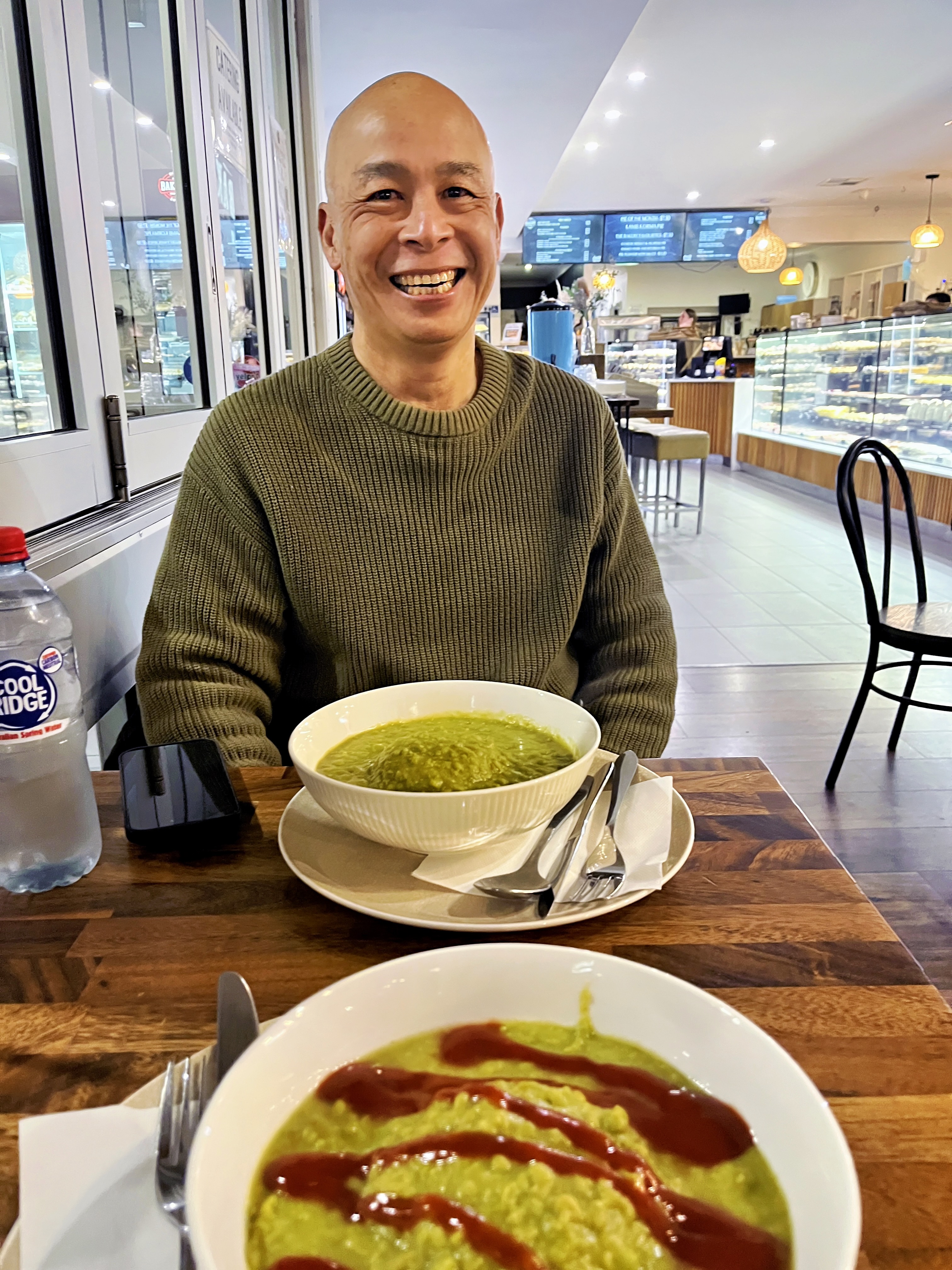
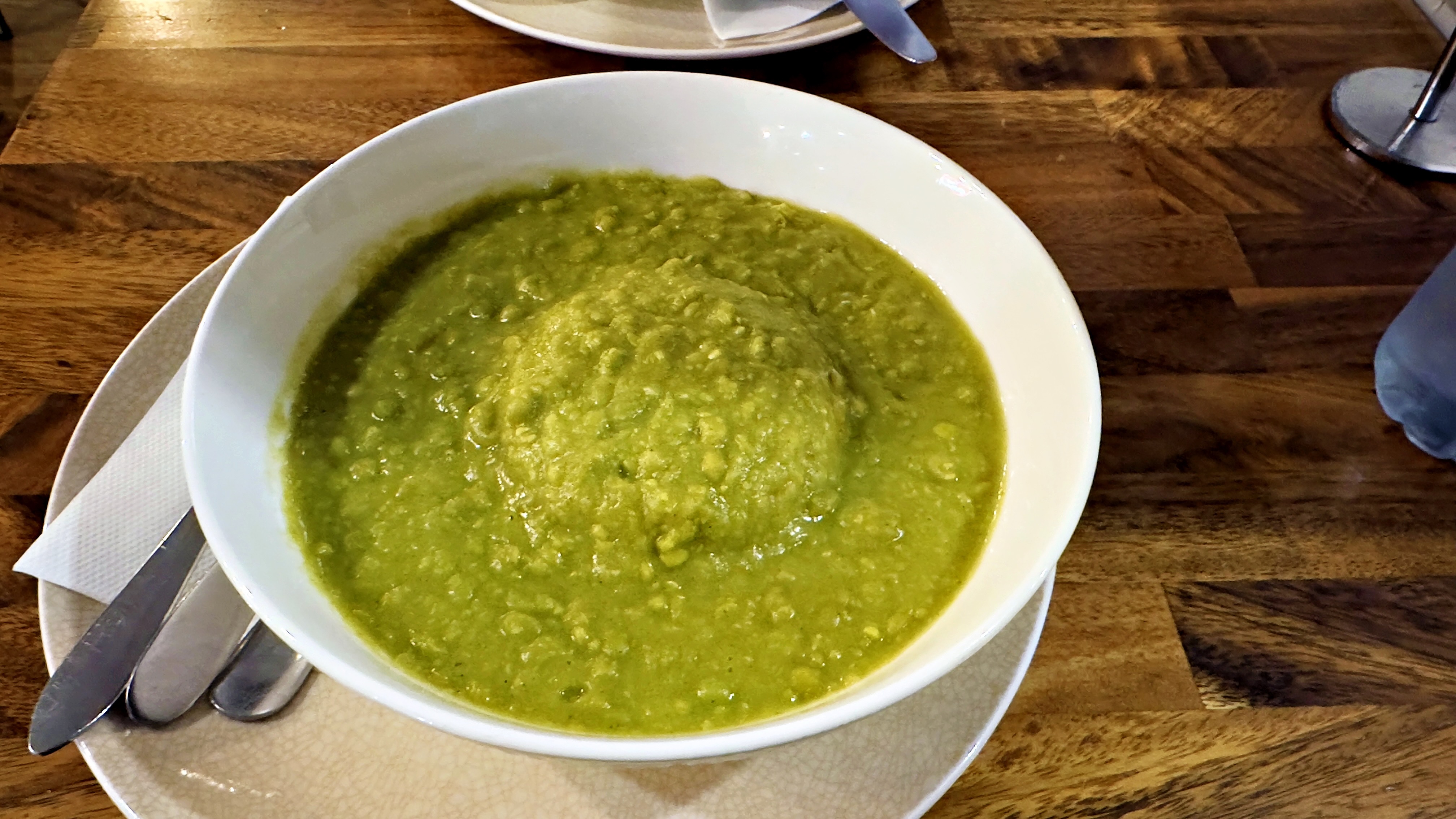
Tonight I served myself the blue cheese sauce with a piece of Coorong black angus rump cap, which I cooked sous vide for approximately 3 hours at 57 °C. The steak weighed approximately 320 grams.
Recipe
Ingredients
60 mL (¼ cup) cream
30 g (2 tablespoons) blue cheese crumbles
Pinch of freshly ground black pepper (optional)
15 g (1 tablespoon) of butter (optional — but not)
Instructions
Place the butter, cream and blue cheese crumbles in a small saucepan.
Warm over low to medium heat, stirring constantly until the cheese begins to melt.
Continue to cook for 3–5 minutes, until the mixture bubbles gently and thickens to a saucy consistency.
Remove from heat, season with a crack of black pepper, and spoon directly over your cooked steak.
Nutritional Information (per serving)
Net Carbs
Total Carbs
Fat
Protein
Calories
2 g
2 g
26 g
4 g
254 kcal
This recipe yields approximately 2 g of net carbs per serving, making it suitable for a ketogenic way of eating (assuming the daily intake of carbohydrates remains <20 g).
Tips and Variations
To serve two people, double the amount of all ingredients.
For extra richness, whisk in 1 tablespoon (15 g) of unsalted butter along with the cream.
Stir in chopped chives or a dash of white wine vinegar at the end for freshness.
Best served immediately—if reheated, the fats may separate.
Pairing Suggestions
A juicy scotch fillet steak, cooked to medium-rare, amplifies the creaminess of the sauce. Cooking meat too rare can result in an unattractive mix of red meat juices and pale sauce. While choosing well-done is an option, I do not like well-done steak. I find for a fat-rich steak, 57 to 58 °C a good temperature. You’ll find a lot of sous vide experts who recommend 55 °C. The fat doesn’t render as well at that temperature in my experience.
Pair with a low-carb side, such as garlic and butter sautéed spinach or roasted asparagus.
Photographs
Thoughts on the meal
I enjoyed tonight’s meal. Cutting the steak into slices so I could dip each piece into a small pot of blue cheese sauce felt luxurious. The umami-rich, beefy, thick, and juicy steak pairs perfectly with the salty-umami and funky flavours of the blue cheese, creating a harmonious blend of flavours and textures. It was almost Holy Matrimony. Being a lover of fat, the fat and the blue cheese also combined well.
Questions
Have you tried blue cheese and steak? What did you think?
Do you have any tips on making a blue cheese sauce?
How would you serve blue cheese and steak if you were cooking?
This is a long post. It’s broken into three parts.
There is a recipe section, a section on potato gems, and a section on state of origin. The latter two sections are long form pieces for readers who may want more information.
Introduction
In the old version of Yummy Lummy (before I deleted all the content), I had many posts devoted to footy food. It included posts about meat pies, sausage rolls, hot chips, potato scallops (outside of the rugby league states they are called cakes and fritters), potato gems, and all manner of carbohydrate-rich choices.
These days, I’m trying to minimise my carbohydrate consumption to ward off metabolic syndrome and diseases like metabolic dysfunction-associated steatotic liver disease (MDASLD) – try saying that quickly three times, type 2 diabetes mellitus (T2DM), and clinical obesity (FAT).
Occasionally, I enjoy a sweet treat (especially anything with vanilla custard in it) and sometimes a starchy treat.
On Wednesday evening, I wanted a special meal before the third game in this year’s State of Origin series. Many of those posts on the old version of Yummy Lummy described the State of Origin rugby league competition and how important it is.
Now we’re in Yummy Lummy 2.0 territory, so I have an opportunity to write again about “State of Origin.”
I asked Microsoft Copilot lots of questions to find sources of information. It came back with material that I’ve put together later in this post on “State of Origin.”
My footy food choice resulted in “potato gems”. Readers from North America will know them as “tater tots”. Both names are registered trademarks.
In the old days, I’d have centred the entire meal around the potato gems and made my version of poutine. I remember buying the most luxurious Gravox® instant gravy (Gravox® Our Best Beef Gravy), and instead of cheese curd, I used mozzarella cheese.
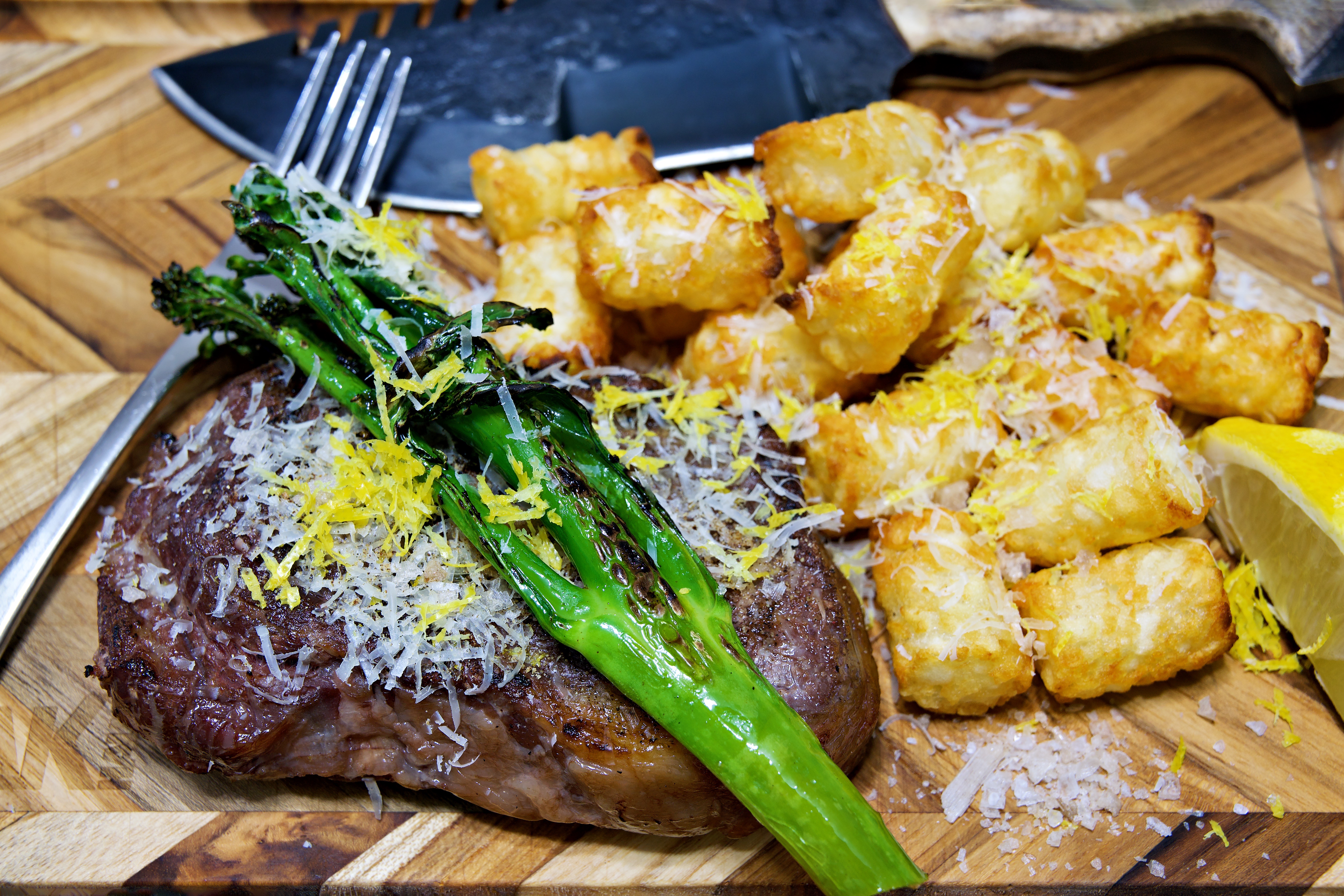
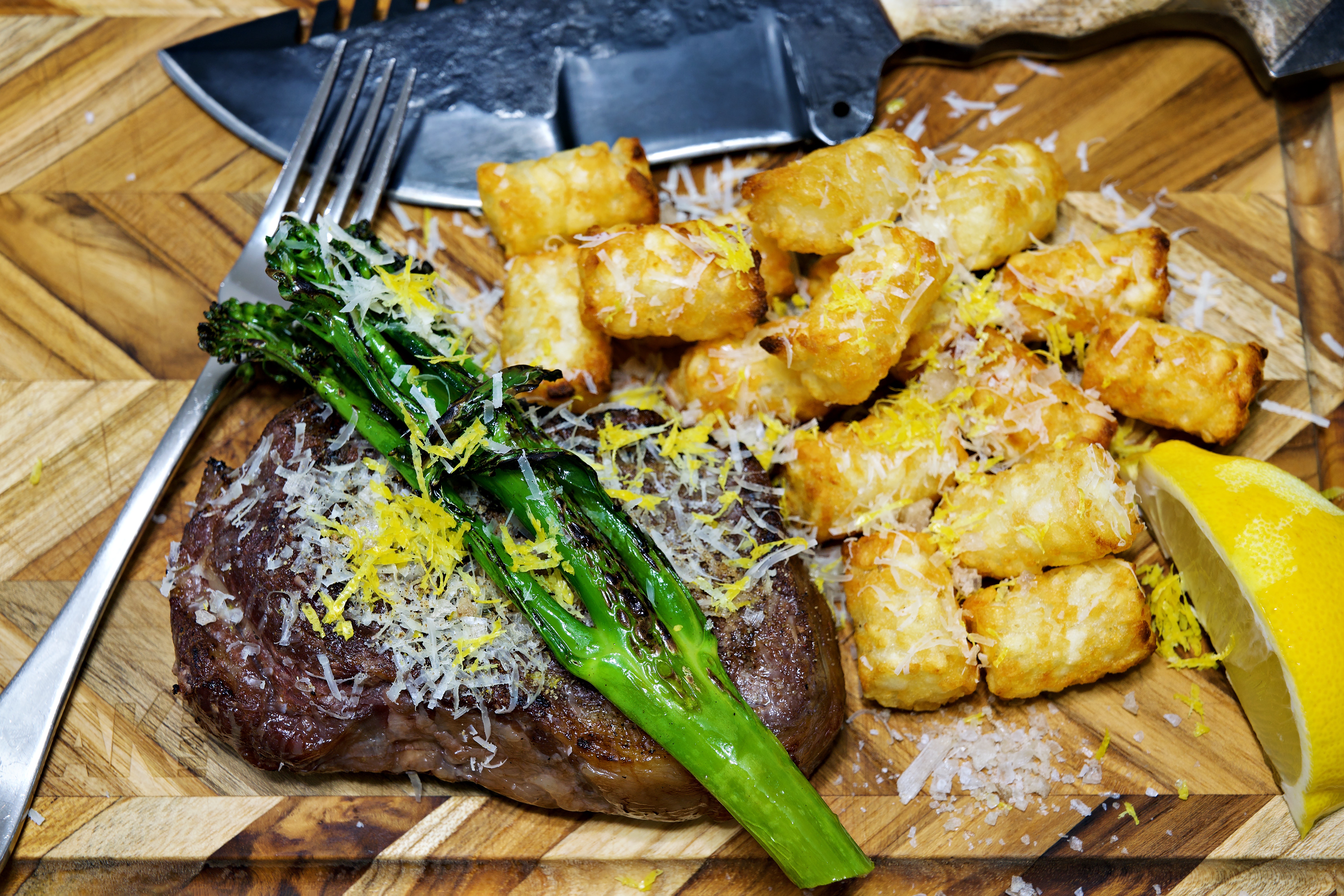
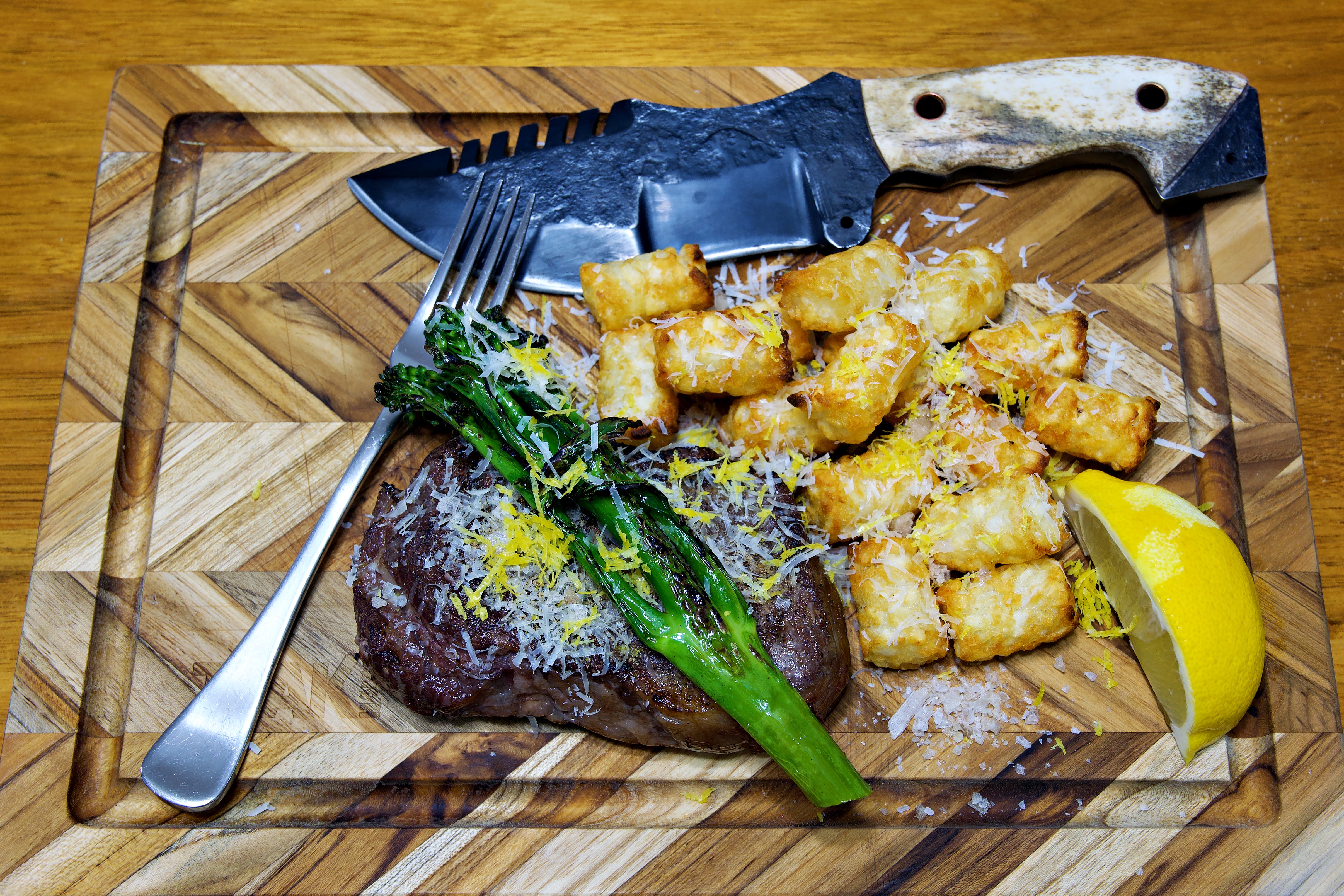
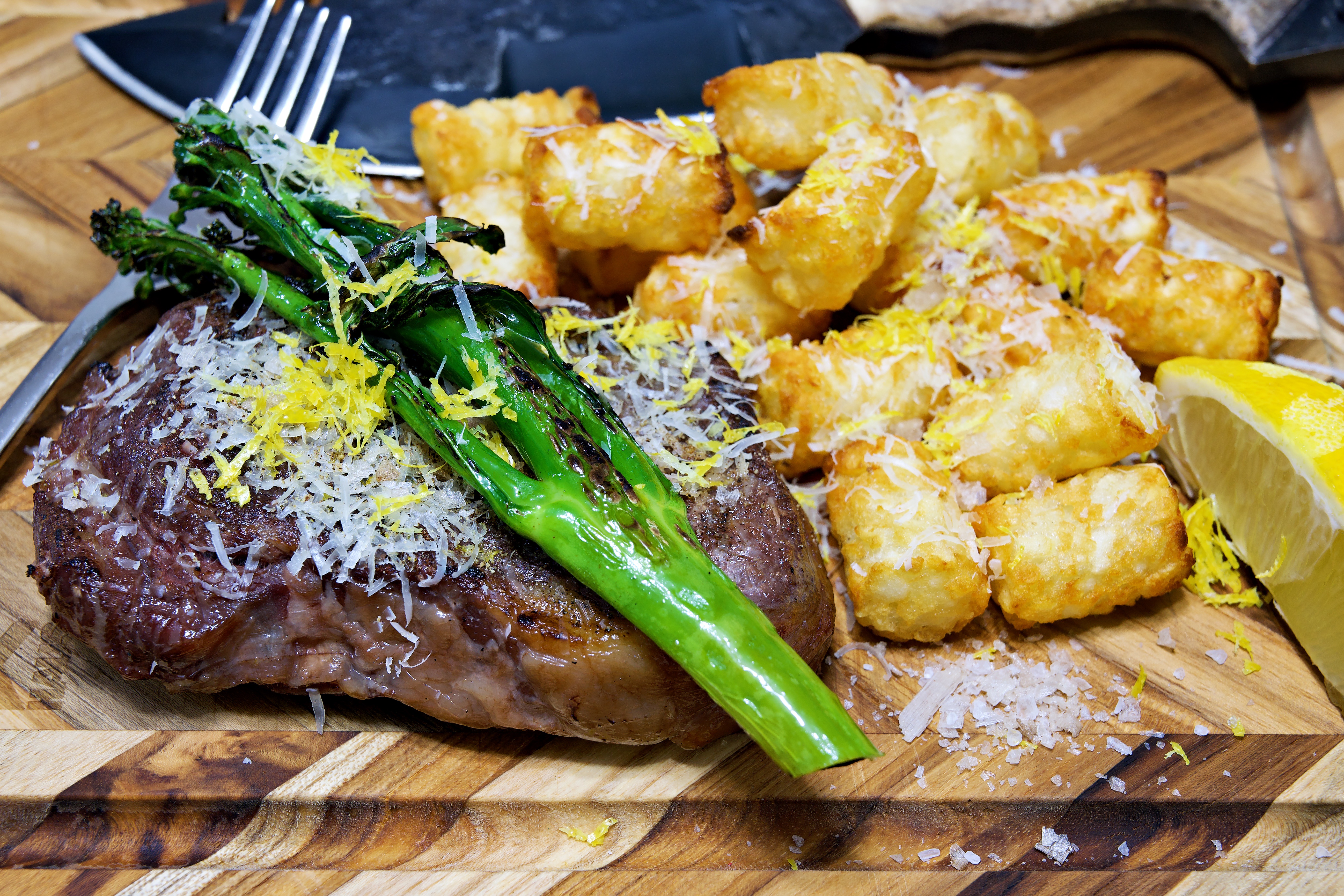
Rather than being the main event, the potato gems were the side to a steak (of course).
Recipe
Ingredients
Steak – Grain-fed scotch fillet (280 grams)
Broccolini
Potato gems
Salt – smoked flaky salt
Salt – cooking salt
Black peppercorns
Parmesan cheese
Equipment
Precision cooker
Water bath
Barbecue grill
Gas torch
Microplane grater
Instructions
Dry brine the steak for about 24 hours.
Cook the steak in the water bath for 3 hours at 57 °C.
Sear the steak with a gas torch while placed on a barbecue grill.
Blanch the broccolini in boiling water.
Finish on a hot barbecue grill with a coating of beef fat.
Touch the broccolini with the gas torch when searing the steak.
Cook the potato gems in an air fryer for 20 minutes at 220 °C.
Place the steak on a plate and lay the broccolini over the steak. Place the potato gems next to the steak. Grate the Parmesan cheese over the broccolini, steak, and potato gems. Season with flaky salt and freshly ground black peppercorns.
Photographs
Thoughts on the meal
The steak was good. The broccolini was okay. The potato gems were enjoyable. Altogether, it was a special meal and made me feel good before relocating to recline on the lounge chair with the TV on.
I’ve put together some information about “Potato Gems” if you’re interested.
Thoughts on the game
This game was fantastic. The Mighty XXXX Maroons played an almost faultless game. It was obvious the XXXX Maroons played for each other. It was also obvious that the NSW Blues was a team of superstars who played for their own individual glory and not for their brothers.
The final score looks good for the Blues, who scored in the final two minutes of the game.
I’ve put together some information about “State of Origin” if you’re interested.
Potato Gems: A Crispy History and Ultimate Guide
Introduction
Potato gems are those addictive golden potato bites that I have loved all my life. Internationally known as tater tots in North America, these mini hash-brown nuggets are famous for their crispy exterior and fluffy potato inside. In this post, we’ll explore everything about potato gems – their history (both in Australia and around the world), what goes into them, how homemade versions compare to the ones from the shops, nutrition information, the ways to cook them, and ideas for serving them. Whether you’re reminiscing about school tuck shop snacks or looking for new ideas for dinner, read on.
History of Potato Gems in Australia and Around the World
The story of potato gems begins in the United States in the early 1950s. Potato gems were invented in 1953 by the Ore-Ida company as a way to use up leftover potato scraps from cutting chips. The scraps were chopped, mixed with a bit of flour and seasoning, then extruded through holes and sliced off to form small cylinders – creating the first tater tots (as North Americans call them). They were first introduced to American grocery stores in 1956. Initially, potato gems were cheap (being made of “fried scraps”) that shoppers overlooked them; only after the price was raised did people start buying, as the higher price implied better value. The quirky name “Tater Tot” (with “tater” being slang for potato and “tot” meaning small child) was chosen in a naming contest by a housewife, and it became a trademark of Ore-Ida. Potato gems quickly grew in popularity – today, Americans eat around 70 million pounds of them per year. There’s even a National Tater Tot Day celebrated on 2 February in the US.
Australia got its first taste of potato gems soon after. The Ore-Ida product itself wasn’t directly imported; instead, Simplot (the company behind Birds Eye in Australia) introduced their own version. “Potato Gems” was registered as a trademark in Australia back in 1960 by a Birds Eye-affiliated company. Birds Eye Potato Gems became a household name, and over the decades “potato gems” entered the Aussie vernacular as the generic term for this snack. Because “Potato Gems” is a trademarked name, other brands have used different labels for similar products – you might find them sold as “potato royals” or “potato pom-poms” in some supermarkets. Whatever the name, Australians embraced potato gems eagerly. In the UK, a similar concept has been likened to mini potato croquettes, and in other parts of the world there are local twists (for example, in South Korea, potato gems – called “mat-gamja” – are served as street food with sweet spicy sauce). Despite the different names and slight regional variations, potato gems remain universally loved for their winning combination of crispy fried potato goodness.
What’s in a Potato Gem? (Ingredients)
One reason potato gems are so popular is that they’re made from simple, familiar ingredients. Potato makes up around 85–90% of the product by weight. The potatoes are peeled, grated or minced, and then formed into a bullet shape. To help the gems hold together and crisp up, a small amount of starch or flour is added (often corn starch in commercial recipes) along with seasoning. A standard ingredients list for store-bought potato gems is: potato, vegetable oil, corn starch, salt, and dextrose. The dextrose (a natural sugar from corn) is included in tiny amounts to promote golden browning and add a hint of sweetness. Salt is added for flavour, though typically not much else in terms of spices, unless a particular brand adds its own herb seasoning.
Commercial potato gems are usually pre-fried or par-cooked in vegetable oil (often canola or sunflower oil) before being frozen and packaged. This is why they have that satisfying “crunchy on the outside, fluffy inside” texture once you heat them up – the frying fat helps form a crispy exterior. Notably, many major brands in Australia market their potato gems as having no artificial colours, flavours or preservatives. In other words, they’re pretty straightforward: just potato and a few basic additions. (Birds Eye, for example, highlights that its Potato Gems are made with Tassie spuds and contain no added artificial ingredients.)
Homemade potato gem recipes follow a similar formula: grated potatoes, a bit of flour (and sometimes an egg as a binder), plus salt and pepper. You can also mix in your own seasonings like garlic powder, paprika, or herbs if you’re making them from scratch. In the United States, the Ore-Ida recipe historically included a couple of additives for colour and texture stability – for instance, sodium acid pyrophosphate may appear in the ingredients list to prevent the potatoes from greying. By and large, though, a potato gem is a very simple food: it’s basically a mini hash-brown made of shredded potato and a bit of seasoning, formed into a nugget.
Homemade vs. Commercial Potato Gems: What’s the Difference?
If you’ve ever wondered whether it’s worth making potato gems at home or just buying a bag from the supermarket, there are a few key differences to consider. The table below compares homemade potato gems with the store-bought kind:
Aspect
Homemade Potato Gems
Commercial Potato Gems
Ingredients and Freshness
Made from scratch with fresh potatoes (no preservatives or additives). You can use quality ingredients (e.g. organic potatoes, fresh herbs).
Contain added salt and sometimes preservatives for shelf life. Often use simple ingredients too, but may include minor additives (like dextrose or stabilisers). This is therefore an ultra-processed food.
Flavour and Seasoning
Customisable seasoning – you control the salt and can add herbs, spices, even cheese to the mix for extra flavour. Each batch can be tailored to your taste.
Consistent but less customisable flavour. Usually lightly salted with a one-size-fits-all seasoning. Some brands come pre-seasoned, but you can’t alter the seasoning in packaged gems.
Texture and shape
Can be very crispy if fried properly, though shapes might be a bit irregular. You can choose to make them larger or smaller.
Uniform shape and size (machine-formed), which means they cook evenly. Generally, achieve a reliable crunch when heated as directed, due to pre-frying.
Preparation Effort
Labor-intensive – involves peeling, grating, mixing, shaping, and cooking the potatoes. It’s a fun project but takes time and some kitchen skill.
Very convenient – simply take out of the freezer and cook. No prep mess or time required aside from heating. Great for quick snacks without the hassle.
Cooking Control
You can choose the cooking method (oven-bake or air-fry instead of deep-frying) and control how much fat is used. It’s also up to you how golden and crispy to make them.
Already par-fried; you typically oven-bake or fry them straight from frozen. Less flexibility in preparation method (though you can oven bake or air fry to reduce added fat). The product is designed to turn out crispy with standard instructions.
Nutrition
Likely to be lower in sodium and free of any artificial additives. You can make them lighter (e.g. bake with minimal fat) so they have less fat. However, adding extras like cheese or frying in lots of fat will increase calories.
Often higher in sodium (to taste good even after freezing). They may also have a bit more fat because they’re pre-fried in seed oil. Overall nutrition is similar (mostly carbohydrates from potato and fat from the seed oil), but you have less control over the salt/oil content.
Cost
Cheaper per kilogram – potatoes are inexpensive, so making a big batch from raw ingredients can be very budget-friendly. (You can also freeze your homemade gems for later.)
More expensive per serve – you pay for the convenience. A bag of frozen potato gems costs more than the equivalent weight in raw potatoes. However, there’s zero waste and they save time.
In summary, homemade potato gems shine in flavour and flexibility. You can ensure a fresher potato taste and adjust the seasoning to be just how you like it (for example, adding a dash of chilli or extra herbs). They also let you experiment – for instance, baking instead of deep-frying. On the other hand, store-bought potato gems deliver convenience and consistency. There’s something to be said for being able to pour out uniform, ready-to-cook nuggets that turn out reliably crispy without any fuss. The trade-off is that packaged gems can be a bit higher in salt and typically can’t match the very freshest taste of a homemade batch. Many people find that homemade versions have a more potent potato flavour and can be crispier when done right, whereas commercial ones are milder but satisfyingly uniform. Depending on your mood (and time commitment), both options can hit the spot in different ways!
Nutrition and Serving Size
Like most fried potato snacks, potato gems are an indulgence to enjoy in moderation. Here’s a breakdown of the typical nutritional composition of potato gems:
Energy: Potato gems are relatively calorie-dense for their size due to the fat content. A standard serving of about 10–12 potato gems (approximately 85–100 grams) contains around 160–200 calories. This is roughly on par with the same weight of hot chips. In metric, 100 g of potato gems provides about 740 kJ of energy.
Macronutrients: In that 100 g serve (~10 pieces), you get roughly 20–25 g of carbohydrates (mostly from the potato starch) and 8–10 g of fat. Protein is very low – only about 2 g per 100 g, since potatoes aren’t protein-rich and there’s no significant protein added in the recipe. There is typically about 2 g of dietary fibre in 100 g, coming from the potato itself. The fat used is usually canola or similar vegetable oil, which means the majority of the fat is unsaturated. For example, Birds Eye Potato Gems have under 0.8 g saturated fat per 100 g. They also contain 0 mg cholesterol.
Sodium (Salt): Potato gems can be relatively high in sodium. A 100 g serving can have around 330–400 mg of sodium, which is about 15–17% of the recommended daily limit for an adult. This comes from the salt added for flavour and any sodium-containing additives.
Vitamins and Minerals: Since the main ingredient is potato, you do get some vitamins and minerals, but many are reduced by the processing and cooking. Potatoes naturally provide potassium and vitamin C; a serving of potato gems will give you a bit of potassium (one source indicates around 300 mg potassium per 100 g), which is decent, and trace amounts of vitamin C (though much of that may be lost in processing). However, potato gems shouldn’t be counted on for micronutrients. They are primarily a starchy, energy-rich food.
Here’s a quick summary of the approximate nutrition per 100 g (about 10 pieces) of potato gems:
Nutrient (per 100 g)
Amount (approx.)
Energy
~740 kJ (177 kcal)
Carbohydrate
~22 g (about 51% of calories)
Fat
~8.5 g (44% of calories)
– Saturated fat
~0.7 g
Protein
~2 g
Fibre
~2 g
Sodium
~335 mg
(Values will vary slightly by brand and recipe. The above uses an example from Birds Eye Potato Gems.)
The recommended serving size for potato gems is typically around 1 cup or 85–100 grams, which, as mentioned, is roughly 10 or so pieces (depending on their size). It’s easy to munch through a lot more than that, so it’s good to be mindful. Potato gems are high in carbohydrates and contain a moderate amount of fat. Potato gems can be enjoyed as a side dish and the main component of a meal. For instance, you might have one serving alongside some protein (like grilled chicken or a veggie burger) and vegetables. Sticking to an appropriate portion will keep the calories reasonable (around 170–180 kcal per 100 g serving).
How to Cook Potato Gems to Perfection
One of the great things about potato gems is that they are easy to cook. Most of the time, you’re working with pre-cooked, frozen gems, which means the hard work is already done – you just need to heat them until they’re hot and crispy. Oven baking is the most common method at home in Australia, but you can also deep-fry or air-fry them. Here’s a breakdown of cooking methods:
Oven-Baking: This is a convenient way to prepare potato gems (since you don’t need additional oil). Preheat your oven to about 220 °C (425 °F). Spread the frozen potato gems in a single layer on a baking tray – don’t overcrowd them, or they may cook unevenly. Bake for roughly 20–30 minutes, flipping the gems halfway through cooking. They’re done when they turn golden-brown and crunchy on the outside. In a fan-forced (convection) oven, they may cook a bit faster, so keep an eye on them. Oven-baked potato gems will have a crispy exterior and a tender inside without the excess grease of deep frying.
Deep Frying: The traditional method – and how potato gems are cooked in many restaurants or fast-food outlets. To deep-fry, heat fat in a deep pan or fryer to 175–180 °C (350 °F). Once the fat is hot, carefully lower in a batch of frozen potato gems (do not thaw them first). Fry for about 3–5 minutes until they are evenly golden brown. Be sure not to crowd the basket; fry in small batches so the fat temperature stays up and the gems cook evenly. Remove them with a slotted spoon and let them drain on paper towels to soak up any excess fat. Deep-fried potato gems come out extra-crispy with a beautiful crunch. This method yields the closest texture to fast-food versions – super crunchy outside and soft inside – but of course, it adds more fat to the food. It’s great for a treat or if you want maximum crispiness.
Air Frying: The air fryer has become a popular appliance for cooking potato gems because it can achieve a near-fried texture. To air-fry, preheat your air fryer to around 200 °C (400 °F). Place the potato gems in the air fryer basket in a single layer (you may need to cook in batches if you’re making a lot). Cook for roughly 15 minutes, shaking the basket or flipping the gems about halfway through. The hot circulating air will make them crispy on the outside. Air-fried gems often come out almost as crunchy as deep-fried.
Pan-Frying (Shallow Frying): If you don’t have an oven or deep fryer, you can also shallow-fry potato gems on the stovetop. Heat a few tablespoons of fat in a skillet and fry the gems, turning occasionally, until browned on all sides. This method is a bit more hands-on, and you must be careful to turn them for even cooking, but it works in a pinch. It’s essentially a mini deep-fry.
Microwave: Not recommended. Because potato gems need dry heat to get crispy, microwaving them will just make them hot but soggy. The microwave method can cook the potato inside, but the outside will remain soft and chewy, not crunchy. Manufacturers often advise against using microwave radiation. If microwave speed is your priority, a better hack is to microwave them just to heat, then finish under a very hot grill or in a pan to crisp them up. But generally, stick to oven, air fryer or oil frying for best results.
No matter which method you choose, serve the potato gems immediately once they’re cooked, as they are at their crispest right out of the oven or fryer. If you need to hold them for a short while, you can keep them in a warm oven (120 °C) for a few minutes, but they are best eaten fresh. And if you’re cooking them for a crowd, consider doing multiple batches and replenishing the serving dish so everyone gets a hot, crunchy batch. One more tip: if you’re making homemade potato gems (from raw grated potato), the cooking methods are the same, but you’ll want to make sure to remove excess moisture from the potato mixture and possibly parboil or steam the potatoes first to ensure the insides cook through. Homemade gems can also be frozen raw and then cooked later just like the store-bought ones – a good meal-prep idea if you’ve made a big batch.
Events and Occasions Associated with Potato Gems
Because potato gems are fun and easy to share, they’ve become a popular treat for all sorts of occasions. In Australia, you’ll frequently see potato gems on the menu at children’s birthday parties. Along with party pies and sausage rolls, a bowl of crispy potato gems with tomato sauce on the side is a staple at casual get-togethers. Their nostalgic appeal instantly brings back memories of school tuck shops, kids’ parties, or family movie nights at home. In general, any casual or festive event can be a great time to serve potato gems. They make fantastic finger food for game nights, barbecues, or footy grand final gatherings – basically whenever you’d otherwise consider chips or wedges, potato gems can fill the same role with a fun twist.
Potato gems are also increasingly appearing in more grown-up food events. The U.S. celebrates National Tater Tot Day every 2 February – on that day, restaurants might offer special tot dishes or promotions. Australia doesn’t (yet) have a dedicated “Potato Gem Day.”
Incorporating Potato Gems into Other Dishes
While potato gems are delightful on their own as a side or snack, they’re also incredibly fun to use as an ingredient in other dishes. Creative cooks have found many ways to incorporate these crunchy treats into larger recipes. Here are some popular and inventive ways to use potato gems in dishes beyond just straight-up snacking:
Potato gem casserole: This is a baked casserole. It typically involves a base of minced meat (like seasoned ground beef or lamb) mixed with vegetables and a creamy sauce, layered in a baking dish. Frozen potato gems are then spread on top of the mixture to form a topping, and the whole thing is baked until the gems are golden, and the filling is bubbly. The result is a one-pan meal that’s rich and comforting – think of it as a shepherd’s pie meets potato gems. One slow-cooker version of this potato gem casserole calls for layering browned beef, onions, diced tomatoes, and condensed soup, then topping with potato gems and cheddar cheese. After a few hours of cooking, it comes out as a cheesy, savoury pie with a crispy potato gem crust. This kind of dish is great in winter and a clever way to turn potato gems into a main course.
“Totchos” (Tater Tot Nachos): As the name suggests, totchos are nachos made with potato gems instead of corn chips. You can do the same with potato gems. Bake or fry a batch of potato gems and then load them up with your favourite nacho toppings – sprinkle over melted cheese, diced tomatoes, jalapeños, sliced green onions, bacon bits, sour cream, guacamole, chilli con carne… whatever you like. The gems act like the tortilla chips, providing a crispy base. This fusion snack has become popular; one bar in the US reportedly sells nearly 1,500 orders of totchos in a month, topping them with things like pulled pork, cheese sauce, and house-made chilli. Totchos are good for sharing at parties – imagine a platter of fully-loaded potato gems, with all the gooey toppings, enjoyed with friends during a footy match or movie night.
Loaded Potato Gems / Poutine-Style: Similar to totchos, this involves taking cooked potato gems and loading them with toppings for extra indulgence. A classic approach is to treat them like loaded chips. For example, you can make chilli cheese potato gems – top the hot gems with a spoonful of chilli con carne and shredded cheese, then grill for a minute to melt the cheese, finishing with a dollop of sour cream. Or make it with gravy and cheese (poutine-style): drizzle piping hot gravy over the gems and scatter cheese curds or grated cheese on top. (The old Yummy Lummy blog had a few posts featuring potato gem poutine). The gravy soaks into the gems (much like on hot chips) – messy but delicious. You can get creative with flavours: one could do buffalo chicken gems (toss gems in buffalo hot sauce and blue cheese), carbonara gems (with a creamy bacon sauce), or even baked potato gems (toppings like the inside of a baked potato: sour cream, chives, bacon, cheese). The sky’s the limit. One suggestion from a recipe site: simply toss cooked potato gems with crispy bacon pieces, melted cheese, and chopped spring onions to create loaded gem bites – basically a platter of bite-sized “jackets” loaded with goodness. These kinds of dishes turn potato gems into a more substantial appetiser or meal.
Breakfast Dishes: Potato gems can stand in for hash browns or home chips at breakfast time. You can scatter them in a breakfast hash – fry up some onions, capsicum, bacon, lamb’s liver, etc., then add potato gems (preferably already cooked or leftover from last night) to the pan and sauté until everything is hot and crisp. Crack some eggs on top for a one-skillet breakfast. Another idea is to use potato gems in a breakfast wrap: include a few cooked gems along with scrambled eggs cooked in butter, cheese, and bacon/sausage in a wrap for a hearty morning meal. Even simply serving potato gems alongside eggs (instead of toast) works a treat – picture a big breakfast plate with bacon, eggs, tomato, and a pile of crispy gems in place of hash browns. They bring the same potato comfort factor. In Australia, some cafes might cheekily add potato gems as a side option on brunch menus. Or for a breakfast-for-dinner twist, you could do a tray bake where you crack eggs over a bed of half-cooked potato gems and bake until the eggs set – a kind of gem frittata!
Soup and Salad Toppings: It might sound unusual, but a handful of crunchy potato gems can be used like croutons. Some people like to plop a few hot potato gems on top of a bowl of soup (imagine a creamy tomato soup or pumpkin soup with a couple of crispy gems floating – fun and tasty!). In salads, potato gems can add a warm, crispy element as well. For example, a simple garden salad or a more robust salad (like a Tex-Mex style one with beans and corn) could be topped with a few hot potato gems just before serving, to add a contrasting texture. It’s not an everyday combination, but it’s definitely done – think of it as a playful substitute for potato gem aficionados. Potato gems can be used as a topping for salads or soups for an extra crunch. It’s an easy way to incorporate leftover gems: if you had some from last night’s dinner, reheat them and throw them into today’s lunch salad.
Mixing into Casseroles and Bakes: Beyond being a topper, potato gems can sometimes be mixed into dishes. For instance, you could fold some potato gems into a cheesy macaroni and cheese before baking, to add pockets of potato and crunch (some recipes for “gem mac and cheese” exist where gems are stirred in or used as a top crust). Or use them in a quiche or breakfast bake: line a pie dish with potato gems (pressing them slightly to form a base) and pour an egg mixture over for a quirky crust. Another idea is a potato gem pie – picture a casserole with layers of pulled pork or minced beef, cheese, and potato gems baked together. The gems soak up juices and flavour while still giving you some crispy edges on top.
As you can see, potato gems are more versatile than one might think at first. They can be a star component in many recipes, adding that comforting potato element in a novel form. If you love these little spud nuggets, try thinking outside the box and incorporating them into your next recipe experiment. Whether they’re topping a casserole, loaded with toppings as an entree, or sprinkled on a salad, potato gems can bring fun and flavour to all kinds of dishes. Just be prepared – once you start adding potato gems to recipes, your family might insist you do it more often!
Serving Suggestions: What to Eat with Potato Gems
Potato gems are a fantastic side dish, so you might be wondering what main courses or other foods they pair best with. The short answer is: anything you’d serve with chips or hash browns. They are quite versatile. Here are some classic and tasty serving suggestions for potato gems:
As a Side with Burgers and Sandwiches: Just like chips, potato gems go brilliantly with burgers of all kinds. Serve a heap of hot gems alongside beef burgers, chicken burgers, veggie burgers, or even steak sandwiches. The crunchy potatoes are an excellent companion to a juicy burger. Likewise, they pair well with hot dogs, meat pies, or schnitzel sandwiches – essentially any casual main that could use a starchy side. In Australian pubs or cafes that serve potato gems, you’ll often see them offered as a side alternative to chips. For example, a plate might read “Steak sandwich with chips (or swap for potato gems)”. The gems bring a bit of fun variety to the plate.
With Grilled or Fried Proteins: If you’re cooking a more traditional meal, consider swapping the usual roast potatoes or mash for a pile of potato gems. They taste great next to grilled steak, sausages, lamb chops, or grilled chicken. The soft interior of the gems complements the meat, and the crunchy texture adds interest. They’re also a hit with fried foods – for instance, serve potato gems alongside fried fish in place of chips to make an Aussie “fish and gems” twist on fish and chips. Kids especially will eat up fish fingers or chicken nuggets with potato gems quite happily. Essentially, any time you’d normally do oven chips or potato bake with dinner, potato gems can step in.
At Breakfast or Brunch: As noted earlier, you can serve potato gems in the morning in lieu of hash browns. Try them with a big breakfast plate – eggs (poached, fried, or scrambled), bacon, sautéed mushrooms, grilled tomatoes, and a side of potato gems will certainly satisfy. They also go nicely in breakfast wraps or next to avocado toast for a bit of indulgence. Because they’re smaller than a singular hash brown patty, they feel snackable and can be shared around the table. Some cafes have even offered breakfast poutines or skillets using potato gems. If you’re hosting a brunch, a tray of baked potato gems with aioli on the side can be a fun communal side dish.
With a Fresh Salad: It might sound counterintuitive but pairing potato gems with a salad can make a balanced meal – you get your fresh greens and your comfort food in one go. For instance, serve a bowl of garden salad or a tangy coleslaw alongside a plate of hot potato gems. The crisp, cool vegetables and the hot, salty crunch of the gems play well together. One serving idea is to make a simple green salad with lettuce, cucumber, tomato, etc., and have a side of gems with it – making the meal light-but-indulgent. In fact, some suggest that to balance out the richness of potato gems, serving them “with a salad for a light yet satisfying meal” is a great option. It’s a bit like having chips with salad instead of chips with more heavy carbs – a nice contrast.
Dips and Sauces: No serving of potato gems is complete without something to dip them in! The classic accompaniment is tomato sauce – a squeeze of tomato sauce for dipping each crunchy gem is a nostalgic favourite. Other popular condiments include barbecue sauce, sweet chilli sauce, and mayonnaise or aioli. In fact, mixing mayonnaise and dead horse (tomato sauce) (a “secret sauce” style dip) goes great with gems. For those who like it creamy, sour cream and chives dip is delicious with potato gems. If you want to get fancy, you can serve them with a cheese dipping sauce (think melted cheddar sauce) or even a spicy sriracha mayonnaise. Australian brand Birds Eye suggests serving gems with tomato sauce, mayonnaise or a spicy dip. Basically, any sauce you enjoy with chips or wedges, you’ll enjoy with potato gems. For a crowd, you might put out an array of dips: tomato sauce for the kids, peri-peri mayonnaise or curry sauce for the adventurous, etc., so everyone can dunk to their heart’s content.
On a Share Platter: If you’re doing party food or nibbles, potato gems can be one component of a larger platter. They go well with other finger foods like chicken wings, meatballs, mini quiches, or crudités. You could have a big plate with various snacks – in one corner a pile of potato gems, in another some carrot sticks and cucumber, maybe some cheese cubes, etc. They’ll definitely be one of the first things to vanish! Just keep them warm until serving time if possible.
Adding Toppings at the Table: When serving potato gems as a side, consider putting out some topping options for folks to dress up their portion if they like. For example, a bowl of grated cheese, some chopped chives, crispy bacon bits, or even gravy. This way, people can sprinkle cheese on their hot gems to let it melt or pour a little gravy over a few – kind of a DIY loaded gems bar. It’s interactive and lets each person customise their plate. Even just a dusting of chicken salt can be a nice touch on hot potato gems, and you can serve that on the side.
In essence, treat potato gems as you would any potato side — they are extremely adaptable. Classic pairings include serving them with burgers, fried fish, grilled meats, or as part of a party spread. If you’re aiming for a balanced meal, include some veggies (salad or steamed vegetables) and a protein with your gems. If it’s more of a snack situation, simply enjoy them with your preferred sauce and beverage.
One last tip: serve potato gems piping hot. They tend to lose their crunch as they cool, so time your cooking to coincide with your main dish being ready or keep them warm in the oven until everyone is ready to eat. There’s nothing quite as satisfying as biting into a hot, crispy potato gem and hearing that little crunch before getting to the fluffy middle. Enjoy your potato gems, and don’t be afraid to get creative with what you serve them with – they might just steal the show from the main dish!
State of Origin Rugby League: Queensland vs New South Wales
Summary of the State of Origin Competition
State of Origin is an annual rugby league (aka the greatest game of all) series that pits Queensland’s XXXX Maroons against New South Wales’ Blues in a best-of-three showdown. Established in 1980, it quickly became one of the sport’s fiercest rivalries, encapsulating intense state pride and producing some of rugby league’s most legendary moments. The concept (started by the Aussie rules states for their game (not the greatest game of all)) revolutionised interstate rugby league: instead of representing the state where they played club football (as was the case pre-1980), players represent their state of origin – where they first played senior league or were born. This change levelled the playing field between the states and ignited a new era of passion.
Over four decades, Origin has delivered brutal and fantastic physical contests (“mate against mate, state against state”), all-in brawls, spectacular tries, and iconic feats of courage. Matches are played at ferocious intensity under a cauldron-like atmosphere, especially at Brisbane’s Lang Park (commercially known as Suncorp Stadium (it’s as bad as naming the Sheffield Shield after a milk company)) and Sydney’s major stadiums. Origin is often described as the pinnacle of rugby league due to its intensity and the quality of competition – many players say pulling on a Maroon jersey is equal to, or above, the honour of international Test football. The series routinely draws sell-out crowds and millions of TV viewers, reinforcing its status as Australia’s greatest sporting rivalry. In my opinion, playing for Queensland is better than playing for Australia.
Queensland and New South Wales have traded periods of dominance. Queensland has won more series overall (25 series wins to NSW’s 17 as of 2025, with 2 drawn) and slightly more individual games (70 wins to 61, plus 2 draws). Notably, Queensland strung together a record 8-series winning streak from 2006 to 2013, cementing a Maroon dynasty. New South Wales has had its high points too, including the first Origin clean sweep in 1986 and a resurgence in the late 2010s. Each game is its own saga – often unpredictable, with Queensland frequently embracing an “underdog” tag yet finding extraordinary ways to triumph. The following sections examine the Origin story: its troubled pre-Origin era, the birth of Origin in 1980, profiles of Former Origin Greats (FOGs) who shaped the contest, a rundown of every game’s results and highlights, and an analysis of what makes Queensland’s Maroons uniquely successful.
The Pre-Origin Era: Battling the Odds (Before 1980)
Before State of Origin’s introduction, Queensland and New South Wales played annual interstate matches under the “state-of-residence” selection rule. This meant players were aligned with the state where they played club football, not necessarily where they grew up. The rule heavily favoured New South Wales, home of the richer Sydney club competition. A steady exodus of Queensland’s best talent to Sydney had been ongoing for decades – lured by higher pay with filthy lucre from poker machine-fuelled Sydney clubs (at a time when poker machines were illegal in Queensland). As a result, many Queensland-born stars ended up playing against Queensland in interstate games, donning the sky-blue jersey of NSW. Rugby league Immortal Arthur “Artie” Beetson, for example, hailed from Roma in Queensland yet played 17 times for NSW in the 1960s and 1970s under the residence rule. Other Queenslanders like John Lang, Rod Reddy, Rod Morris, Mitch Brennan, and Kerry Boustead all “headed south” and wore blue.
For Queensland, these years were frustrating and demoralising. The NSW Blues, bolstered by Queensland-born recruits and the depth of Sydney’s competition, thoroughly dominated the Maroons in the 1960s and 1970s. By the late 1970s, interstate matches “were like playing against an Australian side,” as one Queensland veteran recalled. Queensland’s team, drawn only from its weaker local competition, often suffered heavy defeats at the hands of star-studded NSW line-ups. For instance, in 1977, NSW won 13–8, 23–17, and 30–14 in a three-game series, highlighting the typical outcome in those days. A Queensland player of that era, Geoff Richardson, noted that facing NSW meant facing greats like Bob Fulton and Ron Coote (NSW internationals) plus Queensland’s own best who had moved south – truly an uphill battle.
Despite the odds, Queensland occasionally mustered heroic efforts. In 1975, the Maroons achieved a famous 14–8 victory in the first game of the series – their last win under residential selection rules. That team was captained by “Bunny” Pearce (from the Redcliffe Dolphins) and coached by former Queensland halfback Barry Muir, who instilled a fierce siege mentality in his players. Barry “Garbo” Muir was a legendary figure in Queensland league: a feisty halfback for the Maroons and Kangaroos in the 1950s–60s and later Queensland’s coach from 1974 to 1978. Muir had been part of Queensland’s rare successes as a player – he debuted in 1959 when Queensland upset NSW in front of a then-record Brisbane crowd of 35,000. As the coach, in the 1970s, he hated how Queensland’s best were “wearing blue” and was an outspoken critic of the inequity.
Barry Muir: Queensland’s Firebrand and the “Cockroaches”
Barry Muir (1937–2022) is remembered not only for his playing/coaching prowess but also for his tongue and temperament. Small in stature but big in personality, Muir played 22 Tests for Australia (captaining the Kangaroos twice) and represented Queensland 25+ times in the era before Origin. As a player, he was tough and fiery – he even earned a lengthy ban in 1968 for allegedly spitting on a referee in the Brisbane competition. That rebellious streak carried into his coaching. Taking the Queensland reins in the mid-1970s, Muir became a vocal advocate for Queensland pride. He rallied his underdog team with an us-against-them ethos: “They might be Arthur Beetson or Bob Fulton in blue, but they’re human – we can get into these blokes,” he told his players. Under Muir, Queensland’s performances improved; they snagged two draws in 1974 and came heartbreakingly close in 1975 (losing the series by one point on aggregate). Those efforts, however, did little to change the power imbalance or the dismissive attitude from down south.
Frustration with the Sydney-centric system fuelled Muir’s most famous contribution to rugby league lore: the nickname “cockroaches” for New South Welshmen. Legend has it that one night in the late 1970s, Muir was watching an NSW match on a TV with rabbit-ear antennas. The grainy broadcast showed NSW players with the antenna prongs appearing over their heads – prompting Muir to quip that they looked like cockroaches. “That’s the new name we’re giving NSW. We’re sick and tired of the ‘Mighty Blues’ and all that,” Muir told an interviewer, coining a term that has stuck ever since. The next day’s Sydney papers blared “Muir labels NSW as cockroaches”, cementing the insult in Origin culture. In typical tit-for-tat, NSW legend Johnny Raper soon retaliated by calling Queenslanders “cane toads”, and thus both states had unflattering mascots (a tradition that continues with tongue-in-cheek mascots and merchandise).
Muir’s blunt assessments – referring to Blues as “the lowest form of life” in one quip – endeared him to Queensland fans and made him a hate-figure in NSW. Yet, his outspoken campaign against the inequities of the old system also helped spur change. By 1979, momentum was growing for a radical idea championed by QRL chairman Senator Ron McAuliffe: selecting teams on origin, not residency. In 1980, with Queensland’s pride bruised after years of “getting belted”, the rugby league authorities finally agreed to trial the State of Origin concept in one game. Barry Muir’s crusade “lit the flame” for Origin, as Queensland player Chris Close later remarked. Fittingly, Muir’s beloved Maroons would soon get the chance to field their true Queensland team – and the stage was set for a new era.
Birth of Origin: The Historic First Game (1980)
The State of Origin concept became reality on 8 July 1980, at Brisbane’s hallowed Lang Park. This one-off experimental match – the third game of the 1980 interstate series – was allowed only because NSW had already clinched the first two games under the old rules. It was do-or-die for the concept: had Queensland lost, Origin might have been dismissed as a gimmick and scrapped. But Queensland did not lose. In front of a packed house of 33,210 roaring fans, the Maroons defeated the Blues 20–10, a victory that “changed footy forever”.
Lang Park (often nicknamed “The Cauldron”) was at fever pitch that night. For the first time, Queensland’s side was filled with its genuine stars – many returning from Sydney clubs to wear Maroon. Legendary forward Arthur “Artie” Beetson, age 35, had been coaxed out of representative retirement to captain Queensland. Beetson was a revered figure (the first Indigenous Australian to captain a national team in any sport, and an Immortal of the game). Emotionally, he pulled on a Queensland jersey for the first time in his career – he’d never been eligible before despite his Queensland roots. Lining up alongside him were young talents like Mal Meninga (20 years old) and Wally Lewis (also 20), who would soon become household names. Across the field, the NSW Blues featured their usual stars (Parramatta great Mick Cronin, iconic half Tommy Raudonikis, etc.), but for once they lacked many of the Queensland-born ringers that usually bolstered their side. Those men – Kerry Boustead, Rod Reddy, Rod Morris, John Lang – were now wearing Maroon.
On the morning of the game, the Queensland squad had a light training run at the Brisbane Grammar School’s Number 1 Oval. I watched in awe from the chemistry laboratories as Queensland heroes went through drills on my school’s best field. I was 15 and in the fourth form (grade 10). I remember seeing captain Beetson leading the team and a young Wally Lewis practising chip-kicks on my school oval. The sight of the Maroons jerseys glinting in the morning sun, right there on a schoolboy’s turf, made it clear something special was in the air. That evening, as the teams ran out at Lang Park, Queensland’s players carried not only their own hopes but the hopes of every Queensland kid who’d grown up longing to beat the crap out of the cockroaches from down south.
From the kick-off, Origin’s intensity was born. The match was rugged and uncompromising – early on, fights erupted that turned into an “all-in brawl” (melee). Referee Billy Thompson mostly let them go (1980s officiating was lenient by modern standards), and the biff set the tone: this was no mere exhibition, but a grudge match of pride. The defining image came when the normally jovial Artie Beetson set his sights on his Parramatta club teammate, Mick Cronin. Beetson, fired up by a high shot on a Maroon, threw a swinging arm that struck Cronin in the jaw. That moment – captain vs. club-mate – symbolised “mate against mate” and showed that Origin was serious. As Beetson later admitted, “I didn’t go out there to belt Mick, but all my life I’d dreamed of playing for Queensland… and nothing was going to stop me”, reflecting the passion unleashed that night.
Queensland’s play combined raw emotion with skill. Young centre Chris “Choppy” Close had a blinder, barrelling through defenders and embodying Queensland’s hunger (he would be named Man of the Match). Speedy winger Kerry Boustead scored the inaugural Origin try for Queensland, and Close added another. Mal Meninga’s boot was a key weapon – the 20-year-old calmly slotted 7 goals (many from long range), accounting for 14 of Queensland’s points. It was a remarkably composed performance from a rookie in such a febrile atmosphere. For NSW, Raudonikis and Graham “Wombat” Eadie tried to rally, and they did manage two tries (including one by Raudonikis). But Queensland would not be denied. Fittingly, Wally Lewis, the Brisbane kid who had idolised Artie Beetson, came off the bench to replace an injured player and helped direct the Maroons home. When the final siren sounded at 20–10, Lang Park erupted in euphoria.
“Little did we know we were witnessing history in the making,” coach Graham Lowe (who attended as a spectator) later mused. Queenslanders celebrated like never before; after decades of hurt, they finally proved they could beat the Blues with a level playing field. The Sydney media, which had sneeringly called the game a “phoney promotion” and dismissed Queensland as “hillbillies” in the lead-up, were forced to eat humble pie. The success of that night ensured State of Origin would become a permanent fixture from 1981 onward.
1981 saw another single Origin fixture (on July 28, 1981). Again Queensland triumphed – 22–15 at Lang Park – with Mal Meninga, Wally Lewis, Brad Backer and Chris Close scoring tries. Close was Man of the Match once more, proving the 1980 result was no fluke. The Maroons had emphatically demonstrated the validity of the Origin concept. After 1981, interstate series permanently switched to full best-of-three Origin series starting in 1982. Queensland’s interstate fortunes had been reborn.
For Queenslanders, that first Origin game of 1980 remains almost mythical – the night their “Queensland spirit” was vindicated on the field. It wasn’t just a win in a rugby league match; it was a cultural moment, a restoration of pride. As journalist Hugh Lunn wrote, “to the Queensland hillbillies in Premier Joh’s Bananaland, the State of Origin match might be a big deal” – and indeed it was, launching a phenomenon that would grip both states for generations.
Legends of the Maroons: Icons of State of Origin
Over 45 years, State of Origin has been the stage for many greats of rugby league – legends whose performances and leadership transcended the sport. Queensland, in particular, has produced a pantheon of Origin heroes, celebrated for their skill, toughness, and that intangible “Queensland spirit.” Below are short biographies of some of the most legendary players, coaches, and even an official, who have become synonymous with Maroons Origin folklore:
Arthur “Artie” Beetson (Player and Captain) – The Godfather of Origin
Arthur Beetson (1945–2011) is often called the “Godfather of Origin.” A barnstorming prop forward known for deft ball skills and bigger-than-life personality, Beetson was the first Indigenous Australian to captain a national team in any sport (he captained the Kangaroos in 1973). Born in rural Queensland (Roma), Beetson had a decorated club career in Sydney (winning premierships with Eastern Suburbs) and played 28 times for Australia, but paradoxically never represented Queensland under the old rules – he wore NSW blue in interstate games because he played for Sydney clubs. In 1980, at age 35, Beetson answered Queensland’s call to captain the first Origin game, fulfilling a lifelong dream to finally wear Maroon. The inspirational effect was immediate – Beetson’s passion galvanised the team, and his thumping hit on NSW’s Mick Cronin is still viewed as the moment Origin found its soul. Queensland won, and Beetson’s leadership became the template for Maroon spirit: pride, toughness, and camaraderie.
Beetson only played that one Origin match (becoming one of the oldest Origin debutants), but his impact was immense. He later coached Queensland (1981–84 and 1989–90), nurturing players like Wally Lewis and Mal Meninga in their early Origin careers. An Immortal of rugby league, Beetson’s legacy lives on with the man-of-the-match medal in Origin Game 1 named in his honour from 2008. A bronze statue of Artie stands outside Lang Park, forever reminding players and fans of the “big fella” who helped launch State of Origin.
Wally “The King” Lewis (Player and Captain)
If one player’s name is synonymous with State of Origin, it is Wally Lewis. Dubbed “The King” (also the Emperor of Lang Park), Lewis dominated Origin in the 1980s like no other, earning Man of the Match a record 8 times. Born and raised in Brisbane, Wally was a skilful five-eighth with an uncanny football brain, tough defence, and a flair for the big occasion. He was Queensland’s field general from 1981 through 1991, captaining the Maroons in 30 Origin games. Under his leadership, Queensland won seven Origin series. Lewis had a knack for rising to the moment – whether it was a long cut-out pass to set up a try, regathering his own chip kick, or pulling off try-saving tackles. NSW fans begrudgingly remember how many times he tormented them; he seemed to have an extra gear when wearing Maroon.
Some of Wally’s iconic moments include the famous 1984 Origin try where he chipped over the defence, regathered and scored under the posts at Lang Park, sending the crowd into raptures. In 1989’s Game 3, despite Queensland having no reserves and players injured (a game often called “Lewis’s Last Stand”), Wally marshalled a beaten-up Maroons side to a heroic 22–12 win, sealing a series whitewash. For his sustained excellence, he was named Player of the Series a record 4 times and later had the annual series best player award named the Wally Lewis Medal. In total, Lewis played 31 Origin games, scoring 7 tries and a field goal, and was an inaugural inductee in the Sport Australia Hall of Fame for rugby league. His legend is such that Queensland’s home ground in the 1980s, Lang Park, was nicknamed “The House That Wally Built.”
Standing proudly outside the northern plaza of Lang Park (Suncorp Stadium) in Brisbane, the Wally Lewis statue immortalises rugby league’s greatest icon.
Mal Meninga (Player and Coach)
Mal Meninga is a Queensland colossus both on and off the field. As a player, Mal was a powerhouse centre with tree-trunk thighs (it’s true, I’ve seen them), famously hard to stop. He debuted in the very first Origin in 1980 at just 20, kicking seven goals, and went on to set longstanding records. Meninga played 32 Origin matches from 1980 to 1994, scoring 161 points through tries and goals. He was often Queensland’s go-to goal-kicker and a clutch player in deciders, for example, his sideline conversion in Game 2 of 1992 helped Queensland secure that series. Mal captained the Maroons in the early 1990s and was central in the 1980s dominance alongside Wally Lewis. His signature runs and ability to offload in tackles created countless tries.
Beyond playing, Meninga’s Origin legacy grew when he became Queensland coach (2006–2015). In that role, he led the Maroons to an unprecedented dynasty – eight straight series victories (2006–2013). Mal’s coaching emphasised “pick and stick” loyalty and cultivating the Maroons’ proud culture. Under his calm, motivational leadership, stars like Thurston, Smith, Slater, and Inglis flourished. Meninga’s feat of eight consecutive shields as coach is unrivalled. After Origin, he went on to coach Australia’s national team. He is also an Immortal of the game (inducted 2018) for his overall contributions, which include four Kangaroo Tours as a player and being the only player to captain two Kangaroo Tours (1990 and 1994). In Queensland, Big Mal is revered both for his playing power and masterminding the Maroon Dynasty of the 2000s.
Billy Moore (Player)
Billy Moore was born on 7 May 1971 in Tenterfield, New South Wales, simply because that town’s hospital sat closer to his family’s home in Wallangarra than the one in nearby Queensland. He spent his childhood just metres across the border, attended Wallangarra State School, and always pledged his allegiance north of the line. “My mum assures me I was rushed back to the Channel Country before the oxygen had time to affect my lungs,” he quipped about that brief NSW birthright.
After starring for local Junior clubs, Moore joined the North Sydney Bears in 1989, breaking into first grade by 1991 and earning a Queensland State of Origin debut in 1992. Over five series, he played 17 games for the Maroons, scoring the sole try in Queensland’s famous 5–4 win at Lang Park in Game II of the 1992 series and solidifying his reputation as a fierce forward.
His most enduring legacy came in 1995 during Game I of the Super League–split series. Facing overwhelming odds and banned Super League stars, Moore charged from the dressing-room tunnel at the Sydney Football Stadium, unleashing a primal “Queenslander! Queenslander!” cry that ignited his teammates. Cameras caught the moment, and suddenly the rest of the rugby-league world knew the chant that had long echoed in Maroons change rooms. “We start screaming Queenslander and everyone in the change sheds were whipped into a frenzy. It was the rally cry to help your mate, do something special,” Moore later recalled.
Watch that iconic tunnel-exit moment here:
Allan “Alfie” Langer (Player)
Allan Langer, affectionately “Alfie”, was a diminutive halfback with a giant influence on Origin. Standing just 5’5” (165 cm), Langer’s vision, cheeky confidence, and trademark banana grubber kicks made him a constant menace to the Blues. He debuted for Queensland in 1987 and became a fixture through the 1990s, playing 34 Origin games and scoring 10 tries. Langer’s combination with forwards like Martin Bella and creative play with backs like Steve Renouf helped Queensland to series wins in 1987, 1988, 1991, 1995 and 1998. He captained the Maroons in the mid-1990s and was renowned for his unpredictable darting runs near the try-line.
Alfie’s most legendary Origin moment came in 2001. Having retired from Australian rugby league and playing in England at age 35, Langer was sensationally called up by coach Wayne Bennett for the deciding Game 3 of the 2001 series. In a fairytale return, flown in secretly from the UK, Langer led Queensland to a 40–14 thrashing of NSW, scoring a try himself. I had to fly to Canberra that night. As soon as I got into my hotel room, I turned on the TV to see Alfie score that memorable try. The image of Alfie, grinning with arms raised after that comeback win, is burned into Origin folklore. The gamble paid off – it delivered Queensland the 2001 series and affirmed Langer’s status as a Maroon folk hero. Post-playing, Langer has been an assistant trainer for Queensland teams, often seen running the water with a smile. His adventurous spirit on the field and that 2001 miracle return ensure Alfie Langer’s Origin legend endures. Alfie is often considered the 14th maroon on the field.
Darren Lockyer (Player and Captain)
Darren Lockyer is one of Queensland’s greatest ever, a player who successfully morphed from fullback to five-eighth and excelled in both roles. Lockyer played 36 Origin games (1998–2011), captaining 22 of them, and was integral in 6 series wins. Early in his Origin career, Lockyer was a dynamic running fullback – he famously scored a long-range try in the 2001 decider. Later, as a playmaking five-eighth and captain (taking over from Gordie Tallis in 2004), he guided the Maroons with cool composure. Lockyer had a knack for clutch plays: none bigger than in the 2006 series decider. With Queensland trailing in the final minutes and the entire eight-series dynasty on the line, Lockyer intercepted a pass from NSW’s Brett Hodgson and sprinted away to score under the posts, sealing a 16–14 win. That try is often cited as the moment that launched Queensland’s golden era of 8 straight titles.
Known for his leadership by example, Lockyer also holds the distinction of scoring the most points in Origin for a time (he accumulated 9 tries and many goals early in his career). He bowed out of Origin in 2011 with a series victory, fittingly winning his last game in Queensland. His transition from being a strike weapon at fullback to a wise playmaker at five-eighth showcased his rugby IQ. Off the field, the humble Lockyer became a statesman of the game. In Origin annals, Darren Lockyer is remembered as the ultimate captain courageous, leading Queensland to the start of their dynasty and steering them through many tight contests with an icy nerve.
Cameron Smith (Player and Captain)
Cameron Smith is often called the ultimate Origin warrior, and with good reason. The durable hooker from Logan, Queensland, holds the record for most State of Origin games in history with 42 appearances for Queensland (2003–2017). He was the linchpin of Queensland’s play – as hooker, Smith touched the ball more than anyone, directing play with sublime game management, clever dummy-half runs, and pinpoint kicking. Smith’s calm leadership saw him captain the Maroons in 21 games (second only to Lewis and Lockyer), including during the bulk of the 8-straight winning streak (he took over captaincy in 2008 after Lockyer was injured, and continued through 2017).
Statistically, Smith also amassed points – 5 Origin tries and numerous goals – placing him among top scorers (though Johnathan Thurston eventually surpassed his points tally). But numbers don’t capture Smith’s influence. He had an uncanny ability to control the tempo of matches – tightening things when Queensland needed composure or speeding it up when spotting an opportunity. His tackling workload was immense; he could make 50 tackles in an Origin and still have energy to scheme attacking plays. Smith’s leadership was instrumental in series like 2017, where after losing game one, he rallied Queensland to win the next two in classic fashion. By the time he retired from Origin, Cameron Smith had become the most capped Origin player and captain, a testament to his longevity, consistency, and success (he was part of 11 series wins). Many consider him one of the greatest hookers – and Origin players – of all time.
Gorden “Raging Bull” Tallis (Player and Captain)
Gorden Tallis brought intimidation and fire to Origin like few others. The man nicknamed “Raging Bull” was a destructive back-rower/prop who played 20 Origin games (1994–2003). Tallis became a symbol of Queensland aggression and pride. His most iconic moment came in the 2002 Origin at Stadium Australia in Sydney: in a memorable sequence, Tallis chased down Blues fullback Brett Hodgson and, in a show of raw strength, rag-dolled the smaller Hodgson by the collar and flung him over the sideline like a cowboy throwing a steer. That image – Tallis’s face contorted with effort as he hurled Hodgson out – is replayed to this day as epitomising Maroon passion.
Tallis also had his share of fiery confrontations. In 2000, he was sent off after verbally clashing with referee Bill Harrigan, famously shouting that the ref “should be sacked” – an outburst that underscored his win-at-all-costs mentality. Gordie captained Queensland in 2001 and 2002, including the drawn series of 2002 where the shield was retained by Queensland. As captain, he led by enforcing physical dominance. Despite neck injuries ending his career in 2004, Tallis left a legacy as one of Queensland’s most fearsome enforcers. Off-field, he’s soft-spoken, but on it, Gorden Tallis will always be remembered as the human embodiment of Queensland’s ferocity – the forward who took on all comers and never took a backward step. He ranks among Origin’s greatest forwards (named in the top 20 Origin players of all time).
Trevor “The Axe” Gillmeister (Player)
Trevor Gillmeister earned the nickname “The Axe” for his chop-down tackling style – he would cut opponents in half with low, scything tackles. A hard-nosed back-rower from Gladstone, Queensland, Gillmeister played 22 Origin games between 1987 and 1996. Though not the biggest forward, he was renowned for his fearless defence and high work rate. His personal Origin legend peaked in the 1995 series. That year, Queensland fielded an inexperienced team of so-called “no-names” (due to many stars being unavailable in the Super League war). Gillmeister was the captain of that underdog Maroons side coached by Paul Vautin. Before Game 3 of 1995, with Queensland having already sealed an unlikely series win, Gillmeister was hospitalised with a serious viral infection and ordered not to play. But on match day, “The Axe” checked himself out of hospital, against medical advice, to lead his state in the dead-rubber third match. Pale and on an IV drip just hours prior, Gilly played – and not only played, but scored a try in a 24–16 win, completing an astonishing 3–0 whitewash. It was a display of loyalty and toughness that has become Origin folklore.
Gillmeister’s effort embodied the never-say-die Queensland spirit. Post-playing, he served as Queensland’s defensive coach in latter years, instilling the same grit in new generations. Fans fondly recall Gilly running out in Game 3, 1995, visibly bandaged from hospital, then proceeding to flatten NSW ball-carriers. It’s stories like that which make Trevor Gillmeister one of the most beloved Maroons of all time.
Paul “Fatty” Vautin (Player and Coach)
Paul Vautin, nicknamed “Fatty,” wore many hats in Origin. As a player, he was a reliable back-rower who represented Queensland 22 times from 1982 to 1990. Vautin was part of the dominant 1980s Maroons, a hardworking forward doing the unnoticed graft while the likes of Lewis and Meninga dazzled. He scored a classic try in the inaugural 1982 series by supporting a break (one of the first forwards to score in Origin). Vautin was never flashy but always gave his all – a true team man.
However, Paul Vautin’s legend was cemented as a coach in 1995. With the game divided by the Super League war, Queensland’s ranks were stripped of their usual stars (no Langer, Walters, Renouf, etc., who were aligned with Super League). The QRL turned to Vautin – who had never coached a team before – to helm a “makeshift” Maroons squad. In a fairy-tale storyline, Coach Fatty and his band of rag-tag Maroons (dubbed “Fatty’s Nevilles” by some pundits, implying a team of nobodies) stunned New South Wales 3–0, including two gritty one-point victories in Games 1 and 2. Vautin’s simple tactics and impassioned motivation inspired players like Billy Moore, Ben Ikin, and goal-kicking hero Julian O’Neill to play out of their skins. The 1995 clean sweep is considered one of Queensland’s sweetest victories precisely because they were extreme underdogs. After the win, Fatty Vautin quipped, “I’m never coaching again – how could I top that?” (and indeed he didn’t coach Origin again, moving into a successful media career). To this day, mention 1995 to a Queenslander and they’ll grin about Fatty Vautin’s miracle Maroons.
Chris “Choppy” Close (Player)
Chris Close was Queensland’s original Origin star – a rampaging centre/wing who won man-of-the-match in the first two Origin games (1980 and 1981). Built solid like a forward, “Choppy” ran with brutal determination and had a fiery temperament to match. In 1980, Close scored a try and was a constant threat, famously smashing NSW defenders and even getting into a scuffle with a touch judge who tried to escort him off for the sin-bin (Close reputedly told the official off in colourful language). He backed it up in 1981 with another try and dominant performance. Close played 14 Origin games through the early 1980s and scored 4 tries.
Beyond the stats, Chris Close embodied the early Maroon spirit. After the 1980 win, he gave an emotional speech soaking in the Maroons’ sheds, covered in sweat and blood, that galvanised the team. Even in later years, he remained a presence in Origin – presenting the Wally Lewis Medal to Queensland’s player of the series and assisting in team camps. Choppy’s robust charges and no-nonsense toughness set the tone in the formative Origin matches. It’s often said that the likes of Lewis and Meninga learned about Origin intensity by watching men like Chris Close tear into the Blues. To this day, Queensland fans recall Choppy Close as one of the Maroon’s most passionate competitors, the kind who would “run through a brick wall” for the state.
Wayne Bennett (Player (pre-Origin) and Coach)
Wayne Bennett (aka the Super Coach) is a coaching giant whose influence on State of Origin spans decades. A tall, laconic figure, Bennett coached Queensland across four separate stints: 1986–88, 1998, 2001–2003, and 2020. Across those, he coached 25 Origin games, with 13 wins and 5 series titles for Queensland. Bennett’s first tenure in the late 1980s saw Queensland claim the 1987 series and almost the 1988 one (he left after Game 1 in 1988 to focus on Brisbane club duties, but had set the foundations for a Qld win that year).
Perhaps his most famous coaching success was in 2001, when he masterminded the recall of Alfie Langer from England that helped Queensland upset a strongly favoured NSW side. His knack for bold moves and player loyalty paid off. Bennett also coached Queensland during the early 2000s when the Blues had a strong run, even so he snagged the 2001 and 2003 series. After a long break, Bennett returned at short notice in 2020 (at age 70!) to coach a so-called “worst ever” Queensland side – and promptly guided them to a shock 2-1 series win over New South Wales. That 2020 triumph underscored Bennett’s motivational genius; he galvanised a youthful team (with debutants like AJ Brimson and Harry Grant) to upset a star-studded Blues.
Bennett’s coaching style in Origin is often described as old-school inspiration combined with astute tactics. Players invariably speak of the immense belief he instils. The image of Bennett with a rare smile after Queensland’s 2020 victory, holding up three fingers to signify the series score, added another chapter to his legend. Incidentally, Bennett was also assistant coach in the very first Origin game under head coach John McDonald in 1980. From that beginning to 40 years later, Wayne Bennett’s finger prints are on Queensland’s Origin DNA. He is widely regarded as one of the greatest rugby league coaches of all time and certainly one of Origin’s most influential figures.
In the pre-Origin era, Mr Bennett played for Queensland and Australia. Like the players he’s coached, he’s done so as a Maroon and a Kangaroo.
“The Grasshopper” Barry Gomersall (Referee)
Not all Origin legends wore a jersey – one wore a whistle and a white suit. Barry Gomersall, famously nicknamed “The Grasshopper,” was a Queensland referee who became part of Origin folklore in the 1980s. Gomersall officiated 9 Origin matches between 1982 and 1988, more than any other ref of that era. A proudly parochial Queenslander, he was infamous in NSW who accused him of favouring the Maroons. The Blues’ loathing of Gomersall was so intense that he was often considered “Public Enemy #1” in NSW – even more hated than Wally Lewis at times.
Why the controversy? Gomersall had an unconventional style: he let games flow and was reluctant to penalise brawls or foul play unless absolutely necessary. “I let the thoroughbreds run” was one of his sayings. This often suited Queensland’s rough-and-tumble approach in the 1980s, leading NSW to claim he allowed Queensland too much leeway. For instance, in Game 2 of 1984 in Sydney, Gomersall’s refereeing in a brutal forward battle drew outrage from Blues officials (NSW still lost 0–14). He received death threats and tons of abuse from NSW crowds. Yet, Maroons fans loved the larrikin referee who they felt evened the odds against Sydney-based officials.
Gomersall himself chuckled at the drama. He once wore a T-shirt that read “Queenslander” under his ref uniform (as a joke) and was unapologetic about being friendly with Maroons identities. When asked about NSW complaints, he famously retorted, “If they don’t like me, that means I must be doing something right for Queensland”. After his last Origin in 1988, the Grasshopper retired, and Queensland named an award after him for Junior referees. While refs usually aren’t cheered, Gomersall got a hero’s reception at Lang Park more than once. His role as the much-maligned, folk-hero ref adds a colourful thread to Origin’s tapestry. It reminds us that in Origin, even the whistle-blower can become a legend.
(Many other Queensland greats could be mentioned – from the modern brilliance of Johnathan Thurston and Billy Slater to earlier stars like Gene Miles, Steve Price, and Gary Belcher. The contributions of some NSW players are also relevant, but who cares)
The Origin Saga: Game-by-Game Results and Highlights (1980–2024)
Below is a summary of the State of Origin games played between Queensland and New South Wales since the concept’s inception in 1980. The tables are organised by decade, detailing each game’s result, venue, and a key highlight or notable fact.
Key: The score is given as Winning Team Score–Losing Team Score. (Q) or (NSW) indicates the winner if not obvious.
1980–1989: The Early Years – Queensland Dominance
Date
Game
Venue (City)
Score
Highlight / Notable Moment
8 Jul 1980
1980 Exhibition(one-off)
Lang Park (Brisbane)
QLD 20–10 NSW
First Origin: QLD’s Beetson leads all-in brawls; Chris Close Man of Match.
28 Jul 1981
1981 Exhibition(one-off)
Lang Park (Brisbane)
QLD 22–15 NSW
QLD wins again; Mal Meninga scores 1 try and 5 goals; concept proven viable.
1 Jun 1982
1982 Game 1
Lang Park (Brisbane)
NSW 20–16 QLD
First full series game. NSW’s inaugural series win; Mal Meninga kicks 5 goals in loss.
8 Jun 1982
1982 Game 2
Lang Park (Brisbane)
QLD 11–7 NSW
QLD evens series; veteran Rod Morris wins Man of Match for QLD.
22 Jun 1982
1982 Game 3 (Decider)
SCG (Sydney)
QLD 10–5 NSW
QLD clinches 1st series 2–1; Wally Lewis Man of Match, scoring a try.
7 Jun 1983
1983 Game 1
Lang Park (Brisbane)
QLD 24–12 NSW
Wally Lewis scores 2 tries, Mal Meninga 6 goals; QLD dominate opener.
21 Jun 1983
1983 Game 2
SCG (Sydney)
NSW 10–6 QLD
Tight defensive battle in rain; Peter Sterling (NSW) Man of Match.
28 Jun 1983
1983 Game 3 (Decider)
Lang Park (Brisbane)
QLD 43–22 NSW
High-scoring shootout: QLD sets then-record 43 pts; Wally Lewis MOTM with FG.
29 May 1984
1984 Game 1
Lang Park (Brisbane)
QLD 29–12 NSW
Kerry Boustead (QLD) bags hat-trick of tries; vintage Maroons attack.
19 Jun 1984
1984 Game 2 (Series win)
SCG (Sydney)
QLD 14–2 NSW
QLD’s defence shines (no NSW tries); clinches series with game to spare.
17 Jul 1984
1984 Game 3
Lang Park (Brisbane)
NSW 22–12 QLD
NSW avoid sweep; Steve Mortimer leads with inspired halfback play (MOTM).
28 May 1985
1985 Game 1
Lang Park (Brisbane)
NSW 18–2 QLD
Torrential rain in Brisbane; NSW’s Michael O’Connor scores all 18 points (2T,5G).
11 Jun 1985
1985 Game 2 (Series win)
SCG (Sydney)
NSW 21–14 QLD
NSW seals first-ever series win2–0; late Brett Kenny try sparks jubilation.
23 Jul 1985
1985 Game 3
Lang Park (Brisbane)
QLD 20–6 NSW
Pride on line: QLD avoid sweep. “Bunny” Pearce leads QLD; Wally Fullerton Smith MOTM.
17 Jun 1986
1986 Game 1
Lang Park (Brisbane)
NSW 16–0 QLD
NSW posts first Origin shutout; fiery clash, 4 sin-bins. Mortimer and Pearce star.
NSW 3–0 sweep (first in Origin). Michael O’Connor kicks winning goal in tight finish.
8 Jul 1987
1987 Game 1
Lang Park (Brisbane)
QLD 16–12 NSW
Allan Langer (QLD debut) shines. Lewis vs. Mortimer rivalry heats up; QLD holds on late.
21 Jul 1987
1987 Game 2 (Series win)
SCG (Sydney)
QLD 12–6 NSW
Heavy rain; QLD packs dominate. QLD wraps up series 2–0; coach Bennett’s first series win.
6 Aug 1987
1987 Game 3 (Exhibition)
Veterans Stadium (USA)
NSW 30–18 QLD
Exhibition match in Los Angeles (non-series). NSW wins; Sterling MOTM.
1 Jun 1988
1988 Game 1
Sydney Football Stadium
QLD 26–18 NSW
First Origin at SFS; QLD comeback led by Man of Match Allan Langer.
14 Jun 1988
1988 Game 2 (Series win)
Lang Park (Brisbane)
QLD 16–6 NSW
QLD secures series 2–0; Wally Lewis’s final Origin at Lang Park, scores try.
20 Jul 1988
1988 Game 3 (Clean sweep)
Lang Park (Brisbane)
QLD 38–22 NSW
QLD achieves 3–0 sweep; debutant winger Michael Hancock scores try.
17 May 1989
1989 Game 1
Sydney Football Stadium
QLD 36–6 NSW
QLD’s biggest win to date (30-point margin); Mal Meninga 14 points.
14 Jun 1989
1989 Game 2 (Series win)
Lang Park (Brisbane)
QLD 16–12 NSW
QLD wins series; epic defence: QLD had 2 men injured, no bench, still held out NSW.
5 Jul 1989
1989 Game 3 (Clean sweep)
Sydney Football Stadium
QLD 36–16 NSW
Second consecutive QLD sweep. Allan Langer 2 tries; NSW’s Ben Elias tries in vain.
Highlights: The 1980s were dominated by Queensland. After NSW broke through in 1985–86 (including the first 3–0 sweep in 1986), Queensland responded with back-to-back 3–0 clean sweeps of their own in 1988 and 1989. Wally Lewis reigned supreme, particularly 1984–89 when he won man-of-the-match in many games. The late 80s also saw explosive growth in Origin’s popularity – game 1 of 1987 attracted 33,000 in Brisbane, and the novelty 4th game in 1987 took Origin overseas to California. By decade’s end, Origin was the showpiece of rugby league.
1990–1999: A Decade of Shifts – Balanced Rivalry
Date
Game
Venue(City)
Score
Highlight / Notable Moment
9 May 1990
1990 Game 1
Sydney Football Stadium
NSW 8–0 QLD
Brutal defensive opener; no tries scored (all goals). NSW’s first win at new SFS.
30 May 1990
1990 Game 2
Lang Park (Brisbane)
QLD 12–6 NSW
Allan Langer intercept try wins it; series tied 1–1.
13 Jun 1990
1990 Game 3 (Decider)
Lang Park (Brisbane)
QLD 14–10 NSW
Lewis and Meninga inspire QLD to series win; Mark Geyer (NSW) binned after brawl.
22 May 1991
1991 Game 1
Lang Park (Brisbane)
QLD 6–4 NSW
Low-scoring slugfest. Mal Meninga’s two goals enough for QLD.
5 Jun 1991
1991 Game 2
Sydney Football Stadium
NSW 14–12 QLD
Famed half-time brawl: Wally Lewis and Mark Geyer face off in fiery standoff. NSW hold on.
19 Jun 1991
1991 Game 3 (Decider)
Lang Park (Brisbane)
NSW 21–14 QLD
Blues win series 2–1, their first in Qld since ’85. Peter Jackson (QLD) scores in valiant defeat.
8 May 1992
1992 Game 1
Sydney Football Stadium
NSW 14–6 QLD
Benny Elias (NSW) bleeds from head but kicks FG off post; iconic image of courage.
3 Jun 1992
1992 Game 2 (Series win)
Lang Park (Brisbane)
NSW 16–4 QLD
NSW clinches series; Laurie Daley try and stellar defence deliver Blues back-to-back series.
15 Jul 1992
1992 Game 3
Lang Park (Brisbane)
QLD 5–4 NSW
Odd scoreline: all goals (Mal Meninga FG wins it late). Allan Langer’s boisterous celebration.
31 May 1993
1993 Game 1
Sydney Football Stadium
QLD 14–10 NSW
Debutant Adrian Lam (QLD) scores decisive try. Crusher Cleal (NSW) knocks self out tackling.
17 Jun 1993
1993 Game 2 (Series win)
Lang Park (Brisbane)
QLD 16–12 NSW
Paul Vautin and co. secure series; named “Team of ’93” for upset win over favoured Blues.
5 Jul 1993
1993 Game 3
Sydney Football Stadium
NSW 24–14 QLD
Consolation win for NSW. Young Fittler and Johns cameo (future stars begin to emerge).
18 May 1994
1994 Game 1
Sydney Football Stadium
NSW 12–4 QLD
Blues forwards dominate; cementing NSW’s new era with Daley as captain.
8 Jun 1994
1994 Game 2
MCG (Melbourne)
NSW 14–0 QLD
First Origin in Melbourne; Blues blank QLD in front of 87k. Mullins two tries.
20 Jul 1994
1994 Game 3 (Clean sweep)
Lang Park (Brisbane)
NSW 27–12 QLD
NSW completes 3–0 sweep; Paul McGregor stars. Wally Lewis’s jersey retired (ceremony as he’d retired).
14 Jun 1995
1995 Game 1
Sydney Football Stadium
QLD 2–0 NSW
Shock upset: QLD (with “no-names”) win with only a single penalty goal (lowest score 2–0).
5 Jul 1995
1995 Game 2 (Series win)
MCG (Melbourne)
QLD 20–12 NSW
Underdog Maroons seal series; heroics from rookie Ben Ikin and captain Gillmeister (playing ill).
19 Jul 1995
1995 Game 3 (Clean sweep)
Lang Park (Brisbane)
QLD 24–16 NSW
“Fatty’s Nevilles “complete improbable 3–0 sweep. Billy Moore’s repeated “Queenslander!” war cry pumps up team.
22 May 1996
1996 Game 1
SFS (Sydney)
NSW 14–6 QLD
Allan Langer returns but NSW defence holds. Johns–Fittler combo clicks for Blues.
5 Jun 1996
1996 Game 2 (Series win)
SFS (Sydney)
NSW 18–6QLD
Blues take series; Andrew Johns dominates at halfback in wet conditions.
19 Jun 1996
1996 Game 3
Lang Park (Brisbane)
NSW 15–14 QLD
Nail-biter: NSW’s Mark Coyne (ironically a Queenslander by birth) kicks series-winning FG.
25 Jun 1997
1997 Game 1 (ARL)
Lang Park (Brisbane)
QLD 18–16 NSW
ARL-only Origin (Super League war). Darren Lockyer debut for QLD; Maroons win late.
11 Jul 1997
1997 Game 2 (ARL)(Series win)
MCG (Melbourne)
NSW 15–14 QLD
Ryan Girdler (NSW) kicks clutch FG; NSW clinches ARL series 2–1 (combined score).
20 Jul 1997
1997 Game 3 (ARL)
SFS (Sydney)
QLD 18–12 NSW
Maroons win dead rubber; Allan Langer masterclass. (SL players absent all series.)
10 Jun 1998
1998 Game 1
SFS (Sydney)
QLD 24–23 NSW
Thrilling opener: QLD’s match-winning try by Tonie Carroll in final minutes.
1 Jul 1998
1998 Game 2 (Series win)
Lang Park (Brisbane)
QLD 26–10 NSW
New coach Wayne Bennett wins series; lockdown defence and incisive runs by Lockyer.
15 Jul 1998
1998 Game 3
Lang Park (Brisbane)
NSW 19–4 QLD
Johns and Fittler salvage pride for NSW. Gorden Tallis suspended (high tackle incident).
16 Jun 1999
1999 Game 1
SFS (Sydney)
QLD 9–8 NSW
Gorden Tallis scores try, Lockyer DG, QLD by 1. (First series as “Suncorp Stadium” under construction, one game in Bris.)
30 Jun 1999
1999 Game 2
Lang Park (Brisbane)
NSW 12–8 QLD
Blues grit out win; Brett Kimmorley’s kicking pins QLD. Series level.
10 Jul 1999
1999 Game 3 (Drawn series)
SFS (Sydney)
10–10 Draw
Series drawn 1–1–1; Lockyer’s late sideline conversion for QLD ties game and series. QLD retains Shield (won 1998).
Highlights: The 1990s saw momentum swing frequently. Queensland started strong (1991 Wally’s last series win in ’90). NSW then had a golden generation (led by Laurie Daley, then Brad Fittler and Andrew Johns) that secured multiple series (1992, 1993 lost to Qld, then NSW sweeps in 1994). The 1995series was a fairy tale for Queensland, with a team of unknowns whitewashing a star-studded Blues amid the Super League split. In 1997, the rivalry was split across two competitions (not counted as official series by ARL for statistics) – the ARL Origin series went to NSW 2-1, while a separate Super League Origin concept was won by NSW as well. By 1998, with the game reunified, new stars like Darren Lockyer, Gorden Tallis and Andrew Johns took centre stage. The 1999 series ended as the first drawn series in Origin history (Queensland retained the trophy).
2000–2009: The Maroon Revival and Dawn of a Dynasty
Date
Game
Venue(City)
Score
Highlight / Notable Moment
31 May 2000
2000 Game 1
Stadium Australia (Syd)
NSW 20–16 QLD
First Origin at Stadium Australia (Olympic Stadium). Ryan Girdler scores 16 points for NSW.
14 Jun 2000
2000 Game 2 (Series win)
Suncorp (Bris)
NSW 28–10 QLD
Blues clinch series; Matt Rogers (QLD) scores all QLD points in loss.
7 Jul 2000
2000 Game 3 (Clean sweep)
Stadium Australia
NSW 56–16 QLD
Record score: NSW racks up 56 (largest ever win); Ryan Girdler 3 tries, 10/10 goals (32 points).
23 May 2001
2001 Game 1
Lang Park (Bris)
QLD 34–16 NSW
QLD bounces back with new coach Bennett; man-of-series Allan Langer sensationally returns mid-series.
13 Jun 2001
2001 Game 2
Stadium Australia
NSW 26–8 QLD
Johns and Barrett lead Blues to big win, setting up decider.
1 Jul 2001
2001 Game 3 (Decider)
Lang Park
QLD 40–14 NSW
Alfie Langer’s comeback game – he scores a try and leads QLD to series win. Coach Bennett’s gamble pays off.
22 May 2002
2002 Game 1
Stadium Australia
QLD 32–4 NSW
Shocking blowout in Sydney: QLD’s Lote Tuqiri scores hat-trick of tries.
5 Jun 2002
2002 Game 2
Lang Park
NSW 26–18 QLD
Brett Hodgson’s elusive runs spark NSW. Series tied; setting stage for a classic decider.
7 Jul 2002
2002 Game 3 (Decider)
Stadium Australia
18–18 Draw
Dramatic draw – series ends 1–1–1. QLD scores last-minute try (Sean Timmins FG attempt misses). Series drawn, QLD retains Shield from 2001.
11 Jun 2003
2003 Game 1
Lang Park
QLD 25–12 NSW
Darren Lockyer brilliant at five-eighth (MOTM). QLD christen renovated Suncorp with win.
25 Jun 2003
2003 Game 2 (Series win)
Stadium Australia
QLD 27–4 NSW
QLD wraps series 2–0 (first series win in Sydney since ’86). Lockyer again dominant, series Wally Lewis Medallist.
16 Jul 2003
2003 Game 3
Lang Park
NSW 36–6 QLD
Brad Fittler (NSW) returns from rep retirement, inspires big win; avoids whitewash.
26 May 2004
2004 Game 1
Stadium Australia
NSW 9–8 QLD (OT)
First golden-point Origin: Shaun Timmins (NSW) kicks winning FG from 40m in tight defensive game.
16 Jun 2004
2004 Game 2
Lang Park
QLD 22–18 NSW
Billy Slater’s incredible chip-and-chase try on debut, one of Origin’s greatest tries, helps QLD win.
7 Jul 2004
2004 Game 3 (Decider)
Telstra Stadium
NSW 36–14 QLD
Blues dominate decider; Anthony Minichiello hat-trick. NSW takes series 2–1.
25 May 2005
2005 Game 1
Lang Park
QLD 24–20 NSW
New QLD coach Michael Hagan; Maroons win late via Matt Bowen intercept try in extra time.
15 Jun 2005
2005 Game 2
Stadium Australia
NSW 32–22 QLD
Andrew Johns returns from injury to orchestrate NSW win with masterful performance (MOTM).
6 Jul 2005
2005 Game 3 (Decider)
Lang Park
NSW 32–10 QLD
Blues win series; Johns and Barrett too strong. End of series means Bennett resigns as QLD advisor; set stage for new era.
24 May 2006
2006 Game 1
Telstra Stadium (Syd)
NSW 17–16 QLD
Tight match; Brett Finch (NSW) kicking FG as late call-up hero. QLD debut future stars Thurston and Inglis (Inglis 2 tries).
14 Jun 2006
2006 Game 2
Lang Park
QLD 30–6 NSW
Maroons rebound emphatically; veteran Tonie Carroll and newcomer Inglis star. Series tied.
5 Jul 2006
2006 Game 3 (Decider)
Telstra Dome (Melbourne)
QLD 16–14 NSW
Darren Lockyer intercept try at 79th minute wins the series – start of QLD’s 8-year dynasty.
Slugfest; QLD defence heroic in final minutes. Lockyer lifts Shield again – QLD wins series in Sydney.
4 Jul 2007
2007 Game 3
Lang Park
NSW 18–4 QLD
Blues avoid sweep. Greg Inglis tries help, but Kurt Gidley leads NSW to consolation win.
21 May 2008
2008 Game 1
ANZ Stadium (Sydney)
QLD 18–10 NSW
Notable for controversial finish: Jarryd Hayne (NSW) steps out on near-try. Folau scores flying try for QLD on debut.
11 Jun 2008
2008 Game 2 (Series win)
Lang Park
QLD 30–0 NSW
QLD blanks NSW in record defensive effort. Lockyer injured pre-game, Thurston and Slater lead team.
2 Jul 2008
2008 Game 3
ANZ Stadium (Sydney)
NSW 16–10 QLD
Under interim coach Bellamy, NSW salvage some pride. QLD’s 3rd straight series win nonetheless.
3 Jun 2009
2009 Game 1
Etihad Stadium (Melbourne)
QLD 28–18 NSW
Maroons too slick; Thurston and Cameron Smith combine brilliantly. Israel Folau two acrobatic tries.
24 Jun 2009
2009 Game 2 (Series win)
ANZ Stadium (Sydney)
QLD 24–14 NSW
QLD wraps up 4th straight series. Blues debut seven rookies in desperate shake-up but Thurston’s kicking torments them.
15 Jul 2009
2009 Game 3
Lang Park
NSW 28–16 QLD
Blues end QLD’s 8-game winning streak. Michael Jennings hat-trick for NSW. QLD still wins series 2–1.
Highlights: The 2000s began with NSW ascendant – the Blues annihilated Queensland in the 2000 series, culminating in the record 56–16 thrashing. That prompted Queensland to revamp. In 2001, Wayne Bennett returned to coach and even brought back Alfie Langer, resulting in a shock QLD series win. The teams traded series through 2005. NSW took 2003 (with Fittler’s comeback) and 2004–2005, while QLD snagged 2001 and a drawn result in 2002. The real turning point was 2006, when Mal Meninga became Queensland coach and a new generation (Thurston, Smith, Inglis, Hunt, later Slater and Cronk) emerged. Queensland captured the 2006 decider with Lockyer’s famous intercept, beginning the greatest dynasty in Origin history: eight consecutive series wins from 2006 to 2013. By 2009, Queensland’s core of Slater–Thurston–Smith–Lockyer (later Cronk) was at its peak, and the Maroons had thoroughly taken control of Origin, winning in clutch moments and also delivering crushing wins (e.g., the 30–0 shutout of NSW in 2008).
2010–2019: The Dynasty’s Peak and NSW’s Fightback
Date
Game
Venue(City)
Score
Highlight / Notable Moment
26 May 2010
2010 Game 1
ANZ Stadium (Sydney)
QLD 28–24 NSW
High-quality, end-to-end contest. Greg Inglis scores late winner.
Darren Lockyer’s final Origin: QLD completes 3–0 sweep; Locky scores try, leaves as 7-time series winner.
25 May 2011
2011 Game 1
Lang Park
QLD 16–12 NSW
Tight battle; Billy Slater try and incredible cover tackle on Michael Jennings save QLD.
15 Jun 2011
2011 Game 2
ANZ Stadium
NSW 18–8 QLD
Blues break 5-game losing streak at home; new halves Pearce-Carney click. Series to decider.
6 Jul 2011
2011 Game 3 (Decider)
Lang Park
QLD 34–24 NSW
Wally Lewis Medal: Cameron Smith leads QLD to 6th straight shield; 9-try thriller, including a 90m Jharal Yow Yeh try.
23 May 2012
2012 Game 1
Etihad Stadium (Melbourne)
QLD 18–10 NSW
Greg Inglis becomes Origin’s all-time try-scorer with controversial try awarded via video (ball off Creagh’s foot).
13 Jun 2012
2012 Game 2
ANZ Stadium
NSW 16–12 QLD
NSW holds off late QLD surge; Hayne and Uate tries give Blues hope, setting up decider in Brisbane.
4 Jul 2012
2012 Game 3 (Decider)
Lang Park
QLD 21–20 NSW
Classic decider: Cooper Cronk nails a 40m field goal at 75’ to win QLD’s 7th straight series in a one-point thriller.
5 Jun 2013
2013 Game 1
ANZ Stadium
QLD 14–6 NSW
All points via kicks: Johnathan Thurston 7 goals. Ferocious defence from Nate Myles and co.
26 Jun 2013
2013 Game 2
Lang Park
NSW 16–12 QLD
Blues stop QLD in Brisbane; Jarryd Hayne shines before injury. Series to Game 3.
17 Jul 2013
2013 Game 3 (Decider)
ANZ Stadium
QLD 12–10 NSW
QLD wins 8th straight series (record); bloodied Justin Hodges and clutch defence in final minutes.
28 May 2014
2014 Game 1
Lang Park
NSW 12–8 QLD
Blues end Maroons’ 9-game home win streak; Hayne’s heroic try-saver on Inglis keys NSW win.
18 Jun 2014
2014 Game 2 (Series win)
ANZ Stadium
NSW 6–4 QLD
Defensive epic: only one try each. Trent Hodkinson scores and converts his own try to seal NSW’s first series win since 2005.
9 Jul 2014
2014 Game 3
Lang Park
QLD 32–8 NSW
Maroons respond with pride, avoiding sweep. Cooper Cronk returns from injury to steer QLD in blowout.
27 May 2015
2015 Game 1
ANZ Stadium
QLD 11–10 NSW
Cooper Cronk field goal wins it for QLD in final minutes. Maroons’ defence holds off Blues’ last attack dramatically.
17 Jun 2015
2015 Game 2
MCG (Melbourne)
NSW 26–18 QLD
Blues revive series at MCG; Michael Jennings brilliant solo try. Series tied going to Suncorp decider.
8 Jul 2015
2015 Game 3 (Decider)
Lang Park
QLD 52–6 NSW
Record margin in decider: QLD scores 8 tries (52 points, largest ever Origin win). Thunderous statement as Maroons take series.
1 Jun 2016
2016 Game 1
ANZ Stadium
QLD 6–4 NSW
Lowest-scoring game in a decade; Johnathan Thurston’s two goals enough. QLD defence relentless (no tries conceded).
22 Jun 2016
2016 Game 2 (Series win)
Lang Park
QLD 26–16 NSW
Corey Oates (QLD) long-range try seals QLD’s series victory. Coach Kevin Walters wins in debut year.
13 Jul 2016
2016 Game 3
ANZ Stadium
NSW 18–14 QLD
Blues salvage finale; Michael Jennings scores last-minute try to win, snapping QLD’s chance at sweep.
31 May 2017
2017 Game 1
Lang Park
NSW 28–4 QLD
Stunning Blues win in Brisbane; Andrew Fifita rampages with a try and big meters. QLD missing key players.
21 Jun 2017
2017 Game 2
ANZ Stadium
QLD 18–16 NSW
Comeback: Johnathan Thurston (playing injured) kicks winning sideline goal at 78’. QLD rallies from 16–6 down.
12 Jul 2017
2017 Game 3 (Decider)
Lang Park
QLD 22–6 NSW
QLD’s new blood (Cameron Munster debuts, MOTM) dominates decider. Maroons send off Thurston (injured) and Cronk (retiring) as winners.
6 Jun 2018
2018 Game 1
MCG (Melbourne)
NSW 22–12 QLD
New era for NSW under coach Fittler; debutants like James Tedesco shine (Tedesco MOTM with try, try assists).
24 Jun 2018
2018 Game 2 (Series win)
ANZ Stadium
NSW 18–14 QLD
NSW secures series 2–0; Tom Trbojevic intercept try pivotal. Blues celebrate end of QLD era (Smith, Cronk, Thurston all retired).
11 Jul 2018
2018 Game 3
Lang Park
QLD 18–12 NSW
Maroons avoid sweep under new captain Greg Inglis (though GI injured this game). Billy Slater (playing last Origin) wins Wally Lewis Medal.
5 Jun 2019
2019 Game 1
Lang Park
QLD 18–14 NSW
Dane Gagai (QLD) scores two intercept tries (one 95m) in second half; Maroons come from behind to win.
23 Jun 2019
2019 Game 2
Optus Stadium (Perth)
NSW 38–6 QLD
Blues bounce back with record win in Perth; Tom Trbojevic hat-trick of tries, Mitchell Pearce returns.
10 Jul 2019
2019 Game 3 (Decider)
ANZ Stadium
NSW 26–20 QLD
Thriller finish: James Tedesco scores series-winning try for NSW in 79th minute, finishing length of field movement. NSW wins back-to-back.
Highlights: The Maroons’ eight-year dynasty continued through 2013, then NSW finally broke through. The Blues under coach Laurie Daley won the 2014 series 2–1, ending Queensland’s streak. Queensland responded emphatically in 2015 with a record 52–6 decider win. Maroons then took 2016 and a dramatic 2017 (where Thurston’s heroic Game 2 and a youthful Maroon side stepped up). The era of immortal players (Smith, Thurston, Cronk, Slater, Inglis) ended by 2018, and NSW ushered in a next generation (Tedesco, Trbojevic brothers, Damien Cook, etc.). Under Brad Fittler, NSW won 2018 and an epic 2019 decider (Tedesco’s last-minute try). The rivalry was very competitive in this period, with five series for QLD (2010, 2011, 2012, 2016, 2017) and four for NSW (2014, 2018, 2019, plus 2013 by QLD and 2015 by QLD). Many games were nail-biters or decided in the final moments, reflecting a balance of talent.
2020–2024: Recent Clashes – New Faces and Underdog Triumphs
Date
Game
Venue(City)
Score
Highlight / Notable Moment
4 Nov 2020
2020 Game 1
Adelaide Oval (Adel.)
QLD 18–14 NSW
Series played end-of-year due to pandemic. Rookie QLD coach Wayne Bennett; debutants like AJ Brimson excel as QLD surprises Blues.
11 Nov 2020
2020 Game 2
ANZ Stadium (Syd)
NSW 34–10 QLD
Blues rebound strongly, led by Cody Walker and Josh Addo-Carr (2 tries). Sets stage for decider.
18 Nov 2020
2020 Game 3 (Decider)
Lang Park
QLD 20–14 NSW
Dubbed “Worst QLD team” by media, Maroons upset star-studded NSW 2–1. Cameron Munster wins Wally Lewis Medal after dominant decider.
9 Jun 2021
2021 Game 1
Queensland Country Bank (Townsville)
NSW 50–6 QLD
Relocated to Townsville; NSW’s Latrell Mitchell and Tom Trbojevic run riot, combining for 4 tries in blowout.
27 Jun 2021
2021 Game 2 (Series win)
Lang Park
NSW 26–0 QLD
Blues clinch series; first time QLD held scoreless at home. Turbo Tom continues rampage.
14 Jul 2021
2021 Game 3
Cbus Super (Gold Coast)
QLD 20–18 NSW
Maroons salvage Game 3 under new coach Paul Green. Ben Hunt scores double as QLD avoids sweep in Gold Coast match.
8 Jun 2022
2022 Game 1
Accor Stadium (Syd)
QLD 16–10 NSW
New coach Billy Slater’s QLD era starts with upset in Sydney; Cameron Munster dazzling runs, Dane Gagai fight with Burton.
26 Jun 2022
2022 Game 2
Optus Stadium (Perth)
NSW 44–12 QLD
Blues explode in Perth, Nathan Cleary orchestrates 32 unanswered points (2 tries, 8 goals) to force decider.
13 Jul 2022
2022 Game 3 (Decider)
Lang Park
QLD 22–12 NSW
Instant classic: brutal, with 3 players concussed early. QLD’s Ben Hunt intercept try (70m) in 78th minute seals series. Kalyn Ponga MOTM with 1 try.
31 May 2023
2023 Game 1
Adelaide Oval
QLD 26–18 NSW
QLD down 2 men late but stuns NSW with two tries in final 8 minutes (Munster magic, then Selwyn Cobbo).
21 Jun 2023
2023 Game 2 (Series win)
Lang Park
QLD 32–6 NSW
Maroons secure series 2–0; Valentine Holmes 16 points. NSW’s Cleary injured, no answer to QLD’s speed.
12 Jul 2023
2023 Game 3
Accor Stadium (Syd)
NSW 24–10 QLD
Blues avoid sweep; debutant Bradman Best (NSW) scores double. QLD’s Reece Walsh suspended after full-time fracas.
31 May 2024
2024 Game 1
Adelaide Oval
NSW 16–10 QLD
NSW under coach Fittler (in likely final year) start strong; rain-soaked defensive tussle. Tevita Pangai Jr’s big hits set tone.
26 Jun 2024
2024 Game 2
Lang Park
QLD 18–12 NSW
Maroons level series at home; Hamiso Tabuai-Fidow continues try-scoring spree (try in each game). Tense finish as QLD hold out.
17 Jul 2024
2024 Game 3 (Decider)
Accor Stadium
NSW 14–4 Queensland
28 May 2025
2025 Game 1
Lang Park
NSW 18–6 QLD
18 June 2025
2025 Game 2
Perth Stadium
QLD 26–24 NSW
9 July 2025
2025 Game 3 (Decider)
Stadium Australia
QLD 24–12 NSW
Highlights: The early 2020s have continued Origin’s unpredictability. The 2020 series, held in November due to COVID-19 disruptions, produced a massive upset – a young, supposedly outmatched Queensland side coached by Wayne Bennett defeated NSW 2-1. In 2021, NSW responded with one of their most dominant performances ever, taking the series 2-1 with two blowout wins (50–6 and 26–0) showcasing the lethal “Turbo-Trell” combination of Tom Trbojevic and Latrell Mitchell. Billy Slater took over QLD coaching in 2022, and his Maroons triumphed in an epic decider at Suncorp – regarded as one of the toughest Origin games in memory, with QLD overcoming adversity to win. Queensland then carried momentum to 2023, winning the first two games and the series (their 3rd in 4 years), while NSW’s leadership came under heavy scrutiny. By 2024, the Blues, having refreshed their lineup and strategy, managed to wrest the shield back (as indicated by series totals on QRL records). The era has seen emerging Maroon stars like Reece Walsh, Selwyn Cobbo, and Tom Dearden, and new Blues talent such as Penrith’s nucleus (Cleary, Luai, Yeo) and outside backs like Brian To’o. The pendulum continues to swing, proving that Origin’s competitive fire burns as bright as ever.
Queensland Maroons vs New South Wales Blues: The Maroon DNA and Dynasty
Over the course of 40+ years, the Queensland Maroons have cultivated a distinct identity in State of Origin – one often characterised by an uncanny ability to punch above their weight. Time and again, Queensland enters a series as the perceived underdog (smaller population, on paper “weaker” squad, key injuries, etc.), yet they manage to triumph against the odds. The Maroons have built actual dynasties on this ethos – most famously the eight-year reign from 2006 to 2013, and again winning 11 of 16 series from 2006 to 2021. What makes Queensland so consistently formidable?
A few key factors distinguish the Maroons’ formula:
“Queensland Spirit” – Passion and Willpower: It’s almost a cliché, but even opponents acknowledge Queensland’s intangible spirit. Former NSW coach Phil Gould once said “Queensland stare at adversity and grow another leg.” Maroons teams seem to thrive on being written off. Whether it was the “no-name” team of 1995 sweeping NSW 3-0, or the 2020 “worst team ever” upsetting the Blues, Queensland consistently channel a deep pride and refuse to concede until the final siren. As one NSW observer noted, “when Origin becomes an arm wrestle, a battle of wills and attrition, NSW tend to come up short… the Maroons find a way to grind out famous victories when it matters most. Underdogs every year, victorious more often than not”. This resilience comes from a long memory of being the underdog – the pre-Origin slights, the smaller-state mentality – forging a special unity in the Maroon camp.
Loyalty and Team Culture (“Pick and Stick”): Queensland selectors and coaches have historically shown greater loyalty to incumbents and “their type of players.” Rather than chopping and changing after a loss, Queensland “pick and stick” – trusting that the players selected will do the job if given confidence. This breeds strong camaraderie and belief. It also means Queensland often field combinations that have bonded over years. For example, in the 2006–2013 dynasty, a core of players (Smith, Lockyer, Thurston, Slater, Inglis, etc.) were kept together series after series, building almost telepathic combinations. Even beyond the superstars, QLD has favoured certain role-players (e.g., Jacob Lillyman, Nate Myles, Ashley Harrison) who might not be flashy but fit the team ethos. Maroons great Chris Close pointed out, “Queensland has always had a pick-and-stick mentality…they choose a certain type of player – an ‘Origin player’ – guys with work ethic and heart, not just fancy skills”. This stability and clarity of role instils confidence. In contrast, NSW at times panicked and made multiple changes or experimented with players out of position, disrupting cohesion. The unified front and loyalty in the Queensland camp – often spoken of by players as feeling like a “family” – give them an extra edge in belief and teamwork.
Attitude Trumps Talent: Queensland has often prided itself on fielding players who might not be the biggest superstars at club level but “turn into Superman” in Origin. They value grit, toughness, and performing under pressure. As a 2024 analysis noted, “Attitude and loyalty surpass strength and speed… hard work trumps talent and athleticism” for the Maroons. Examples abound: players like Nate Myles or Dallas Johnson – not headline makers in NRL, but absolute workhorses and enforcers in Origin – became QLD legends for their efforts. Myles, in particular, was famously picked in 2015 despite middling club form, and delivered monumental defensive performances, because Queensland selectors knew he was built for Origin’s toughness. The same article contrasts NSW’s tendency to be “distracted by the next superstar” and blood brilliant youngsters who sometimes falter in the Origin cauldron. Queensland’s focus on picking players with the right attitude – those who “grew up with work ethic” – means when the game is on the line, those players won’t shirk the hard stuff. This selection philosophy has given Queensland a consistency and mental edge in tight finishes.
Key Playmakers and Combinations: Queensland’s dynasty years were underpinned by having arguably the best spines (key playmakers) in the game: Lockyer/Thurston + Smith + Slater (later Cronk replacing Lockyer) formed a world-class core. These players not only were individually great but had club combinations (Smith/Slater/Cronk at Melbourne; Thurston with Matthew Scott at NQ; etc.) and years of shared Origin experience. That continuity in crucial decision-making positions gave QLD an advantage in executing under pressure. Even outside the dynasty, whenever Queensland has a settled creative core, they’ve prospered (e.g., Langer/Walters in early 90s, Lewis/Miles in 80s). NSW by contrast cycled through many halfbacks and hookers trying to find a stable combo, which sometimes hurt their fluency. Of course, when NSW have settled on combinations (Johns/Fittler in early 2000s; Cleary/Luai recently), they show comparable dominance. But Queensland’s ability to keep their stars together (helped by fewer injuries and suspensions at key times) has been a big factor.
Home Ground Fortress: Queensland’s formidable record at home, especially at Lang Park/Suncorp (often dubbed “The Cauldron”), cannot be overlooked. The Maroons feed off the parochial Brisbane crowd energy. Lang Park’s mystique started back in 1980 and grew – it’s the venue of many legendary QLD moments (the 1984 and 1991 brawls, Lockyer’s 2006 intercept, the 2022 epic decider, etc.). Queensland teams walk a little taller at home, and NSW teams historically struggled to clinch deciders there – Queensland has won the majority of deciders in Brisbane. The crowd’s chants of “Queenslander! Queenslander!” – popularised by forward Billy Moore’s famous hallway chant in 1995 – exemplify how the state passion manifests and lifts the team. That said, Queensland also learned to win in Sydney in critical games (e.g., 2006 Game 3 in Melbourne, 2007 Game 2 in Sydney, 2017 Game 2 in Sydney). But protecting the “home turf” has been a cornerstone: every time Queensland lost a series, they responded fiercely next home game (like 2015’s record win after losing 2014 series, or 2001 after losing 2000 series).
Experience of Winning/Dynasty Momentum: Success can breed success. Once Queensland broke through in 2006 and racked up a few shields, it created a self-fulfilling confidence. Each new player coming into camp was indoctrinated into a culture of winning. Maroons veterans talk about the “standard” that must be upheld – they expect to win, and that mindset itself can be powerful. By contrast, during Queensland’s dynasty, NSW fell into a psychological rut at times, expecting something to go wrong. This momentum shifted some in 2014 and 2018 when NSW rebuilt confidence, but Queensland’s ability to instantly regroup after losses (e.g., losing 2014 but smashing 2015; losing 2018-19 but rebounding 2020) shows that the belief from past success endures. As Chris Close put it bluntly, “The opposite of love is hate – so we hate them [on the field]… and we were always treated as underdogs. This is the thing – what have we got to do to prove that we’re too f—ing good?”. That chip on the shoulder, even when they were winning, kept QLD hungry.
In summary, the Queensland Maroons’ dominance and dynasties have been built on passion, loyalty, and an underdog mentality turned into strength. They harness historical grievance as fuel, maintain a tight-knit team ethos, and select players who epitomise the grit required in Origin’s furnace. Over the years, this formula has produced stunning upsets and sustained success. It’s not that Queensland always has better talent – often they do not on paper – but they consistently maximize what they have and find another gear in clutch moments. Meanwhile, the NSW Blues, when at their best, match Queensland with high skill and physicality (NSW has had its own periods of dominance and legendary players). The Blues certainly have learned lessons and even adopted some of Queensland’s continuity approaches in recent years. This ebb and flow is what keeps Origin fascinating.
Ultimately, State of Origin’s heart is that each team draws on deep pride in their state. New South Wales and Queensland are locked in an eternal arm wrestle where momentum can swing, but the Maroons have shown a unique knack for sustained excellence. As of 2024, Queensland leads the series count and has engineered the longest winning streak. The “mystique” of the Maroons – the never-say-die comebacks, the dynastic runs, the ability to turn unknowns into heroes – is a big part of Origin’s lore. It’s why terms like “Queensland spirit” and “cockroaches vs cane toads “resonate so strongly. Every time the Maroons seem down, they find a way back, often leaving NSW (and their media) bewildered at how it slipped away again.
In conclusion, the State of Origin rivalry between Queensland and New South Wales is not just a sporting contest but a cultural battle – one that has produced legends, unforgettable moments, and a shared history treasured by Australians. Queensland’s Maroons have carved out a legacy as arguably rugby league’s greatest clutch team – dynasty-makers out of underdogs. And that is the magic of Origin: form and predictions can be overturned by raw passion and state pride. As long as that’s true, a Maroons team with its back to the wall will always be a dangerous beast – and more often than not, a victorious one.
This week, Adelaide hosted a public health (communicable diseases) conference. A mate from Darwin called me last week, saying he was attending and asked if I’d go to “Bakery on O’Connell” with him to eat a pie floater.
Microsoft Copilot generated image of a pie floater
Drapes (as he’s known) is a bloke I’ve known for decades. He began as a medical laboratory scientist and has since become a top-flight epidemiologist and public health expert in the Northern Territory of Australia and the Democratic Republic of Timor-Leste.
I’m very fond of Drapes, so despite not wanting to indulge in a fibre and carbohydrate-laden meal, I picked him up the other night and ventured into North Adelaide.
Remarkably, in the early evening, Bakery on O’Connell is fairly quiet, so much so that my usual anxiety about my partial deafness and tinnitus was relieved. I could hear Drapes speaking, and I could carry on a conversation with him.
A pie floater is priced at AUD$ 13. For that, you get a bowl, a knife, a fork, a spoon, a pie (upside down) of your choice, and pea soup. You can also ask for condiments. Drapes went for dead horse (tomato sauce). We both asked for pepper steak pies.
Drapes said he was keen on the pie floater because it’s an iconic thing in Adelaide. I knew a little about pie floaters and, in 2022, had made my own version. It was a lamb shank meat pie in pumpkin soup, which had been made with coconut cream and laksa paste. It was my attempt at fusion cuisine.
My version of a pie floater (22 March 2022). A lamb shank pie floating in spicy pumpkin soup spiced with laksa paste.
Being upside down made the pie easier to penetrate with a spoon. The pie crust was softer on the bottom, allowing me to scoop a spoonful of chunky steak. The meat was delicious. I like a pepper steak meat pie. The pea soup was saltier than I expected. It was thick and substantial.
Photograph from Drapes. Me with a pie floater from “Bakery on O’Connell.”Pie floater from “Bakery on O’Connell.”
If I’m ever in the mood to make a pie floater again, I think I’ll use a slowly cooked lamb meat pie from my butcher. I’d use frozen peas and cook them in beef fat and butter, and then purée them with some pure pouring cream.
Later that evening, my alimentary canal, specifically the colon, became active with audible activity.
All in all, I’m happy that Drapes persuaded me to join him for an Adelaide pie floater. Thanks, Drapes for shouting me dinner.
I’m thinking about visiting Drapes in Darwin next year for a Dolphins game. I’ll be suggesting grilled local barramundi.
Questions
Have you had a pie floater?
Did you enjoy it?
What did you think?
If you’ve not had one, would you try one?
I asked Google Gemini to provide me with words about pie floaters to share on Yummy Lummy. Here is what I’ve crafted with the material collected by Google Gemini.
The Australian Pie Floater: from Pie Cart to Plate
Introduction: A Taste of South Australian Heritage
The pie floater is a distinctive dish, particularly in South Australia. The pie floater marries the comforting familiarity of a savoury meat pie with a thick pea soup. Some argue that it is ingrained in the region’s identity and history. Its composition, often described as a meat pie floating in a bowl of pea soup, immediately sets it apart in Australian cuisine.
The cultural standing of the pie floater is formally recognised, having been declared a “South Australian Heritage Icon” by the National Trust of Australia in 2003. This acknowledgement underscores it as a part of the state’s heritage, cementing its place beyond a food item. Historically, the pie floater gained widespread popularity as a street food, often purchased from mobile pie carts as a late-night comfort meal, a tradition that speaks about its role in South Australian society. I wonder if it has the same legend as a kebab has for late-night shenanigans. 🤔
What is a Pie Floater? Defining it.
At its core, a pie floater is an Australian dish most commonly associated with Adelaide, consisting of a traditional Australian-style meat pie submerged, or sometimes simply sitting, in a bowl of thick pea soup. This simple combination offers a blend of textures and flavours, making it a comfort food for many.
The main components of a traditional pie floater are specific in their nature. The foundation is an Australian meat pie, typically filled with savoury minced beef, often accompanied by a rich gravy, and all encased in a golden-brown pastry. The accompanying pea soup is thick and made from specific varieties of dried peas, such as “blue boiler peas” or “marrowfat peas”. This distinguishes it from the “mushy peas” often found in English cuisine. The soup may be blended to achieve a smooth, creamy, yet substantial consistency.
A hallmark of the pie floater’s presentation is the orientation of the meat pie, which is often placed upside down in the hot pea soup. This particular method of serving is a characteristic of the traditional Adelaide pie floater. The dish is also traditionally served with tomato sauce. “Australian tomato sauce” is distinct from American ketchup; unlike ketchup, the Australian version is typically made without vinegar.
Origins: Etymology and Culinary Roots
The term “floater” itself has historical roots in English culinary traditions. In the 19th century, “dumplings in soup” were commonly referred to as “floaters”. This etymological connection provides a direct explanation for the “floater” element of the dish’s name, linking it to a broader history of hearty, soup-based meals. When I hear floater, I think about tiny specks “floating” in my field of vision.
The culinary concept of combining meat with pea soup also has British origins. Dishes such as the “pea and pie supper,” prevalent in Yorkshire, and “pea soup with eel” or “saveloys” (a type of sausage) were common in 19th-century England. These dishes served a practical purpose, providing budget-friendly and substantial meals for feeding groups of people.
The specific origin of the “Pie Floater” is largely credited to South Australia, with its emergence believed to be in the 1890s. While its birthplace is South Australia, the exact originator is unknown. Ern “Shorty” Bradley of Port Pirie is credited with early advertisements from the 1890s inviting patrons to his coffee stall for “Hot Saveloys, Rolls and Floaters”. However, James Gibbs, a Scottish emigrant who established one of Adelaide’s first pie carts in the 1880s on the corner of King William and Rundle streets, is also a contender. The sudden popularity of his “floaters” enabled him to rapidly expand his business with new carts. The existence of these two figures and locations in the late 19th century suggests that the dish may have evolved through parallel or closely timed innovations, driven by similar culinary needs and influences, rather than a single, definitively recorded invention.
The corner of King William and Rundle streets is now a Haigh’s Chocolate outlet.
The pie floater gained popularity through its association with mobile “pie carts,” which were part of South Australian streetscapes from the 1870s. These carts, originally horse-drawn or food vending trolleys, featured elongated windows where customers could stand and eat. They were moved into position for lunchtime and, as late-evening meal stops became a part of Adelaide’s urban landscape and nightlife.
As traffic increased and the demand for on-street car parking grew, the pie carts became less viable. Adelaide City Council’s refusal to reissue licences further contributed to their decline, leading to the gradual disappearance of permanent late-night pie carts from Adelaide streets by 2011.
Giant Panda
What Constitutes a Traditional Pie Floater?
Specific components and a distinctive presentation define the traditional pie floater.
The meat pie serves as the foundational element. It is typically a traditional Australian-style pie, featuring a savoury minced beef filling, often enriched with gravy and sometimes incorporating vegetables (if you like that sort of stuff), all encased in a golden-brown pastry. While cooking pies from scratch offers authenticity, I’d opt for the convenience of store-bought meat pies.
Traditionally, the pea soup is thick, mushy, and creamy, often made from dried “blue boiler peas” or “marrowfat peas.” These specific pea varieties contribute to the desired texture, which is distinct from the thinner, smoother pea soups. The soup is blended, ensuring a consistent and comforting base for the pie.
A hot meat pie is placed, often upside down, into a bowl of the hot, thick pea soup. I’m told this is a traditional Adelaide pie floater. The pie is upside down for a practical reason. The bottom crust of the pie is softer than the top, and becomes submerged in the hot soup when inverted. This further softens the crust, making it easier to break into and eat with a spoon, which in turn makes eating while standing more convenient. Placing the pie upside down stabilises it within the bowl of soup, preventing it from slipping around and making it safer to consume when standing.
The dish is typically garnished with Australian tomato sauce. Other additions include mint sauce, salt, pepper, and malt vinegar. I’d go for Worcestershire sauce.
Table: Pie Floater Components and Accompaniments
Component/Accompaniment
Description
Meat Pie
Traditional Australian-style, typically minced beef with gravy, encased in pastry. Can be homemade or store-bought.
Pea Soup
Thick, creamy soup made from dried blue boiler peas or marrowfat peas. Often blended smooth.
Presentation
Heated meat pie placed, often upside down, in a bowl of hot pea soup.
Tomato Sauce
Australian style (without vinegar, distinct from ketchup).
Mint Sauce
Common optional condiment, offering a fresh, tangy counterpoint.
Malt Vinegar
Optional condiment, adding a sharp, acidic tang.
Worcestershire Sauce
Optional condiment, providing a savoury, peppery kick.
Salt and Pepper
To taste, for seasoning.
Beyond the Classic: Exploring Pie Floater Variations
The dish has inspired various adaptations, particularly across different regions of Australia. These variations demonstrate the changing nature of culinary traditions, allowing a core concept to evolve and cater to diverse preferences.
The most prominent regional variation is the New South Wales “Tiger Pie,” originating from Harry’s Cafe de Wheels in Woolloomooloo, Sydney. This version deviates from the thick, smooth pea soup of Adelaide, instead featuring thicker “mushy peas.” The “Tiger Pie” is frequently smothered in gravy or topped with a generous dollop of potato mash.
Variations in ingredients and accompaniments exist. While traditional beef is the standard for the meat pie, other fillings such as lamb, pork, and chicken exist. Vegetarians could use mushrooms. For the pea soup base, while dried blue boiler or marrowfat peas are preferred for authenticity, practical shortcuts like using canned soup, regular peas (fresh, canned, or frozen), or green split peas are sometimes used. Methods for thickening soup, such as adding pureed cooked potato or carrot, or a cornflour slurry, can also be used for the desired consistency. The addition of mashed potato and gravy as a topping, particularly in the New South Wales style, is another variation that extends the dish beyond its classic form.
Cassowary
Heritage Claims and Geographical Reach
South Australia, and specifically Adelaide, lays claim to the heritage of the pie floater. This claim was formally recognised in 2003 when the National Trust of Australia recognised the pie floater as a “South Australian Heritage Icon.” This recognition underscores its cultural roots and significance within the region.
While its origins are rooted in South Australia, the dish has also made appearances in other Australian locations. Notably, it has been sold in Sydney from Harry’s Cafe de Wheels since the 1930s, and it even appeared in Brisbane in the 1950s. However, the consistent enduring impact, its “biggest mark,” has remained firmly in South Australia.
Despite the disappearance of mobile pie carts, the pie floater remains available in South Australia at various fixed establishments. For example, Bakery on O’Connell in North Adelaide, along with general pubs, restaurants, and bakeries across the state.
The Pie Floater’s Place in the Day: Mealtimes and Cultural Context
Historically, the pie floater was predominantly purchased from street pie carts as a “late evening meal.” These mobile carts served as essential late-night food stops, providing a quick, satisfying, and often inexpensive meal for hungry Adelaide residents, especially after pubs closed or after Aussie Rules games.
While its traditional role as a late-night street food has diminished with the decline of mobile pie carts, the pie floater has adapted. It is now served in pubs, restaurants, and bakeries, including lunchtime and evening meals. Some bakeries, such as the Bakery on O’Connell, operate 24 hours a day, seven days a week, making the pie floater accessible all the time.
The pie floater holds a place as a “warming winter meal” and a “comfort food.”
Conclusion: An Enduring Australian Comfort food
The pie floater, with its distinctive combination of a hearty meat pie nestled in a bowl of thick pea soup, stands as an enduring dish in Australia.
May is a month of birthdays plus Mother’s Day. There are four first-degree birthdays and three extended-family birthdays. This year had at least three significant birthdays ending in 0 or 5. I spent a weekend in Brisbane to see my parents and daughters.
Maniax axe throwing
On Saturday morning, my daughters and I went to Maniax axe throwing at Newstead. It was my first axe-throwing experience. I enjoyed it. It feels satisfying to throw an axe and hear the solid “thud” as the axe blade embeds into a wooden target. I also enjoyed playing a couple of games of “21” with my daughters. It turns out I’m not too bad at throwing an axe.
We held a birthday celebration dinner at Tempest Seafood restaurant. We had a group of eighteen, and with the loud music, I spent the night in my cocoon of tinnitus.
While my tinnitus made me feel miserable, I found joy in continuing the seafood platter tradition with one of my daughters.
After finishing half of the platter, I experienced an urticarial reaction to something I had eaten. I broke out in an eruption of hives. I had welts on my eyelids, cheeks, lips, inside my ear canals, between my fingers and toes, and on my chest. My tongue didn’t swell, and I had no problem with my airway.
One daughter and her boyfriend drove me to buy some antihistamine medication. The lesions and symptoms resolved within 36 hours of exposure. I think the culprit was some raw tuna.
Urticaria
In general, urticarial reactions to seafood represent a clinical concern. Urticaria, more commonly known as hives, is characterised by transient, itchy, red, or pale welts on the skin. These reactions can vary from mild discomfort to life-threatening anaphylaxis, and understanding them is essential.
At the core of an urticarial reaction lies the immunological response to what is perceived as a threat. In the case of seafood allergies, the immunological system erroneously identifies specific proteins contained in fish, shellfish, or crustaceans as harmful. The protein triggers an immunoglobulin E (IgE) mediated reaction that results in the release of histamine and other inflammatory mediators from mast cells. Histamine quickly increases blood flow and permeability of the blood vessels, leading to the formation of characteristic welts on the skin. This rapid immunological cascade is why symptoms such as redness, swelling, and intense itchiness can develop within minutes of exposure.
Individuals suffering from seafood-induced urticaria typically experience a range of symptoms. Apart from the visible red, raised welts, patients may report a burning or tingling sensation on the skin. In severe cases, urticarial reactions can be accompanied by respiratory difficulties, swelling of the lips or tongue, and, in rare instances, anaphylactic shock—a medical emergency that requires immediate intervention. The variable nature of these symptoms may require an evaluation by an allergist or immunologist, who may employ diagnostic tools such as skin prick tests or serum-specific IgE measurements to confirm the seafood allergen involved.
When I looked at the website, I saw they also had a passionfruit icing option. I am a fan of passionfruit icing. My dream icing is pink passionfruit icing, but I’ve only seen homemade vanilla slices with pink passionfruit icing.
When I arrived, I saw in the display case that the “standard” vanilla slice was the award winner. In my mind, I needed to buy both versions and eat them.
Both vanilla slices are superb. The pastry wasn’t soggy. The custard was delightfully creamy and smooth, with a vanilla flavour that was not too sweet.
The standard icing is okay. It’s a bit thick for me and a bit too sweet.
The passionfruit fudge icing, on the other hand, is fantastic. I love anything sweet and tart. The tarty sweetness makes my lips tingle and “sing”. The passionfruit fudge is thick, but it doesn’t “feel” thick in my mouth, and it’s great to crunch the passionfruit seeds between my teeth.
I ate the standard vanilla slice first because I wanted to finish with the tartness of the passionfruit fudge icing.
I can appreciate why The Village Baker’s standard vanilla slice won this year’s baking award. I prefer their passionfruit fudge vanilla slice.