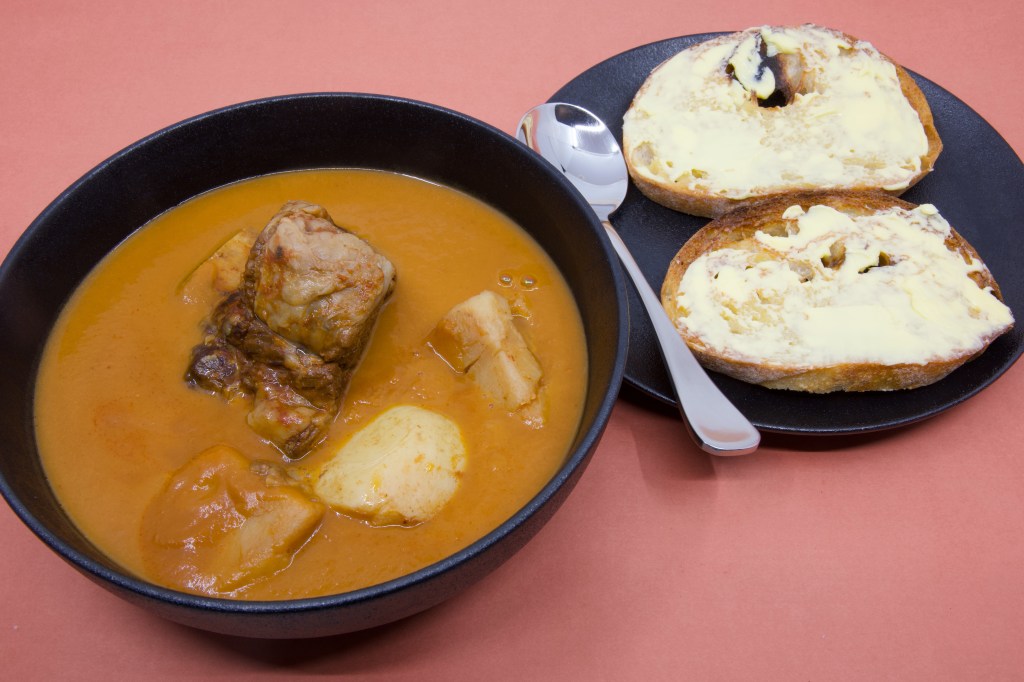
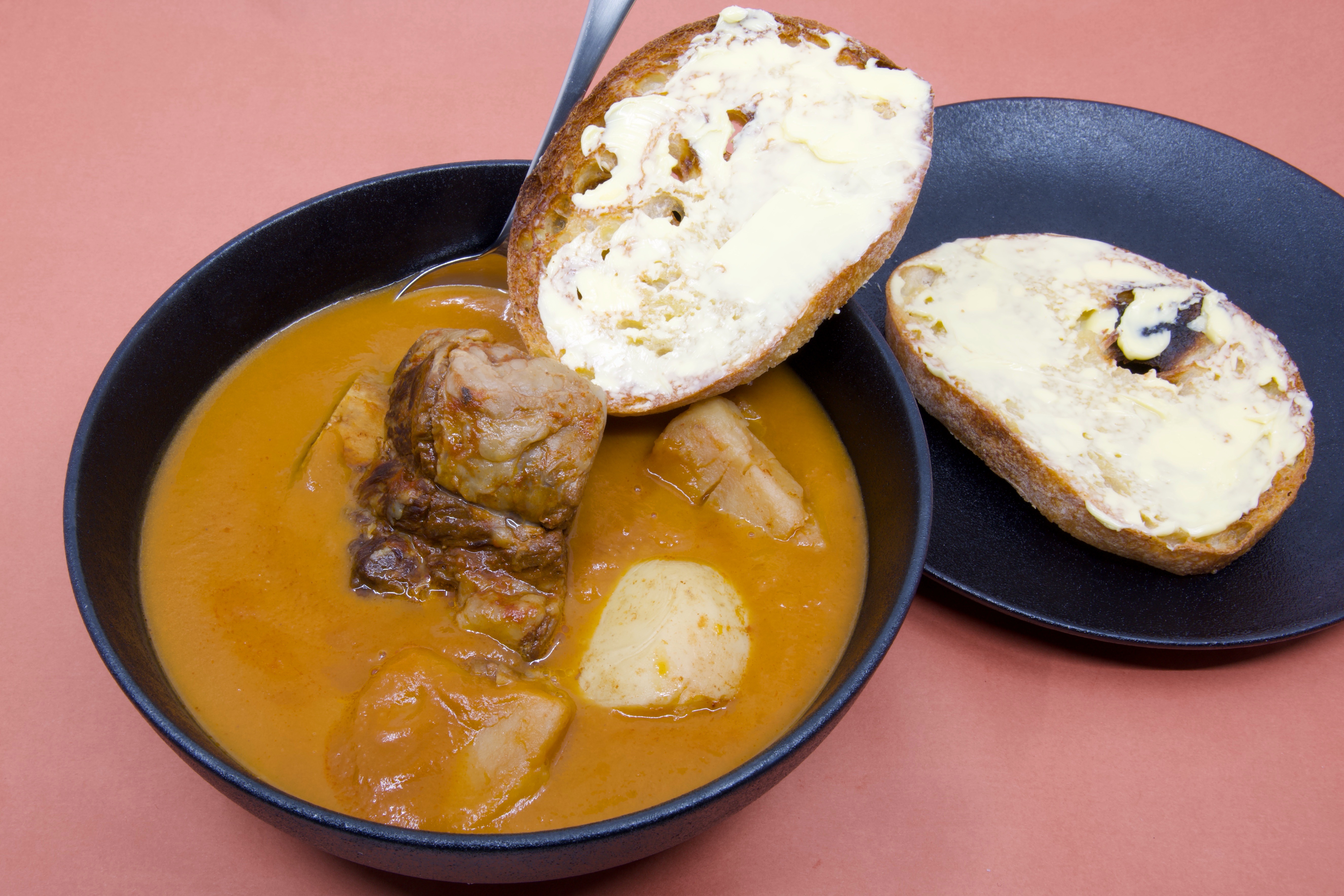
This beefy soup began with a pressure cooker full of short ribs, vegetables, potatoes, passata, and mixed mammal cooking liquor. It ended, after an overnight pause and a little stick-blender persuasion, as a thick, rich soup with tender beef, soft potato, and extravagantly buttered rye sourdough. It is not a quick dinner, but most of the waiting happens while you are doing something more interesting, like sleeping.
At a glance
- Serves: 2 generously or one Gary
- Pressure cooking: 45 minutes at high pressure, followed by natural pressure release
- Chilling: overnight
- Reheating: 30 minutes in a 60 °C water bath, plus time to reduce and blend the soup
Ingredients
- Beef short ribs, cut across the bone into pieces about 5 cm long
- 1 fennel bulb, sliced
- 2 celery stalks, sliced
- 1 brown onion, sliced
- Potatoes, cut into bite-sized pieces
- Passata
- Mixed mammal cooking liquor, sufficient to provide the pressure cooker’s minimum required liquid and partly cover the ingredients
- Rye sourdough, thickly sliced
- Cultured butter, softened
- Salt, to taste
- Freshly ground black pepper, to taste
Yummy Lummy’s note: The exact quantities can vary based on the size of your pressure cooker and your appetite, but do not exceed the manufacturer’s maximum-fill line. Keep enough thin liquid in the pot for the cooker to reach and maintain pressure; passata alone may be too thick.
Equipment
- Electric pressure cooker
- Sharp knife and cutting board
- Cooking twine
- Tongs and slotted spoon
- Fine-mesh strainer or colander
- Three heatproof bowls or containers
- Saucepan
- Stick blender
- Water-bath circulator and heatproof container
- Toaster or grill
- Butter knife
Day 1: pressure-cook the ribs and vegetables.
- Slice the fennel, celery, and brown onion. Cut the potatoes into bite-sized pieces.
- Cut the beef short ribs into pieces about 5 cm long. Tie cooking twine firmly around each piece, securing the meat to the bone. This is culinary seatbelting: it keeps the rib and meat together after its energetic trip through the pressure cooker.
- Place the fennel, celery, onion, potatoes, passata, and mixed mammal cooking liquor into the pressure cooker. Add the tied rib pieces.
- Check that the contents sit below the maximum-fill line and that the cooker contains the minimum volume of thin liquid required by its manufacturer.
- Seal the cooker. Cook at high pressure for 45 minutes.
- When cooking finishes, leave the cooker untouched and allow the pressure to release naturally. Open it only when the pressure indicator confirms that it is safe.
- Using tongs and a slotted spoon, transfer the cooked ribs and potatoes to one container.
- Drain the fennel, celery, and onion, reserving them in a second container.
- Strain the cooking liquor into a third container. Cool everything promptly, cover, and refrigerate overnight.
Day 2: turn the vegetables into soup
- Set the water bath to 60 °C. Place one chilled rib portion and one potato portion in a suitable sealed bag, and warm them for 30 minutes.
- Meanwhile, place the drained fennel, celery, and onion in a saucepan. Add a small amount of the chilled cooking liquor—enough to loosen the vegetables without drowning them.
- Bring the mixture to a gentle simmer. Cook uncovered until it begins to reduce, and the flavours concentrate.
- Remove the saucepan from direct heat briefly, then blend with a stick blender until thick and smooth. Add a little more cooking liquor if it becomes closer to mashed potato than soup. Return it to a gentle simmer.
- Taste, then season with salt and freshly ground black pepper. The cooking liquor may already be salty, so approach the salt cellar with manners.
Twice-Buttered Rye Sourdough Toast
- Toast the rye sourdough until crisp and well browned.
- While the toast is still hot, spread it with a thin layer of cultured butter. This first layer melts into the crumb.
- Allow the toast to cool slightly.
- Spread on a second thin layer of cultured butter. The cooler surface lets this layer remain in golden patches rather than disappearing completely.
- Finish the twice-buttered toast with a light sprinkle of flaky salt.
This is sometimes called two-stage or double buttering. Published descriptions of Nigella Lawson’s method follow the same sequence: butter immediately so the first layer soaks in, wait for the toast to cool, then add a second layer that stays on the surface (Funderburk 2026; Reynolds 2026). I call the result supersaturated toast. It may not be a formal scientific phase, but it is a very satisfactory one.
To serve
Ladle the simmering soup into a warm bowl. Remove the reheated rib and potato from the bag, discard the twine, and settle both into the soup. Serve the twice-buttered rye sourdough beside it for dipping, scooping, or quiet contemplation of butter’s excellent career choices.
Food-safety notes
- Divide the cooked food into shallow containers so it cools quickly. Refrigerate it promptly.
- Keep the refrigerator at 5 °C or colder.
- The 60 °C water bath is a gentle warming step. Start with properly chilled food, use a sealed bag suitable for the purpose, and serve immediately after warming.
- Bring the vegetable soup to a proper simmer before serving. If you are feeding someone who is pregnant, older, immunocompromised, or otherwise vulnerable, reheat the beef and potato until piping hot rather than relying on gentle warming alone.
References
Funderburk, C. 2026, ‘Nigella Lawson just taught me her delicious butter rule for the best toast’, The Kitchn, 3 February, accessed 27 September 2026. Notes: Describes Lawson’s two-stage method—one layer on hot toast, followed by a second after cooling.
Reynolds, L. 2026, ‘Why you should butter toast twice’, Tasting Table, 18 July, accessed 27 September 2026. Notes: Explains how the first layer soaks into the crumb while the second remains on the surface.