Category: Food

  • Whipped Vegemite butter

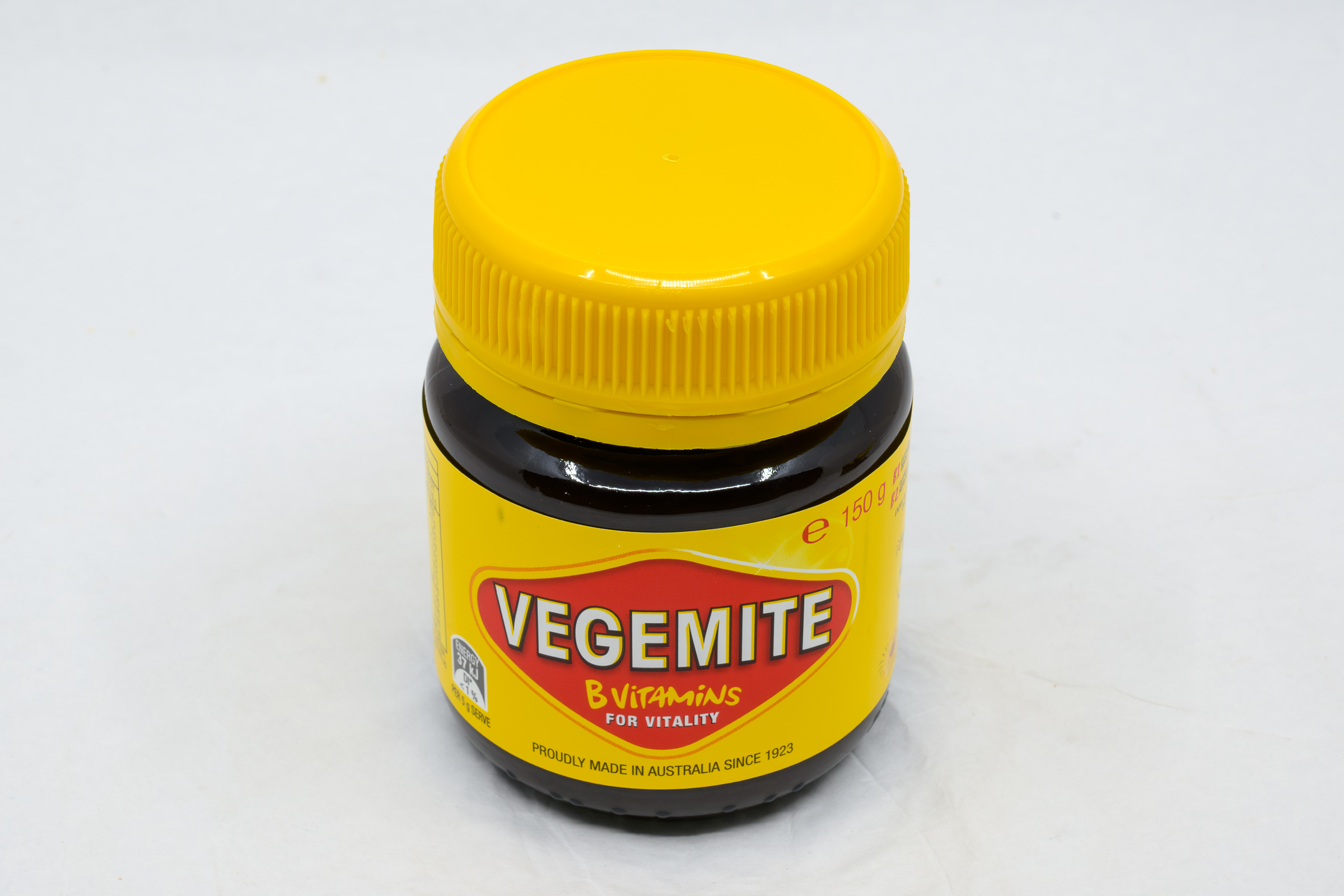
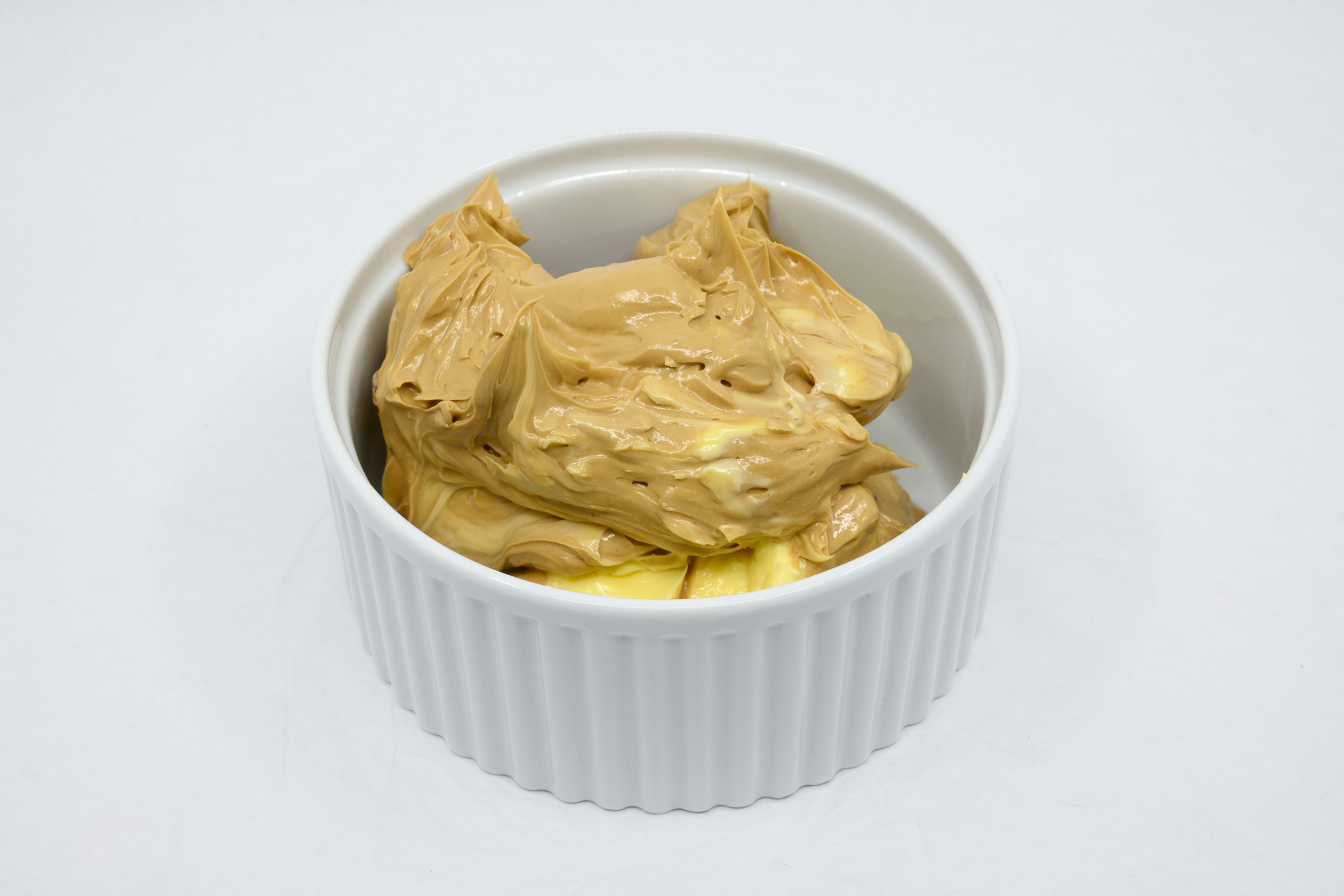
    Whipped Vegemite butter


    Last week on the Lunchbox Envy podcast, the theme was spreads. The hosts made disparaging comments about an Australian food product.

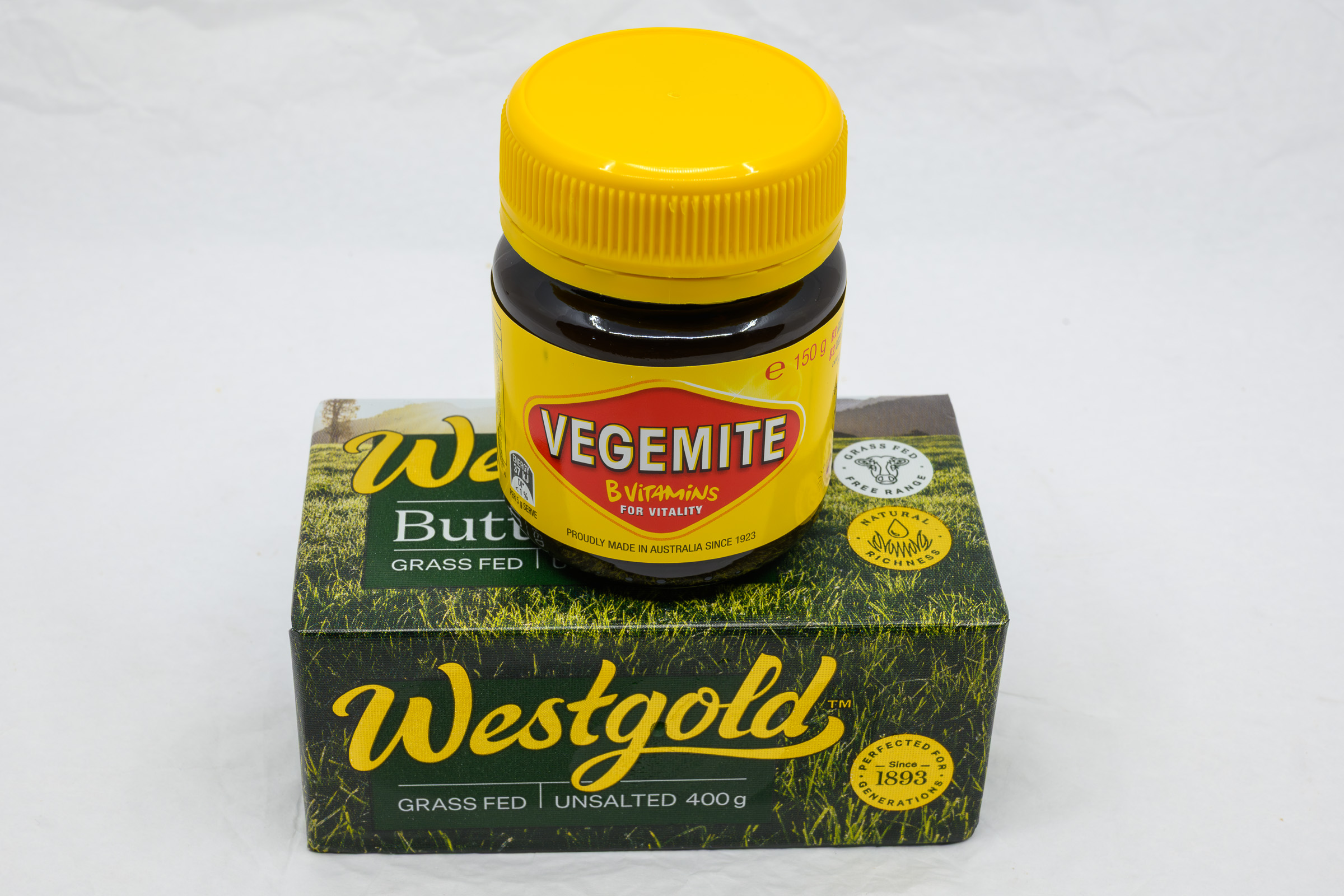
    It inspired me to make whipped Vegemite[i] butter using products from Australia and New Zealand.
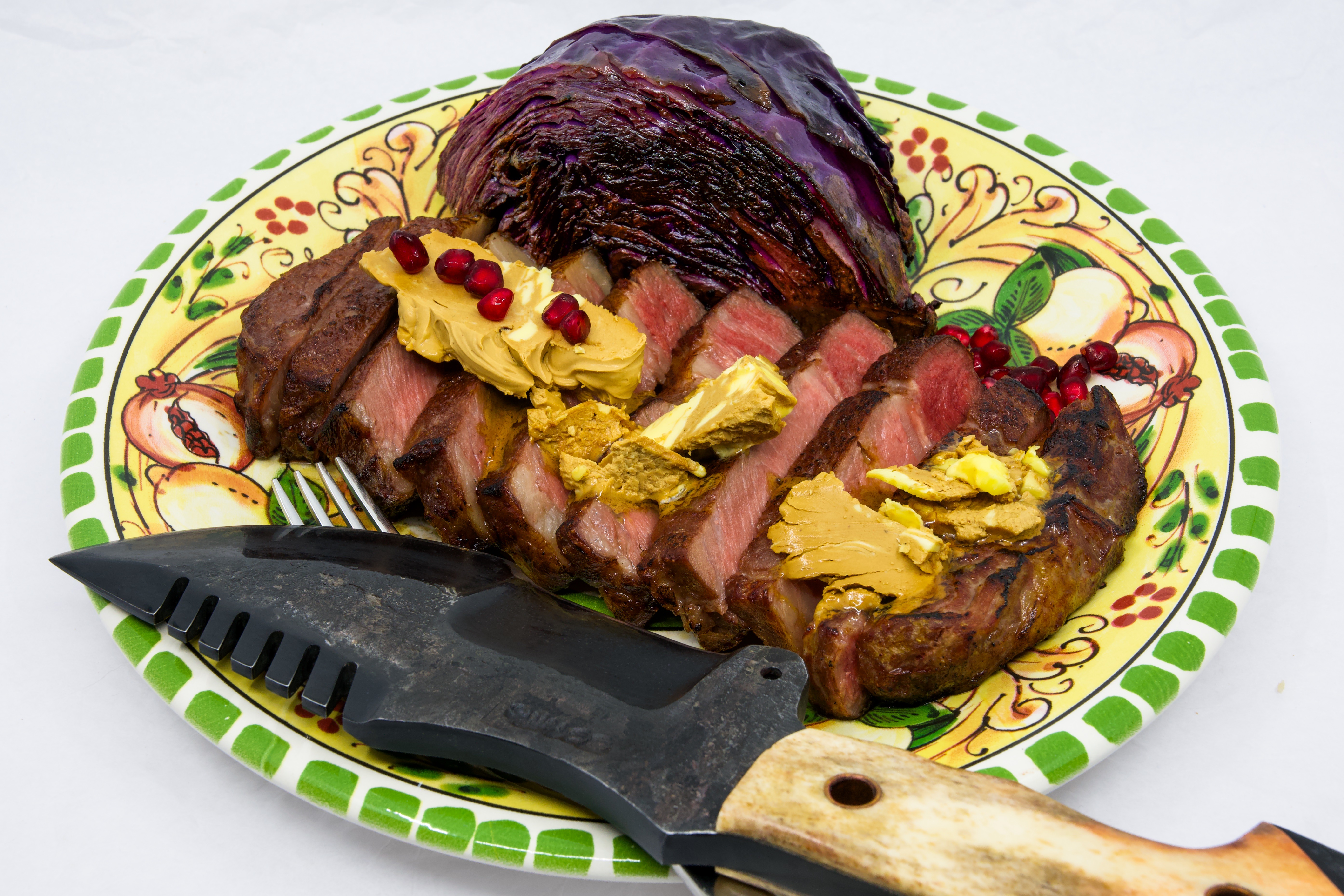
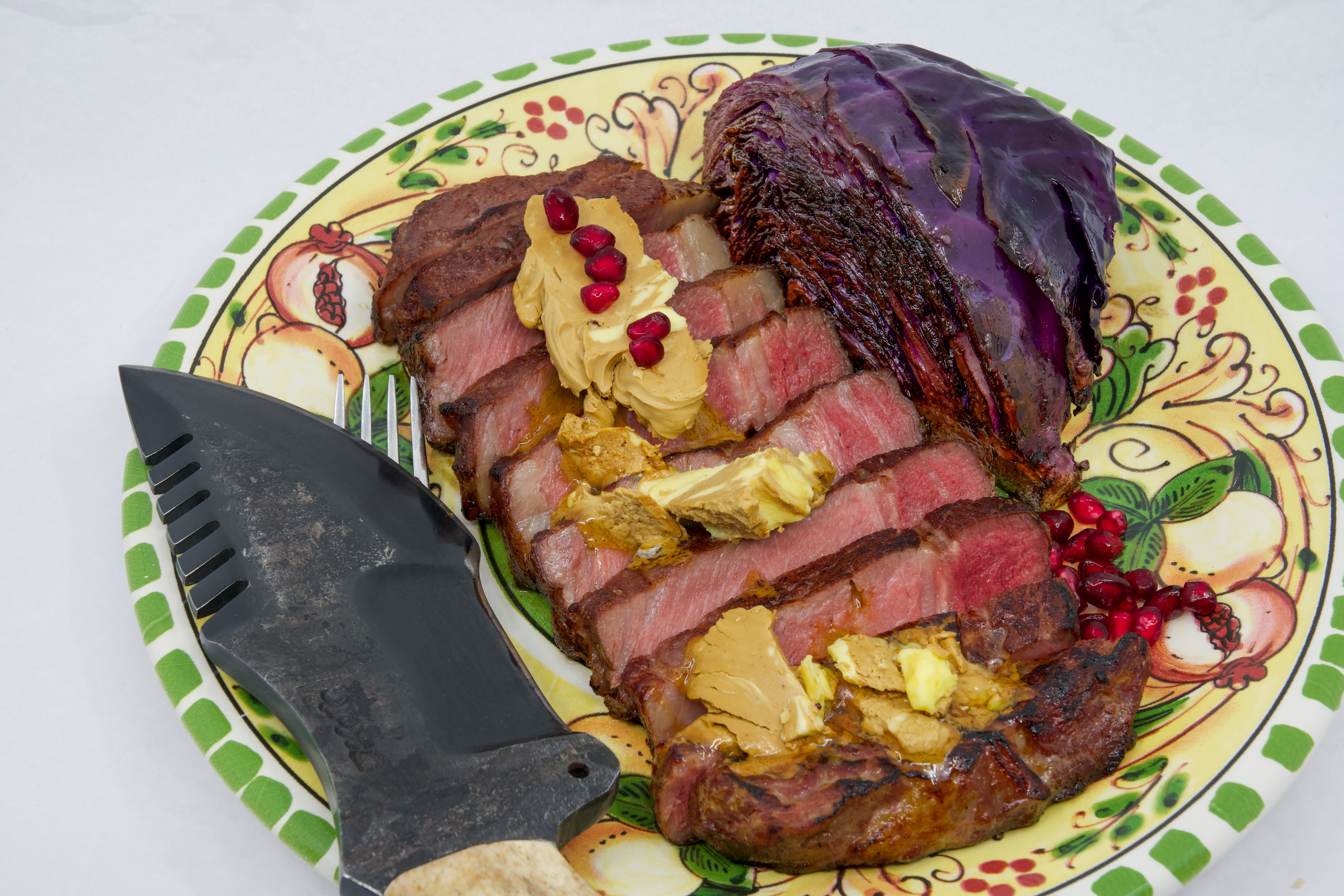
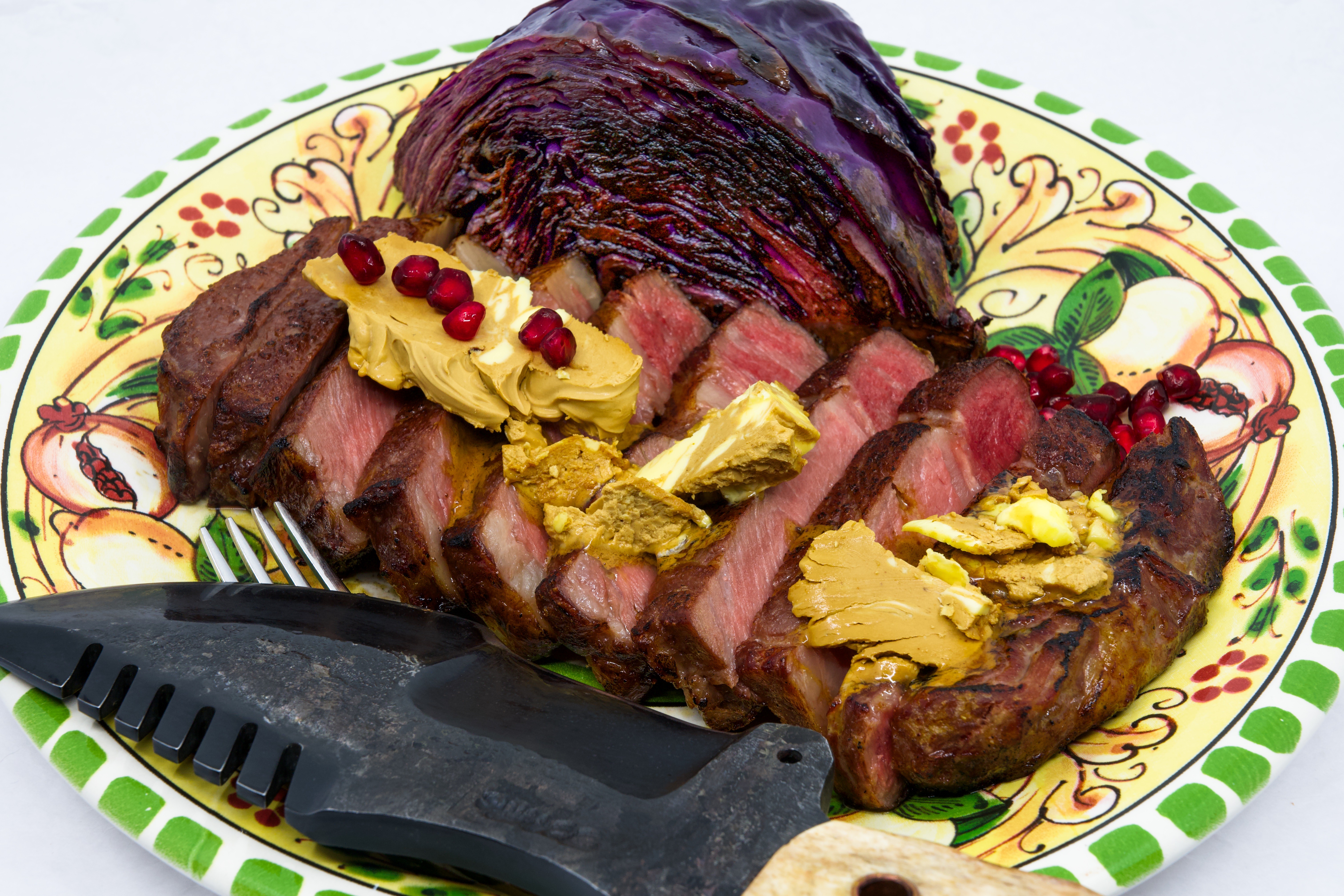
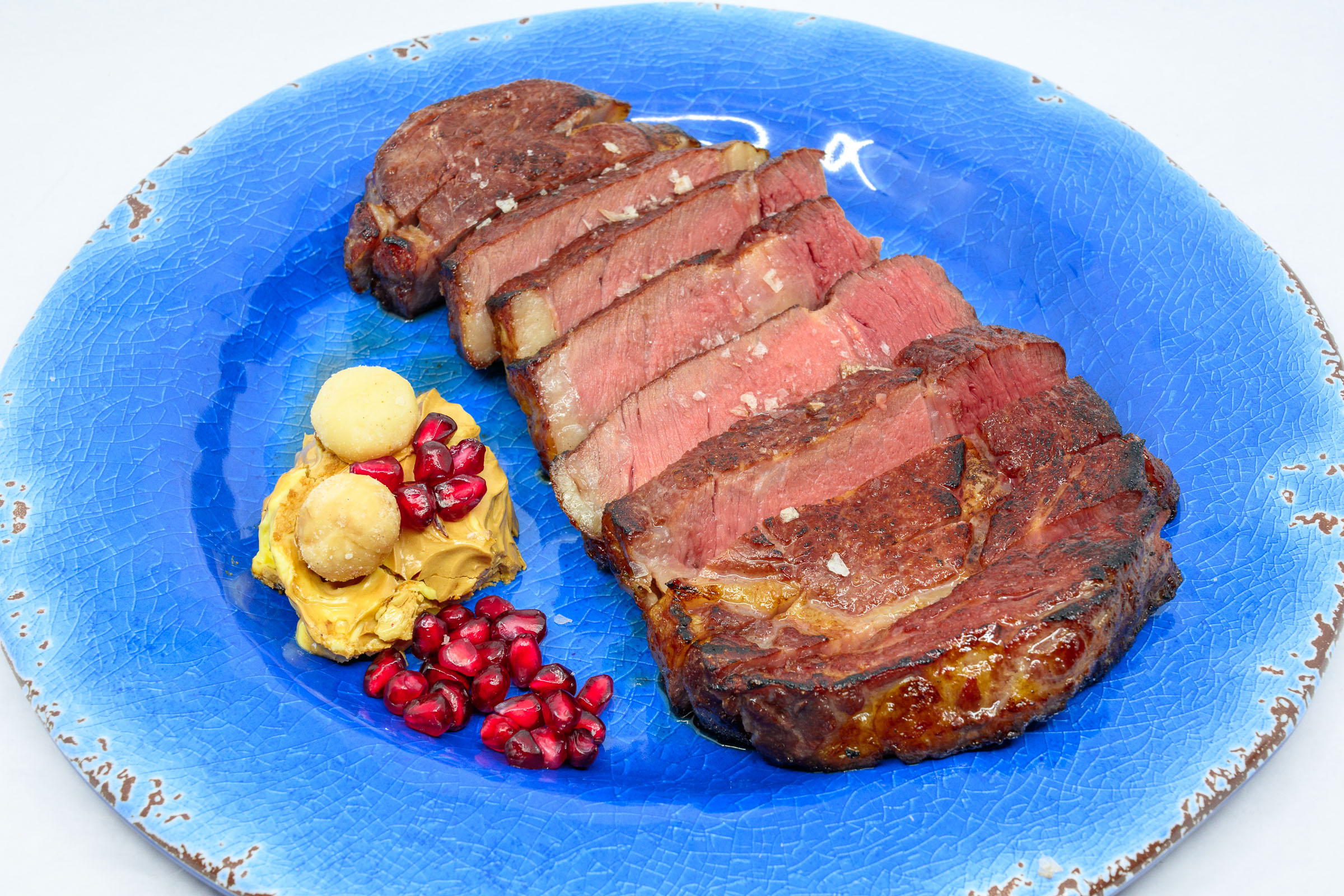
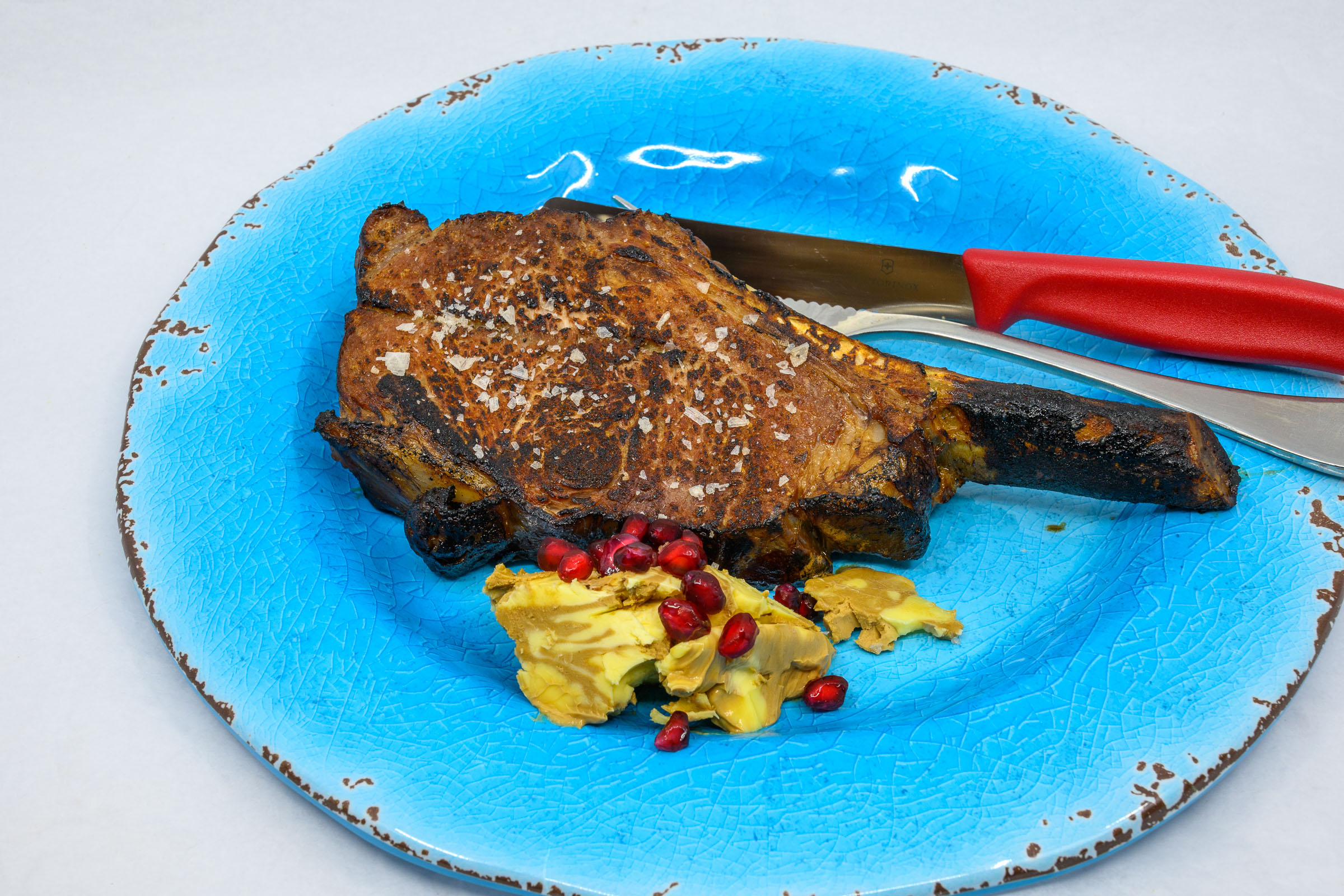
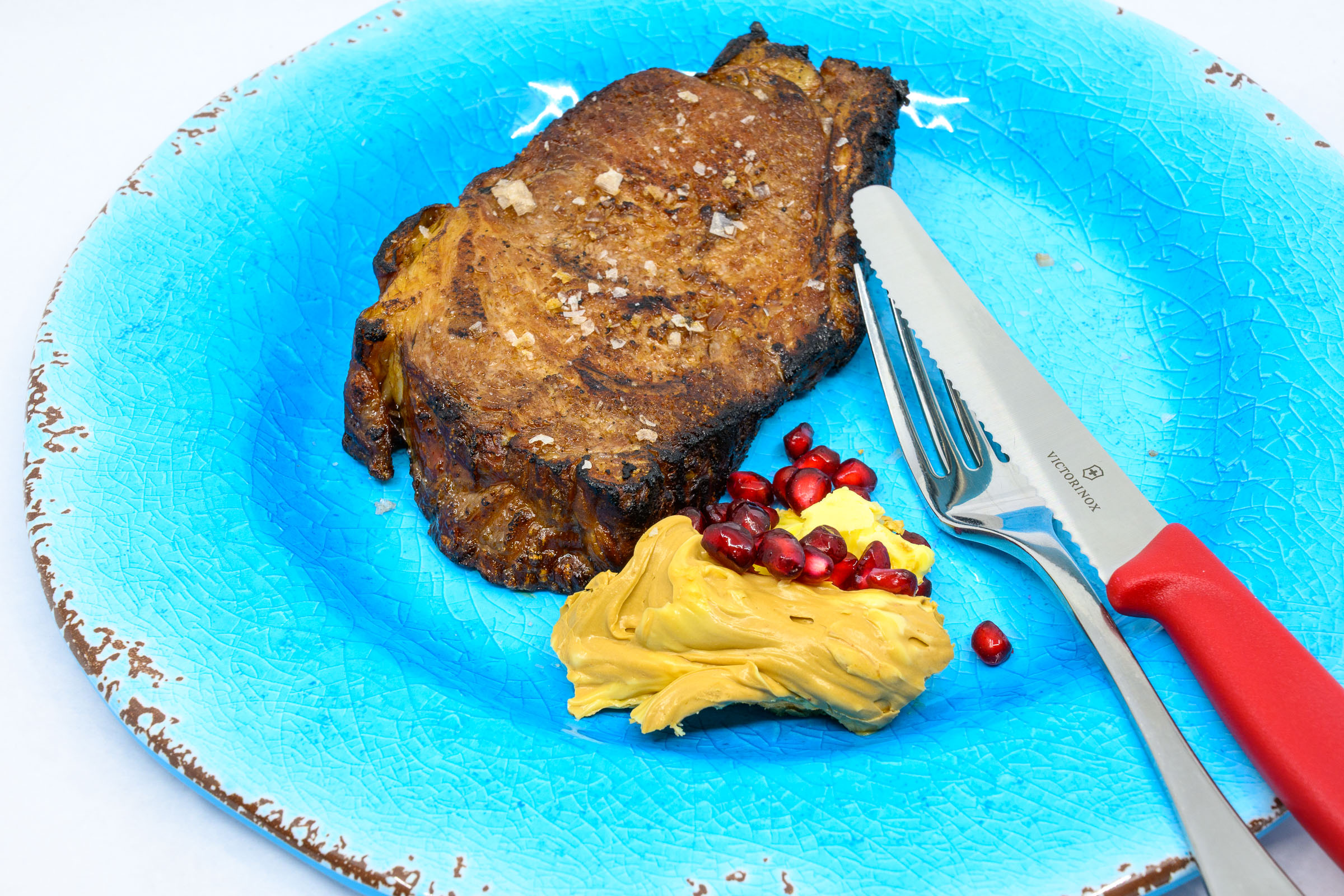
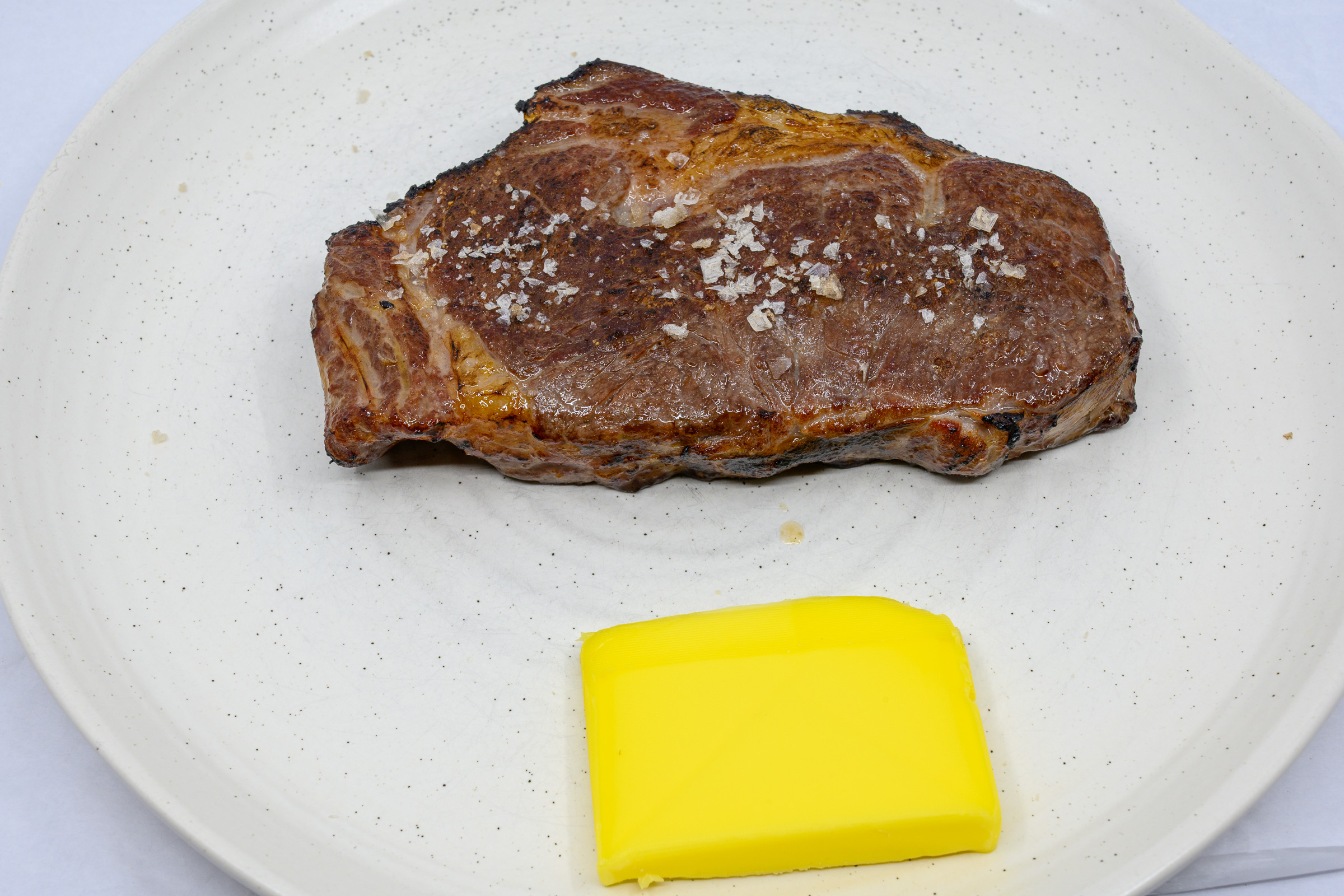
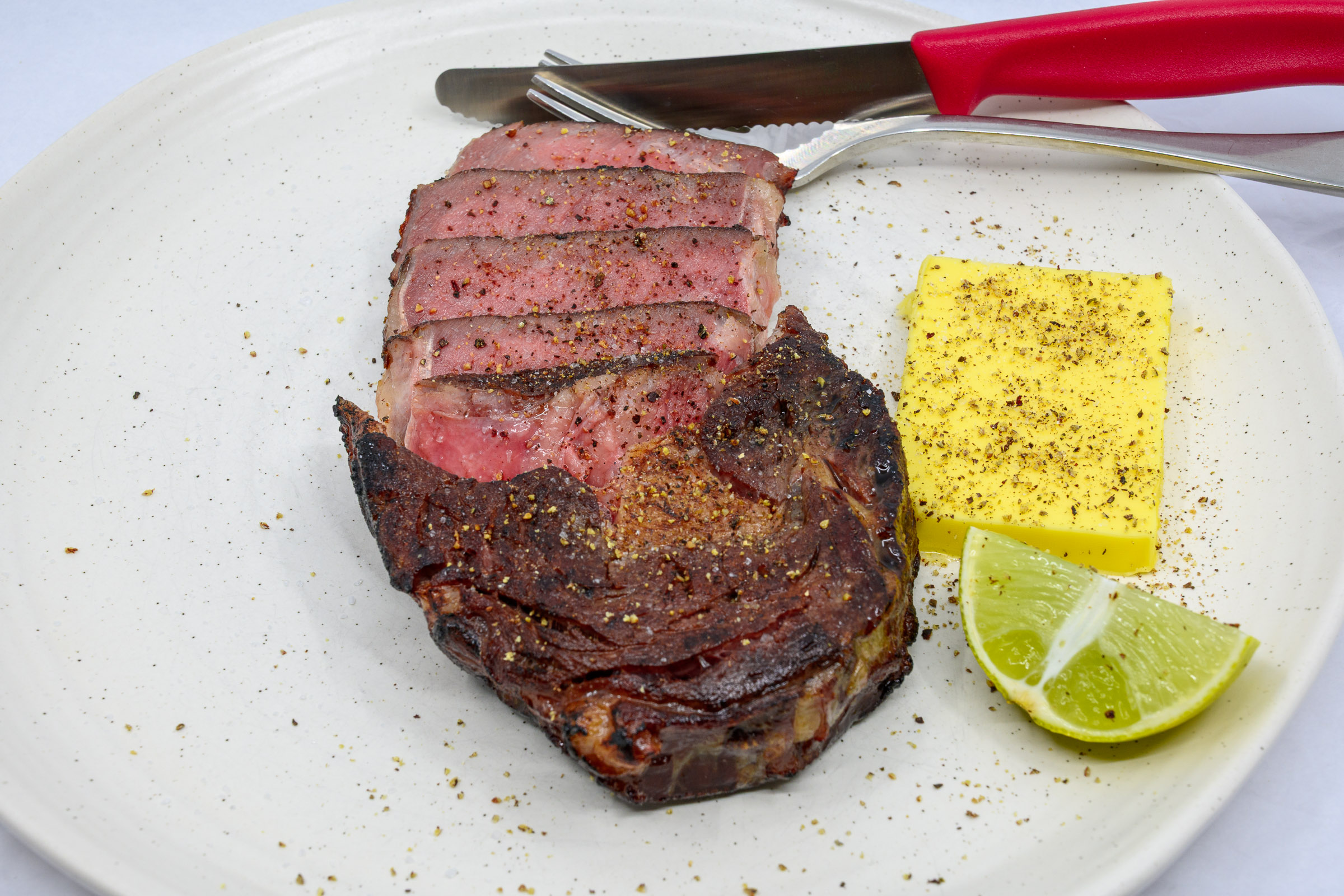
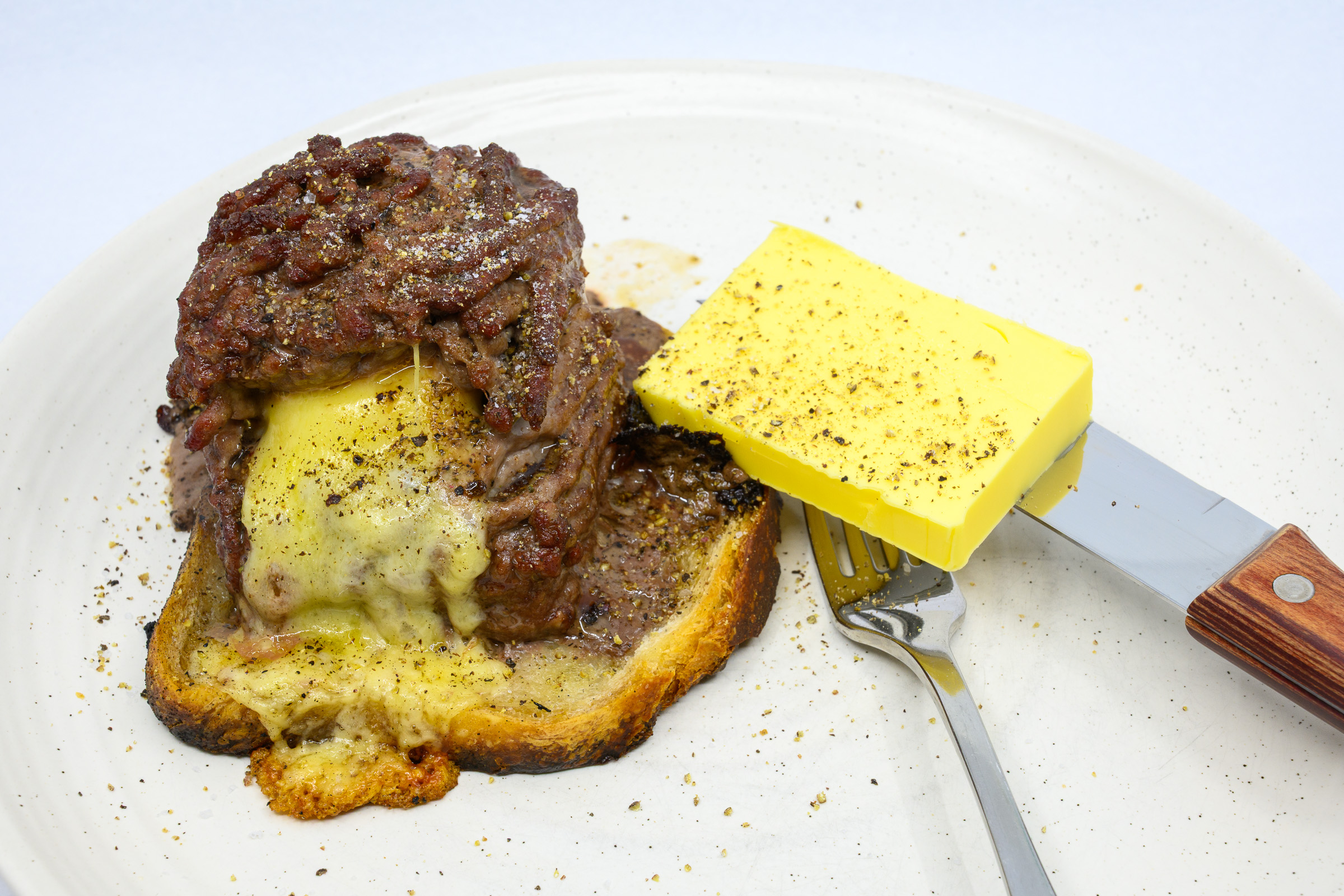
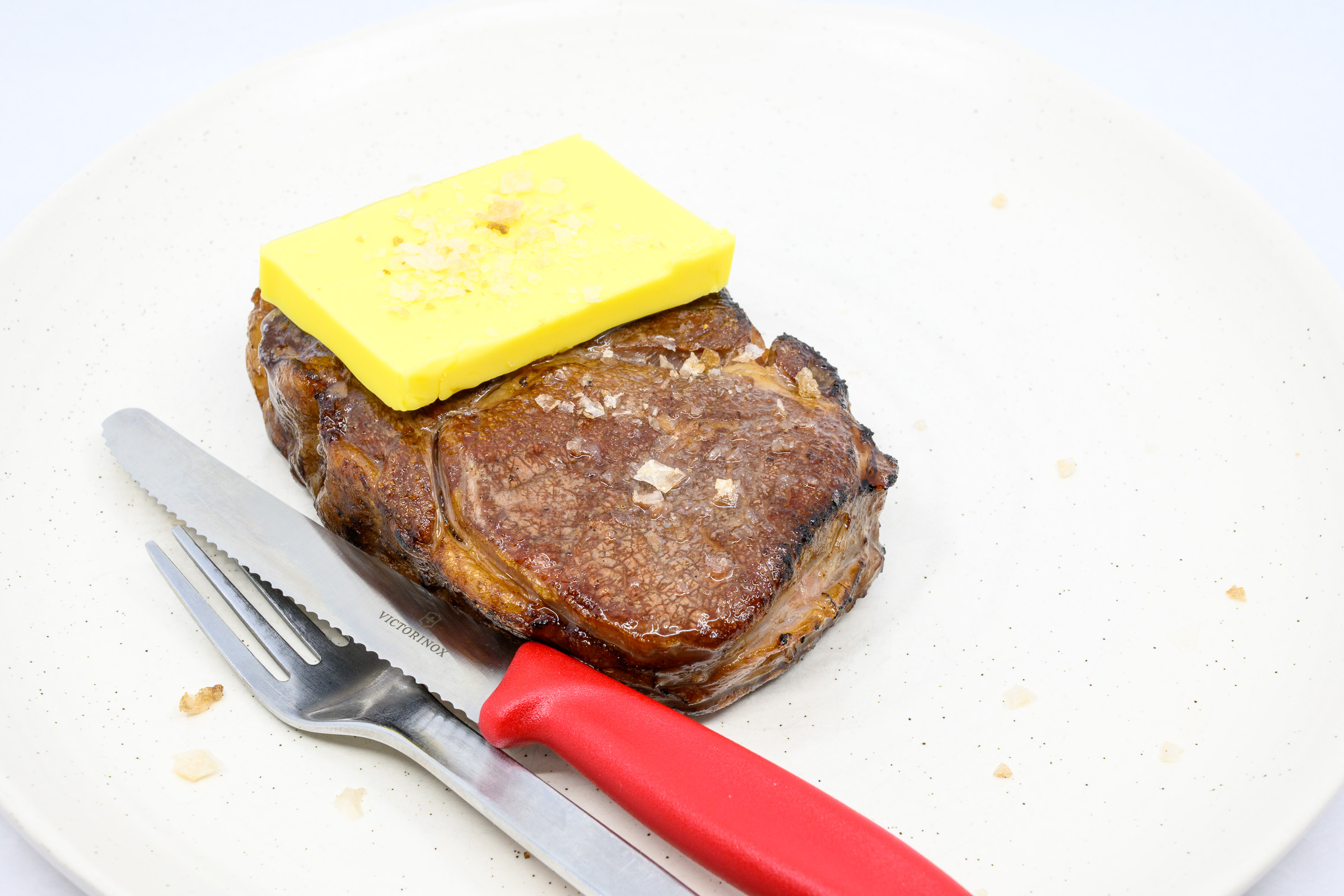
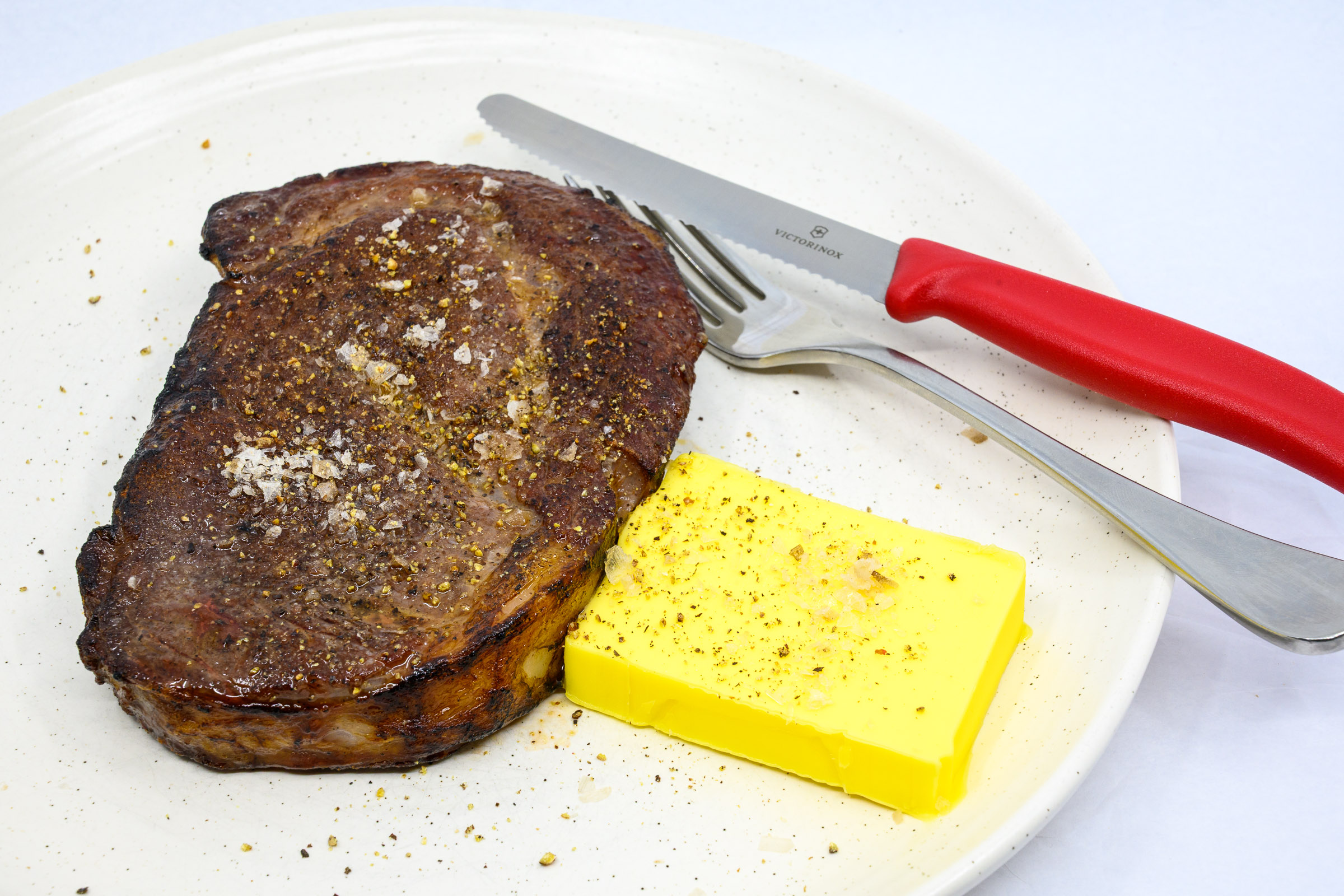
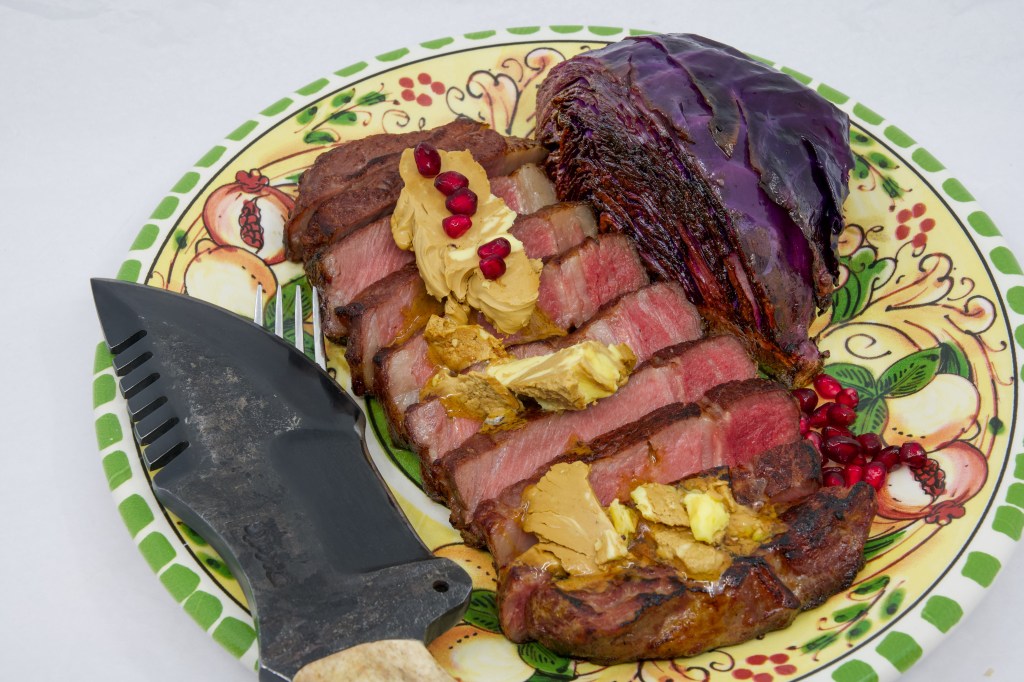
    Grass-fed scotch fillet steak, red cabbage, whipped Vegemite butter, and pomegranate arils

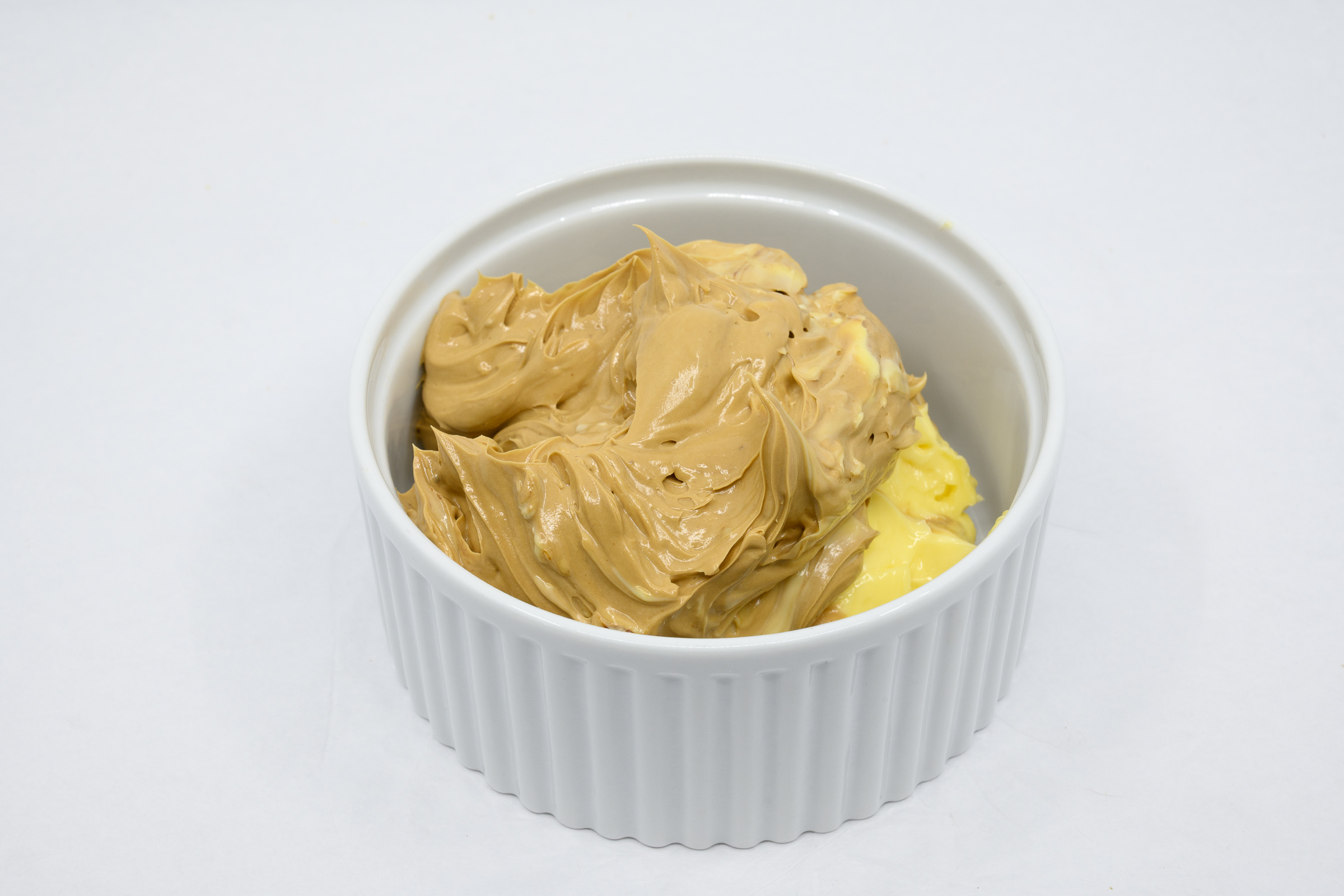
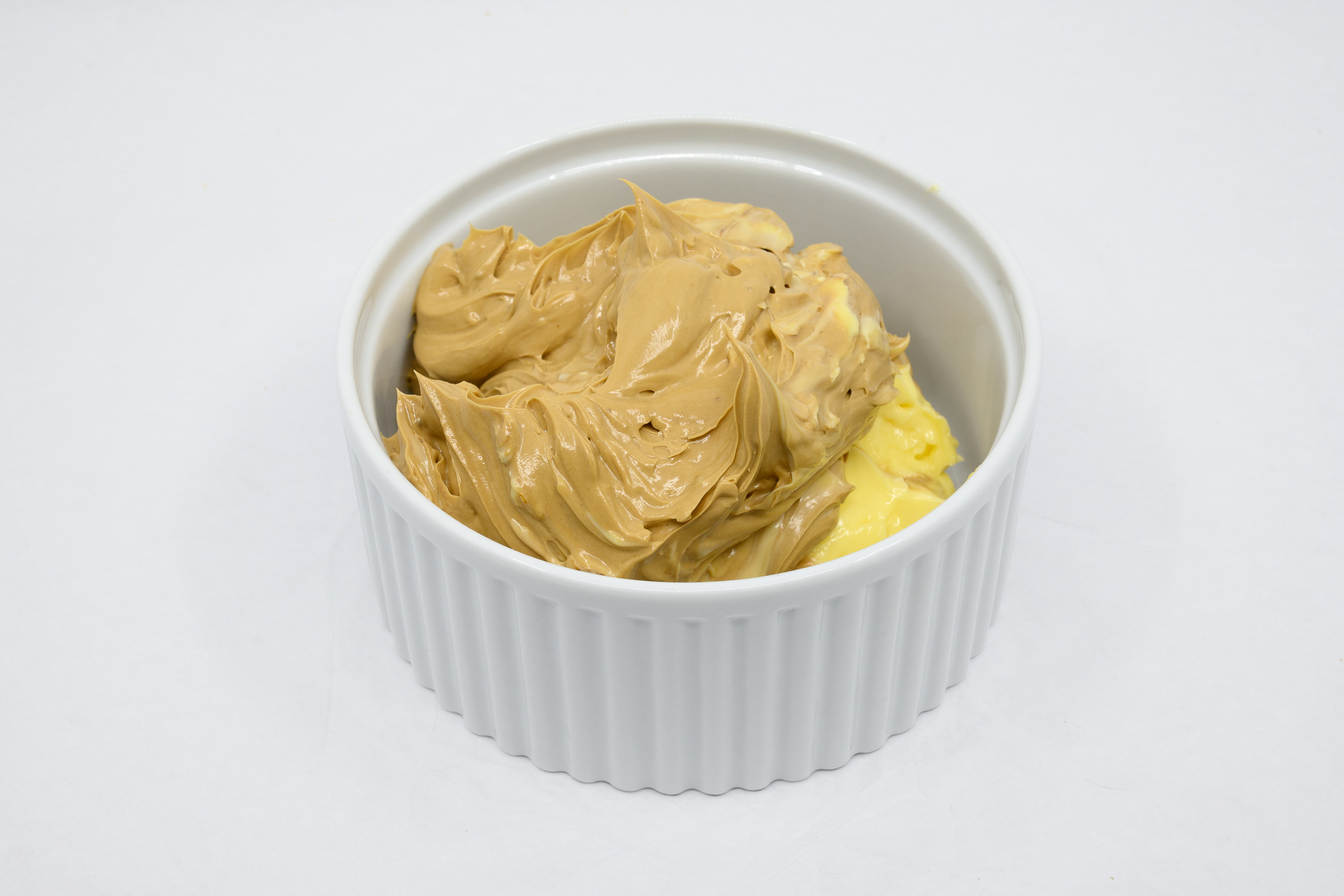
    It was easy to make; it just took a few hours for the butter to soften enough to whip into a light, fluffy butter cream. I was surprised by how little Vegemite was needed to alter the colour and turn the whipped butter into a mousse-like, sweet, chocolate-coloured dessert. Instead, I had a light and fluffy bowl of umami goodness. In my mind, I thought it would be perfect to spread on steak.
    Recipe

    Whipped Vegemite butter

    Ingredients

    • Butter — 200 g
    • Vegemite — 1 teaspoon

    Equipment

    • Hand-held mixer

    Instructions

    1. Allow the butter to get to room temperature.
    2. Place the butter in a bowl and, with a hand-held mixer, whip it until light, fluffy, and well aerated.
    3. Add the teaspoon of Vegemite and continue whipping the Vegemite butter.

    Steak

    Ingredients

    • Grass-fed scotch fillet steak
    • Red cabbage

    Equipment

    • Water bath
    • Precision cooker
    • Hooded barbecue grill
    • Gas torch

    Instructions

    • Cook the steak in the water bath for 2 hours at 57 °C.
    • Heat the hooded barbecue and plate the cabbage on the cast-iron flat-top.
    • Sear the steak on the cast-iron flat-top on the barbecue.
    • Serve the steak with the whipped Vegemite butter.

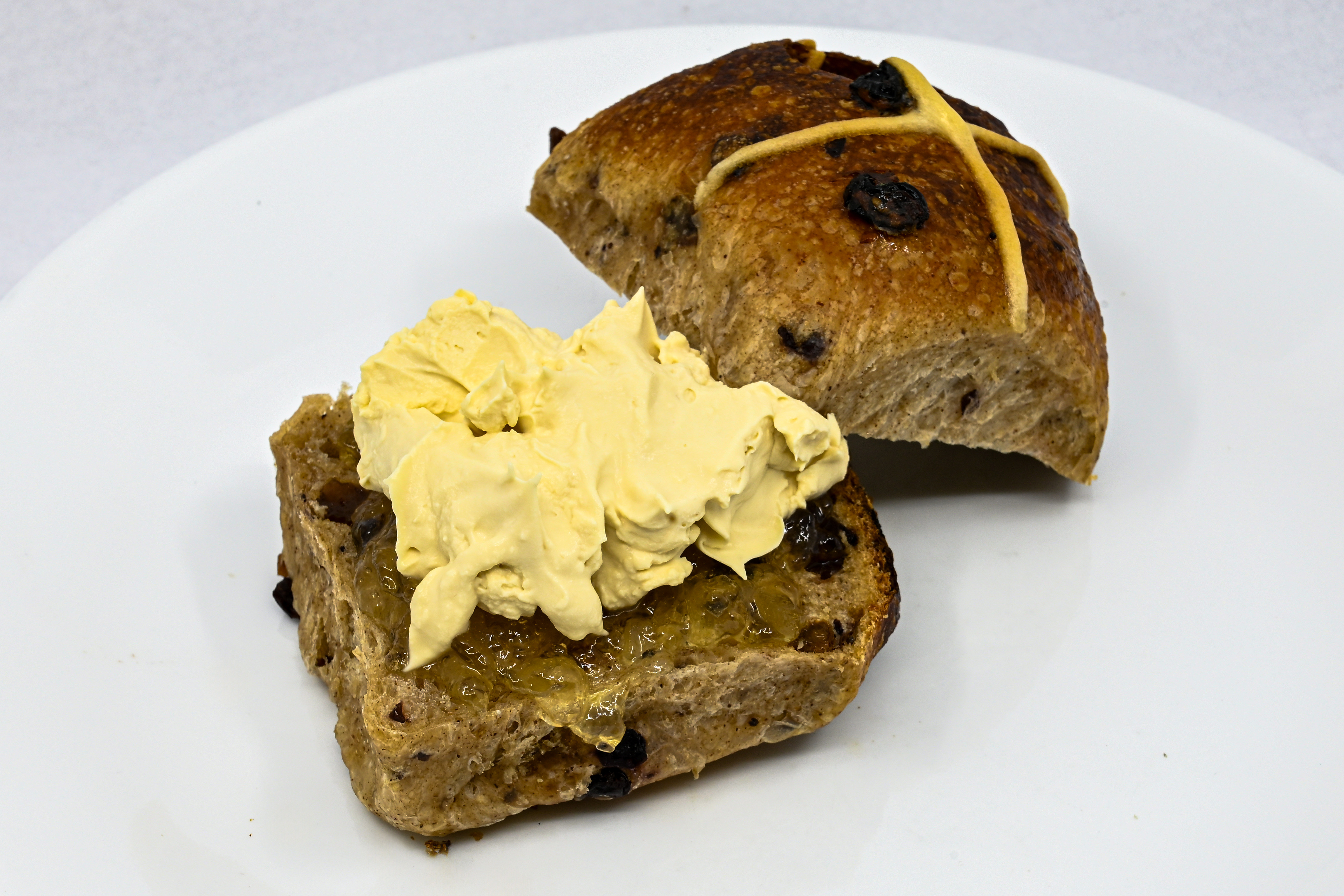
    Dessert — A scone alternative

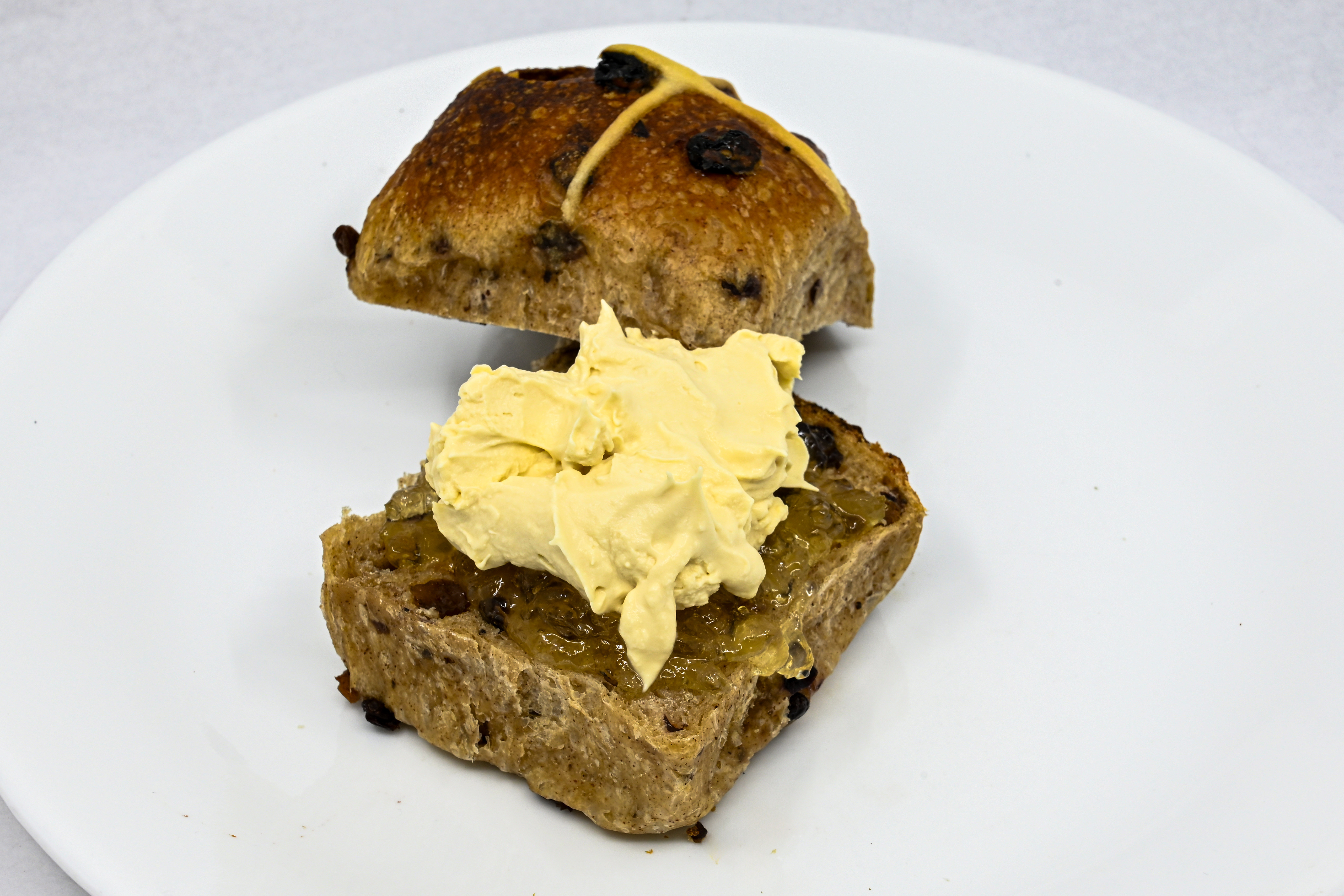
    A sourdough hot cross bun with fruit is a great alternative to a scone. The cream was whipped pure-pouring Cream (300 mL), and the “jam” was Ginger Marmalade (365 g). Marmalade also featured on the “spreads” episode of the Lunchbox Envy podcast.

    This is my version of a “Devonshire tea,” only it is a dessert.

    Photographs

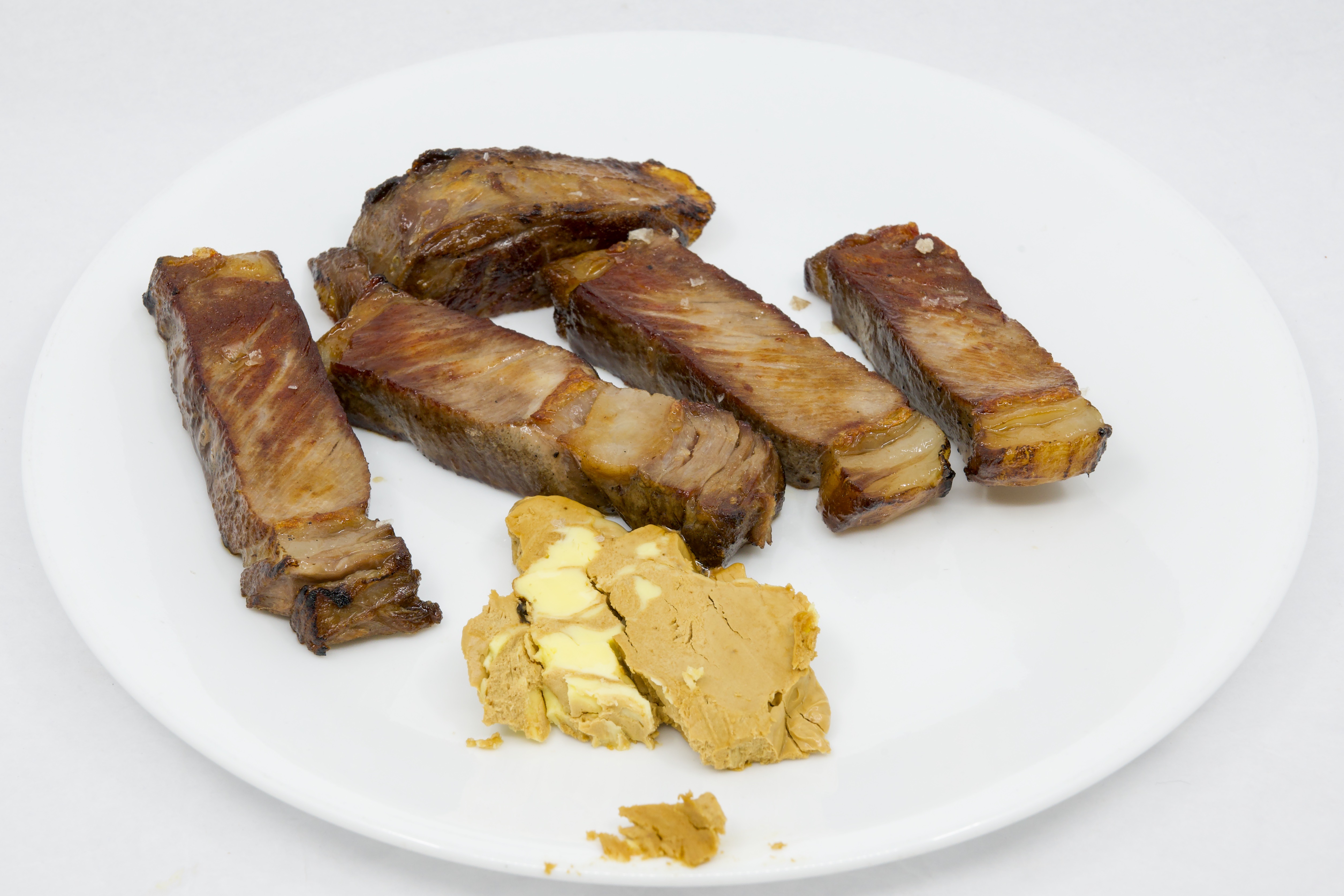
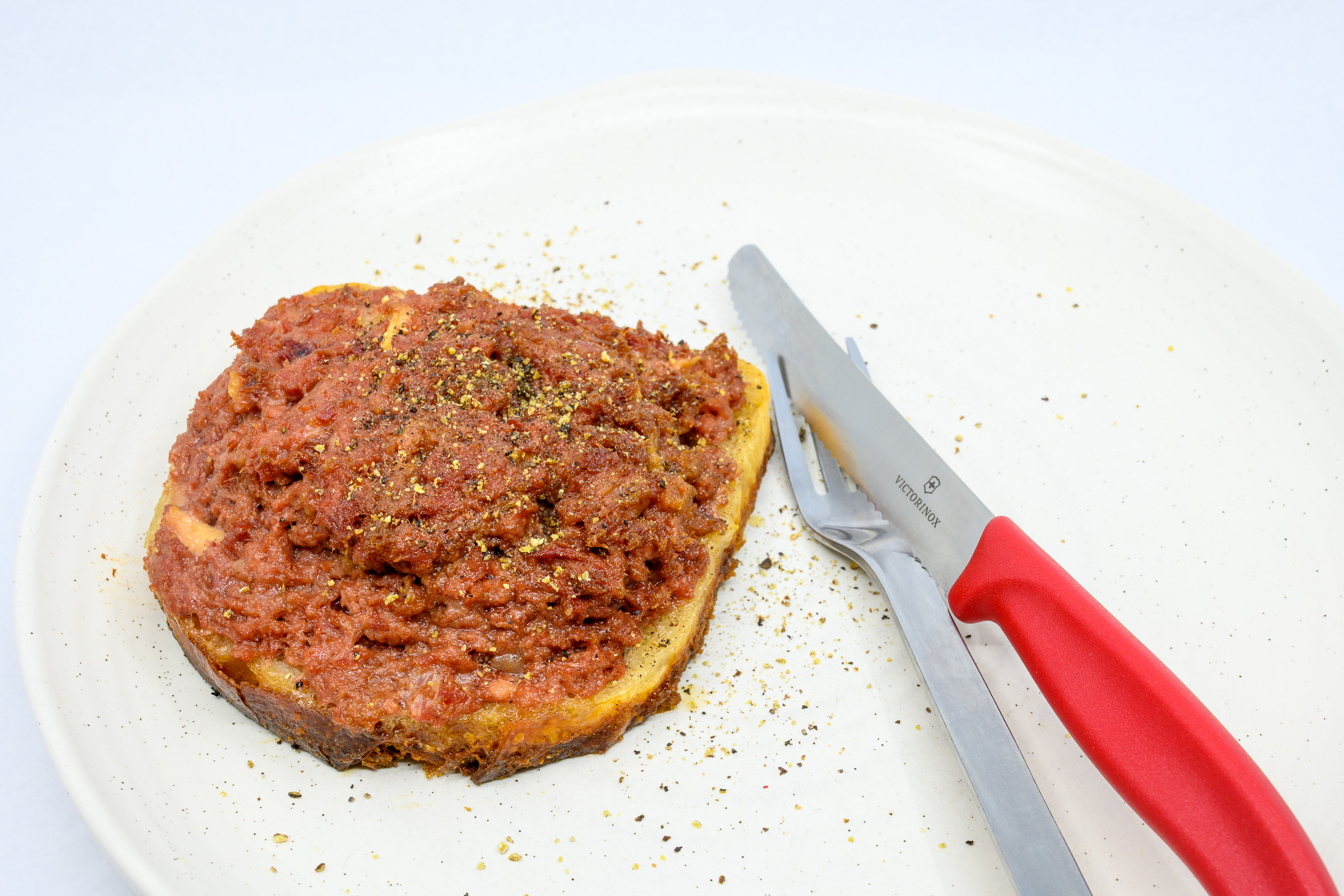
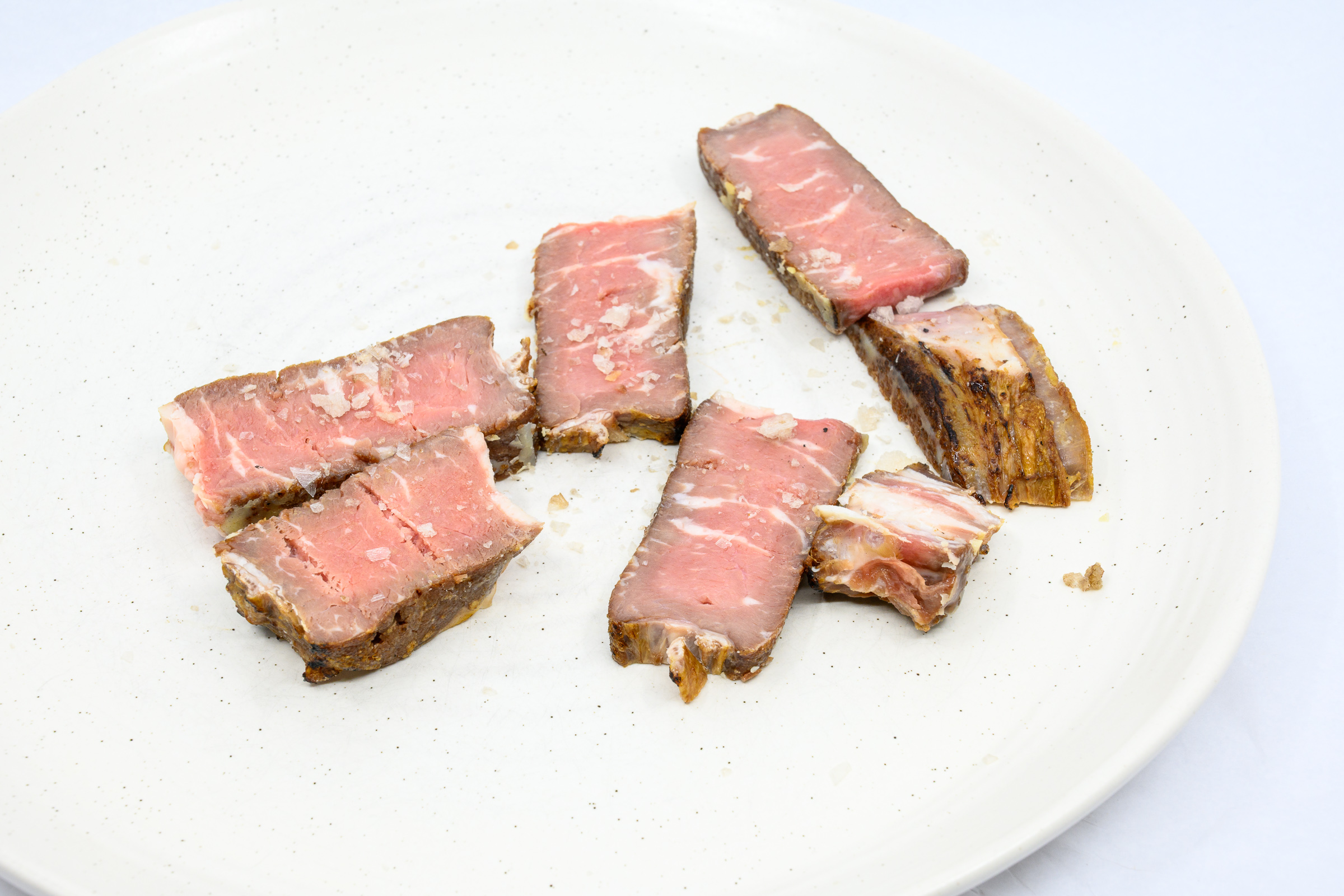
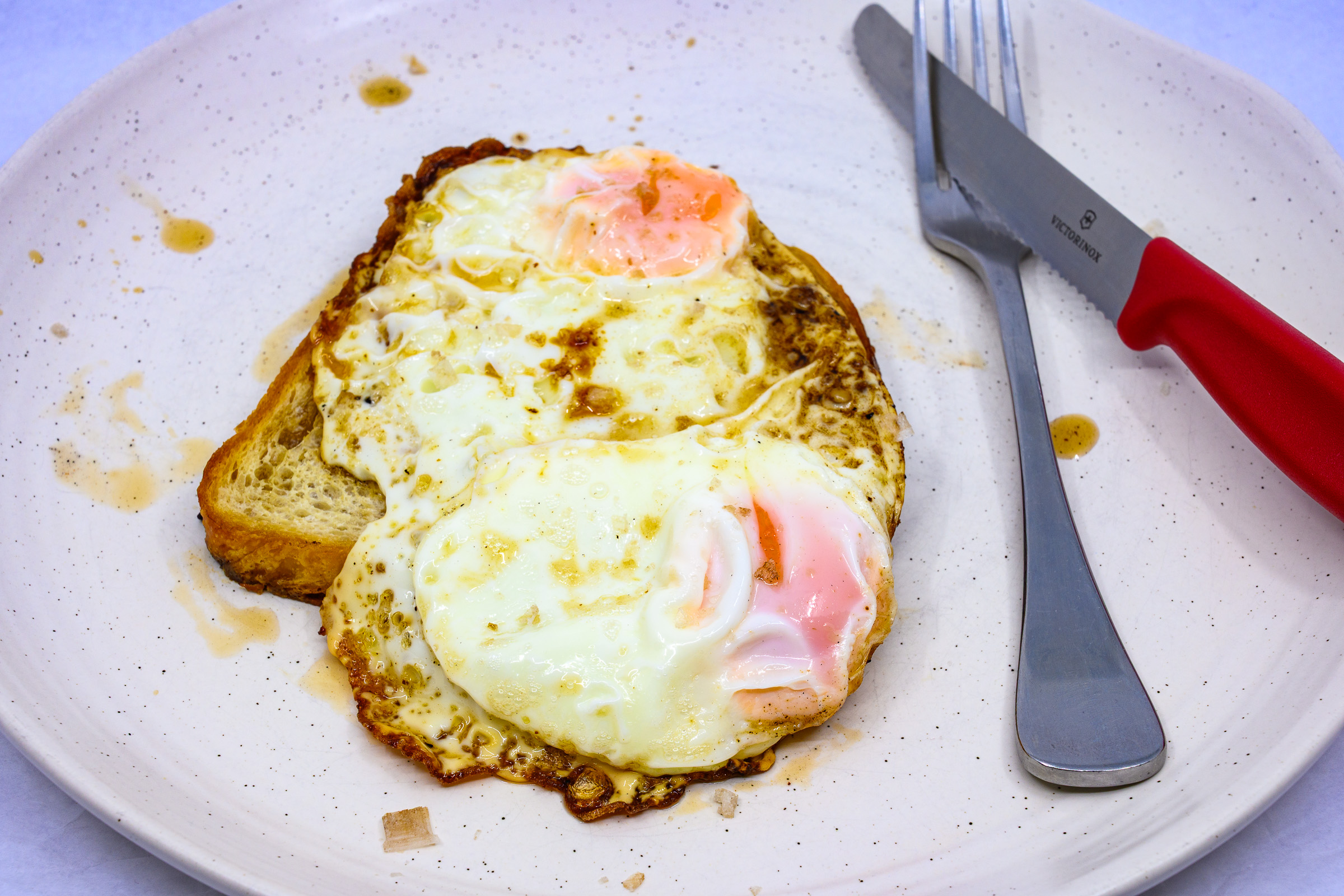
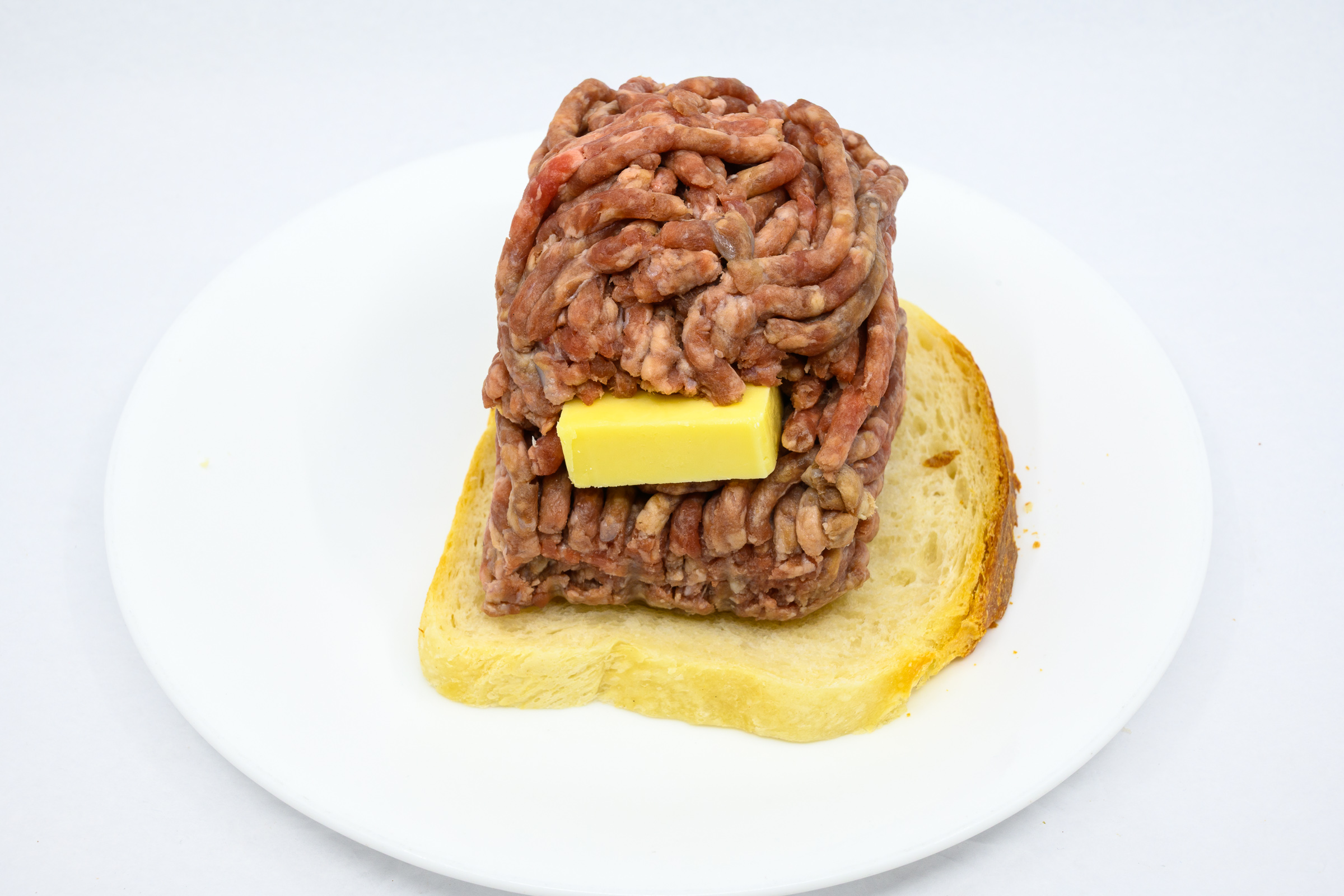
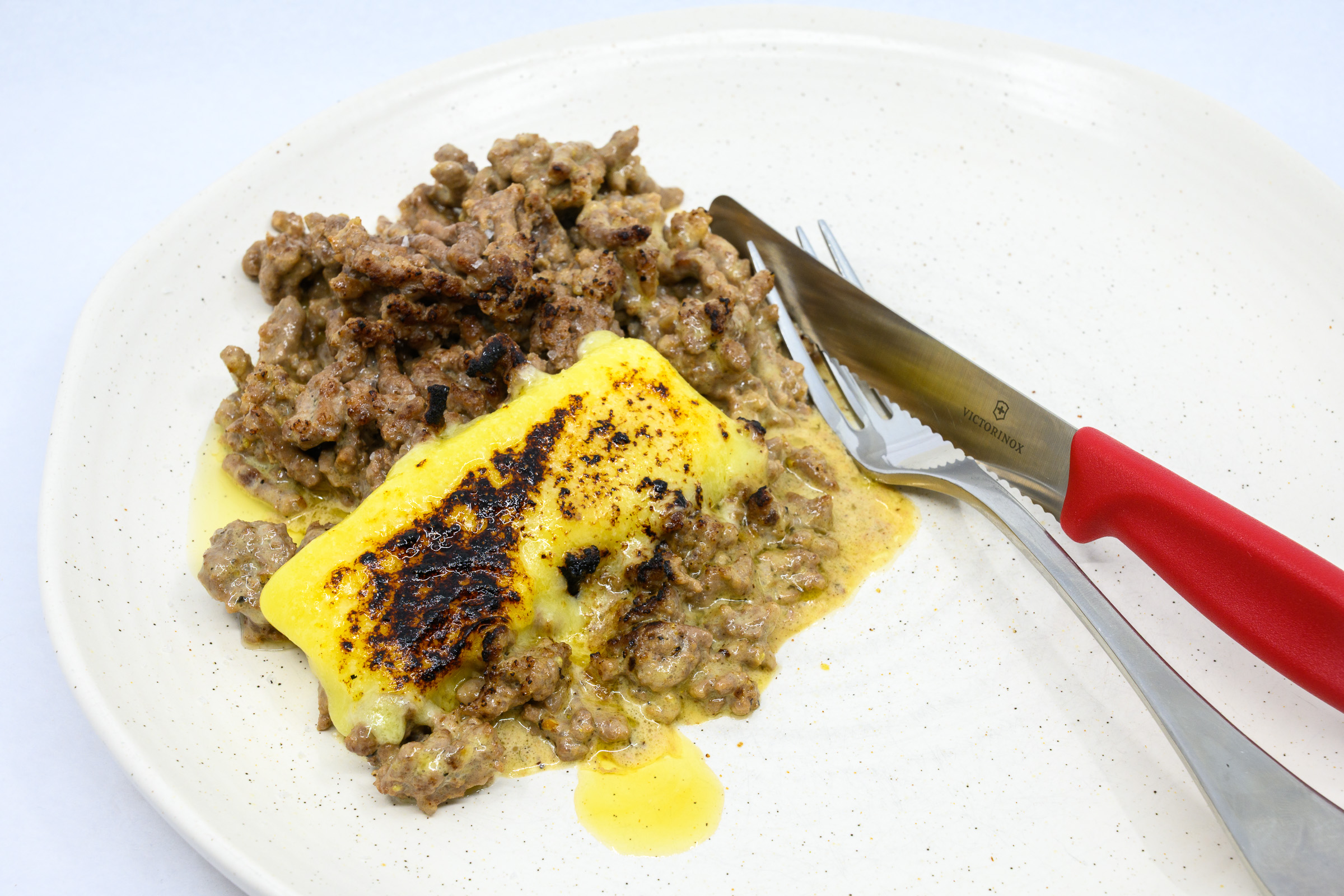
    including previous meals with the whipped Vegemite butter.

    Vegemite love

    When I was in primary school, I used to eat Vegemite sandwiches every day for a year, and the following year I’d alternate with peanut paste sandwiches.


    [i] Vegemite is one of Australia’s most iconic flavours, born in the early 1920s when chemist Cyril Callister set out to create a local alternative to British Marmite. Developed in 1922 and first sold in 1923, it was originally called Pure Vegetable Extract before a naming competition produced the now‑famous “Vegemite.” Although it took time to win over Australian households, wartime shortages of imported goods helped it become a national staple, and it has remained deeply woven into Australian food culture ever since.

    At its core, Vegemite is made from leftover brewer’s yeast extract—a by‑product of beer production—combined with vegetable extracts, salt, and malt extract. The yeast undergoes autolysis, a process that breaks down the cells and concentrates the savoury, umami‑rich liquid that gives Vegemite its signature flavour. This mixture is then blended into a thick, dark brown paste with a consistency similar to firm jelly. The exact vegetable extract blend remains a closely guarded secret, but the result is unmistakable: salty, slightly bitter, deeply savoury, and intensely aromatic.

    Nutritionally, Vegemite is surprisingly dense for such a small serving. A teaspoon delivers around 1.3 grams of protein with minimal fat and carbohydrates, making it extremely low in calories. Its standout feature is its B‑vitamin content—thiamine (B1), riboflavin (B2), niacin (B3), and folate (B9) are all present in significant amounts, with some versions also fortified with vitamins B6 and B12. These micronutrients support energy metabolism and overall wellbeing, which is part of why Vegemite was historically marketed as a health food. The only caution is its naturally high sodium content, though reduced‑salt varieties are now available.
  • Long weekend standing rib roast

    Long weekend standing rib roast


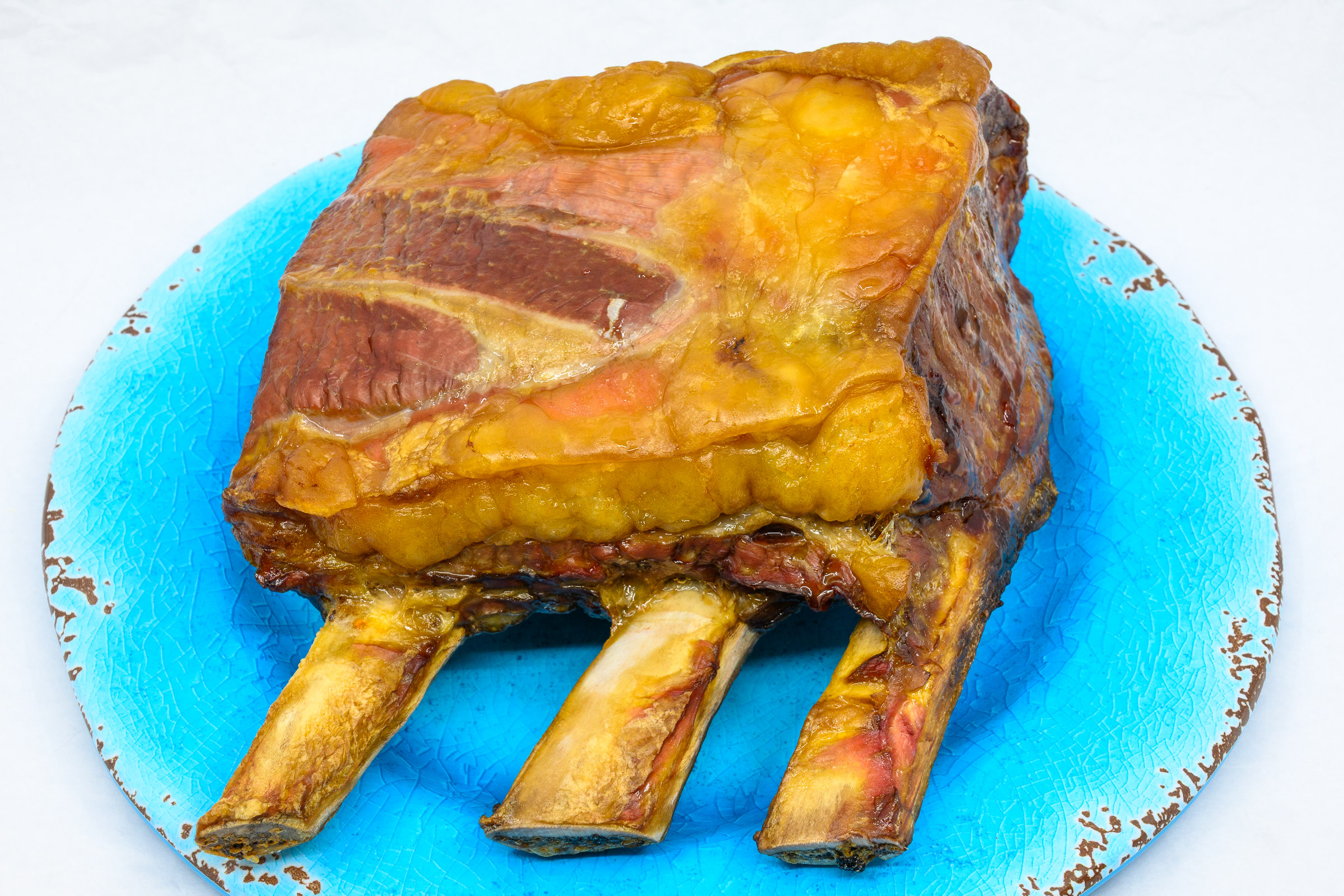
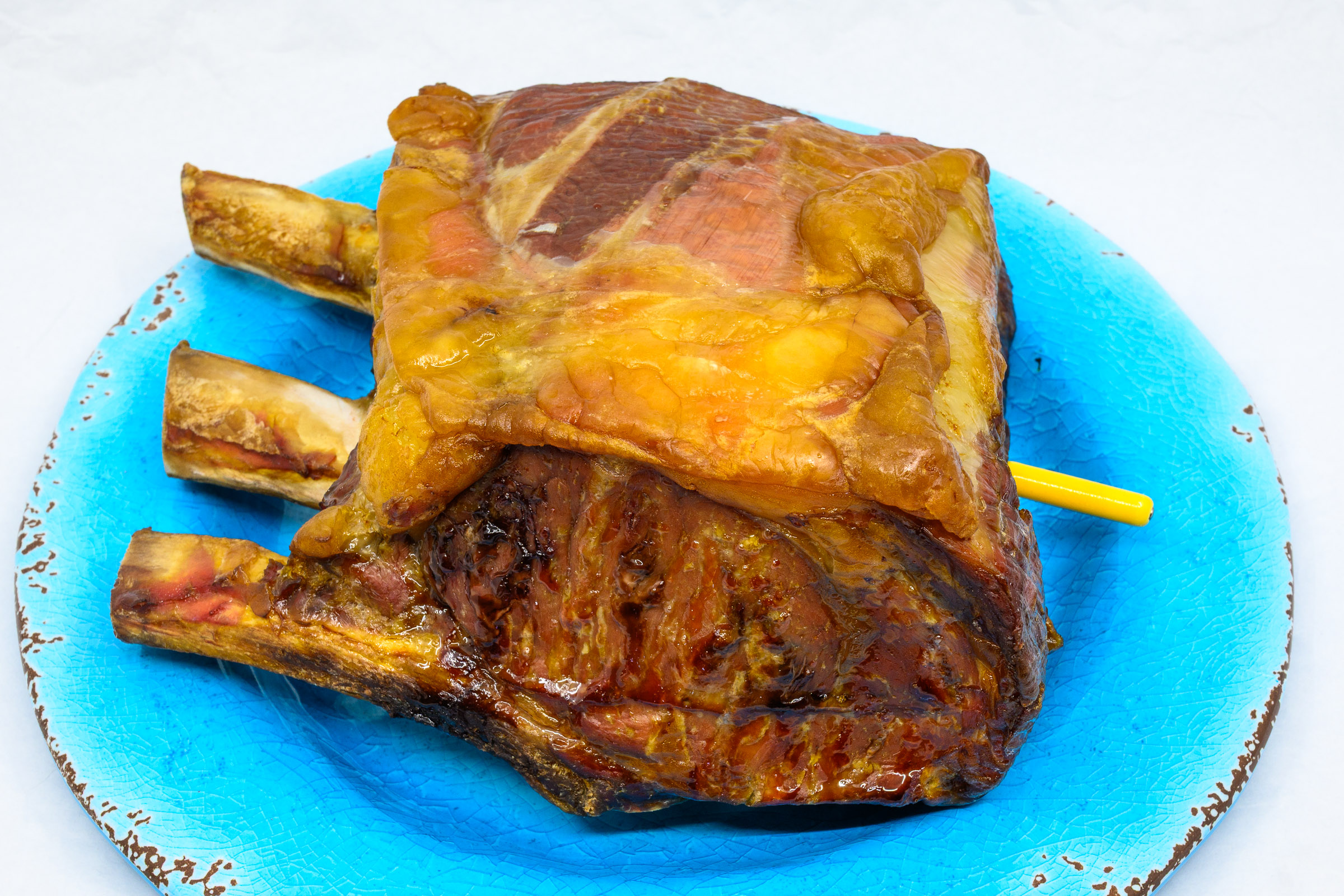
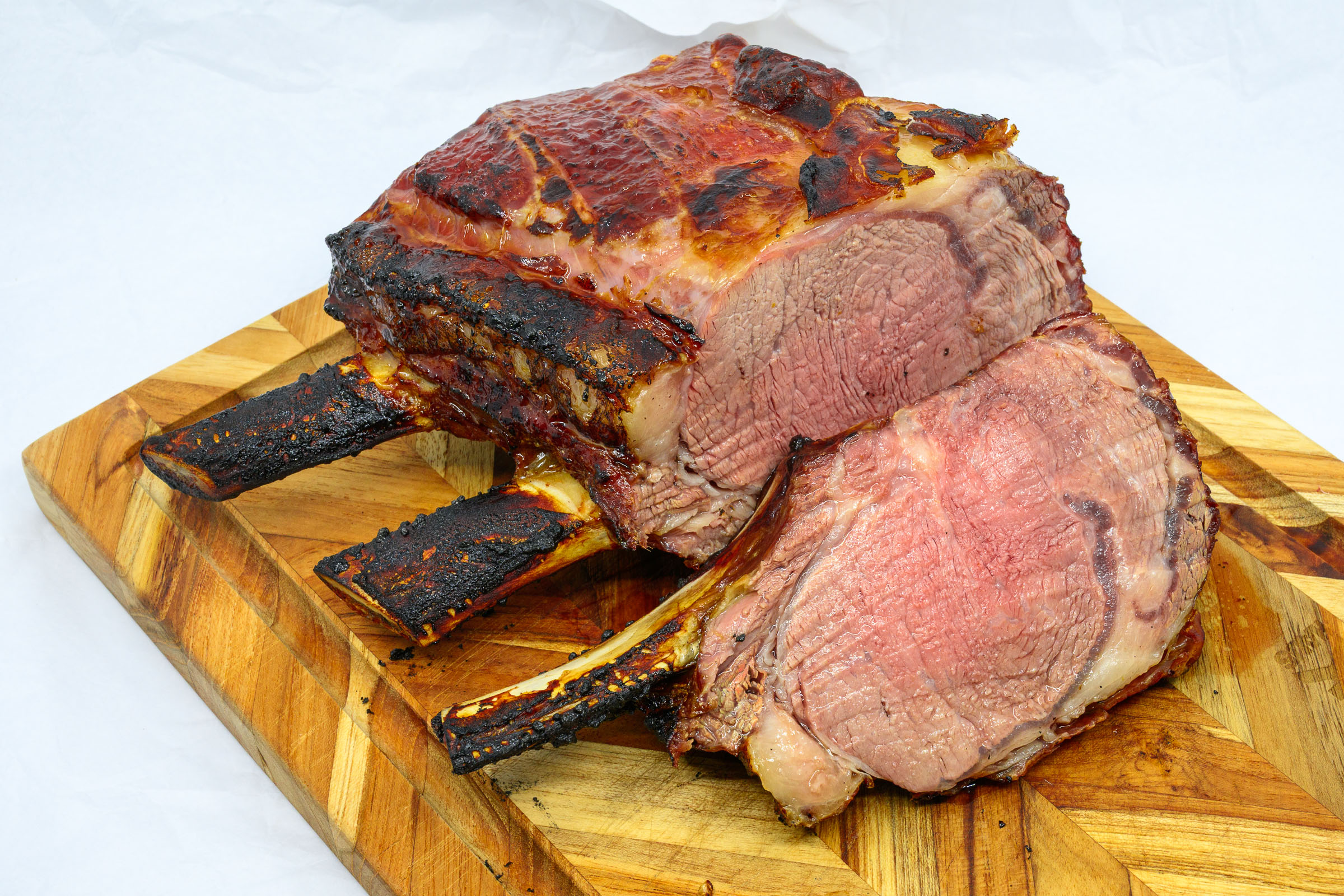
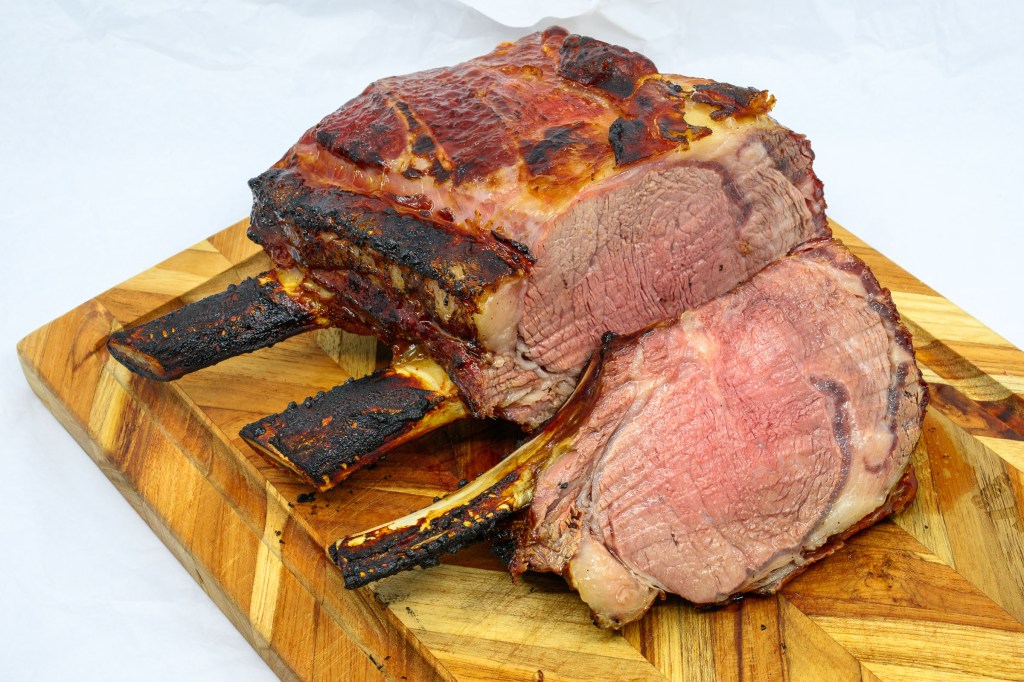
    It’s been a while since I’ve seen a standing rib roast[i] in a meat display. The last time I cooked a standing rib roast was for Christmas 2023. It was the day before I dropped a blade through my left foot and severed my extensor hallucis longus tendon[ii].

    I saw one on a shelf at my butcher’s yesterday.

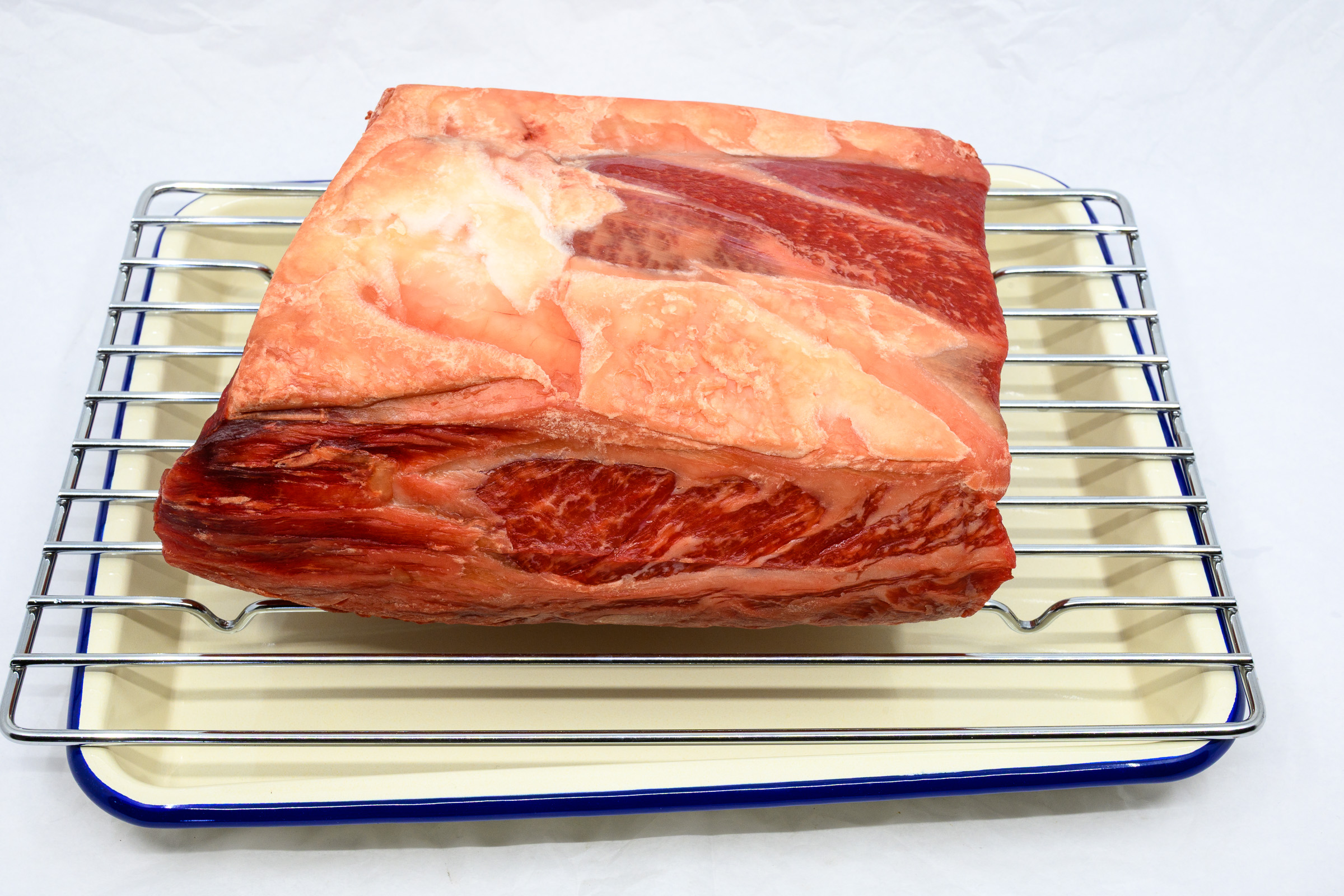
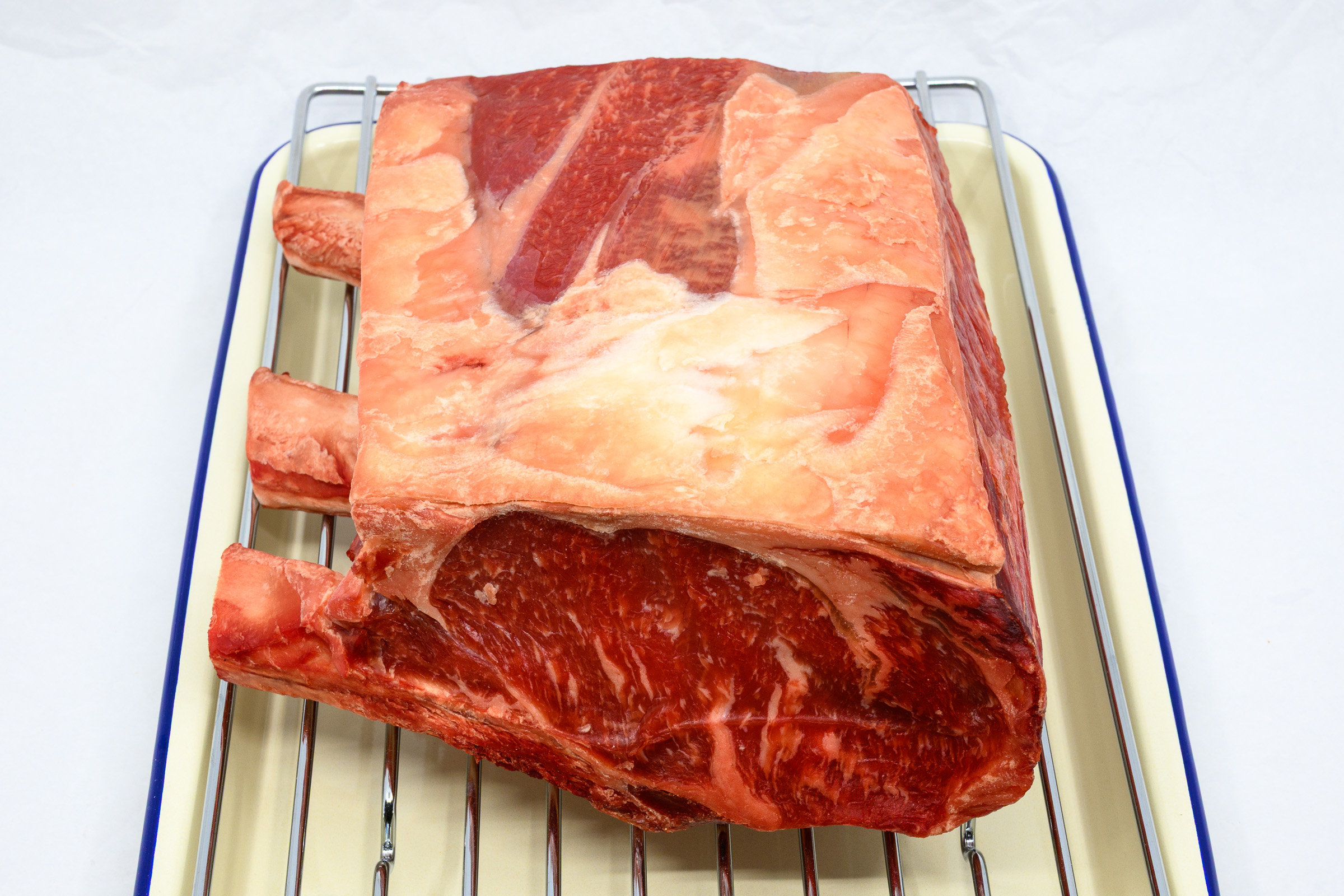
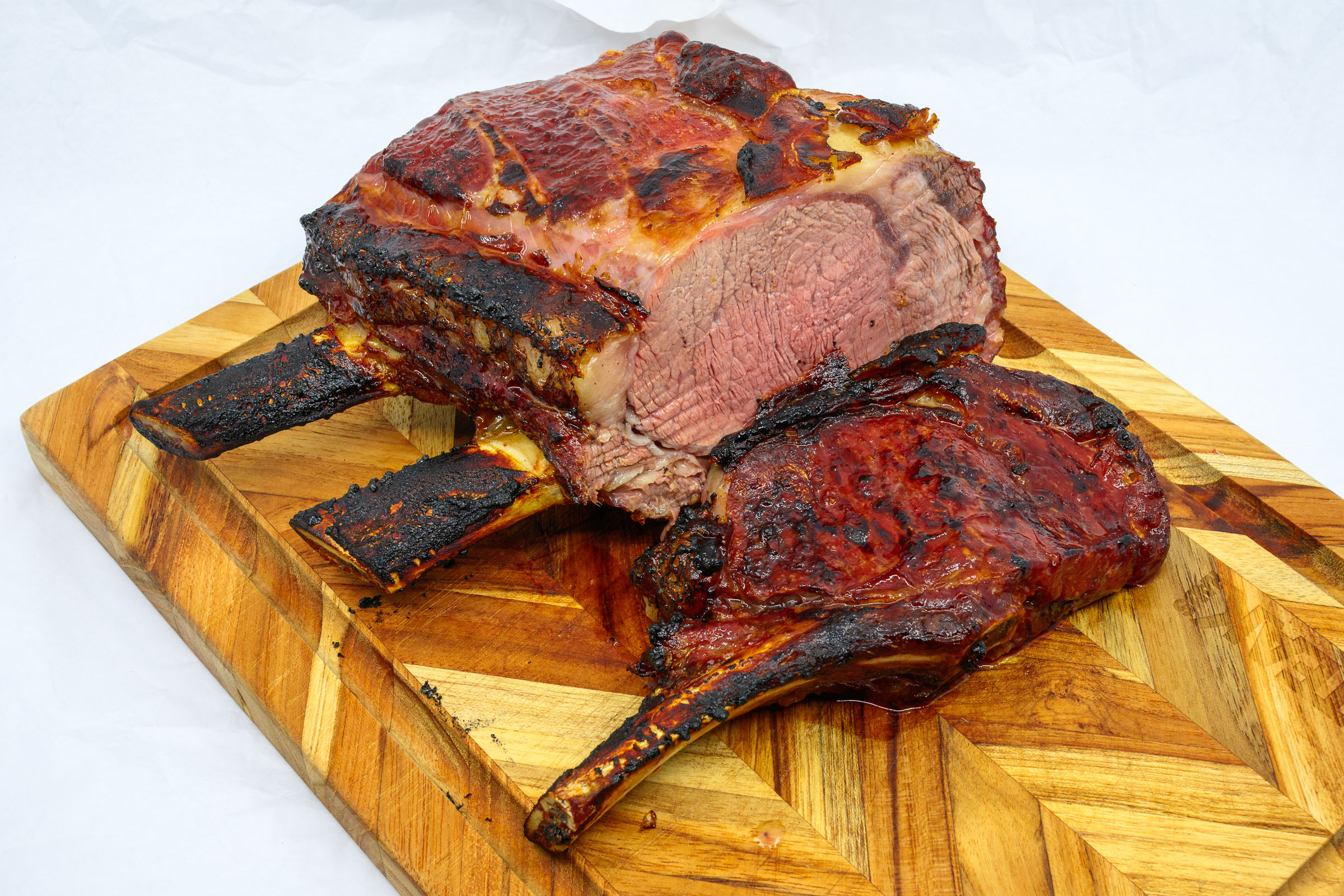
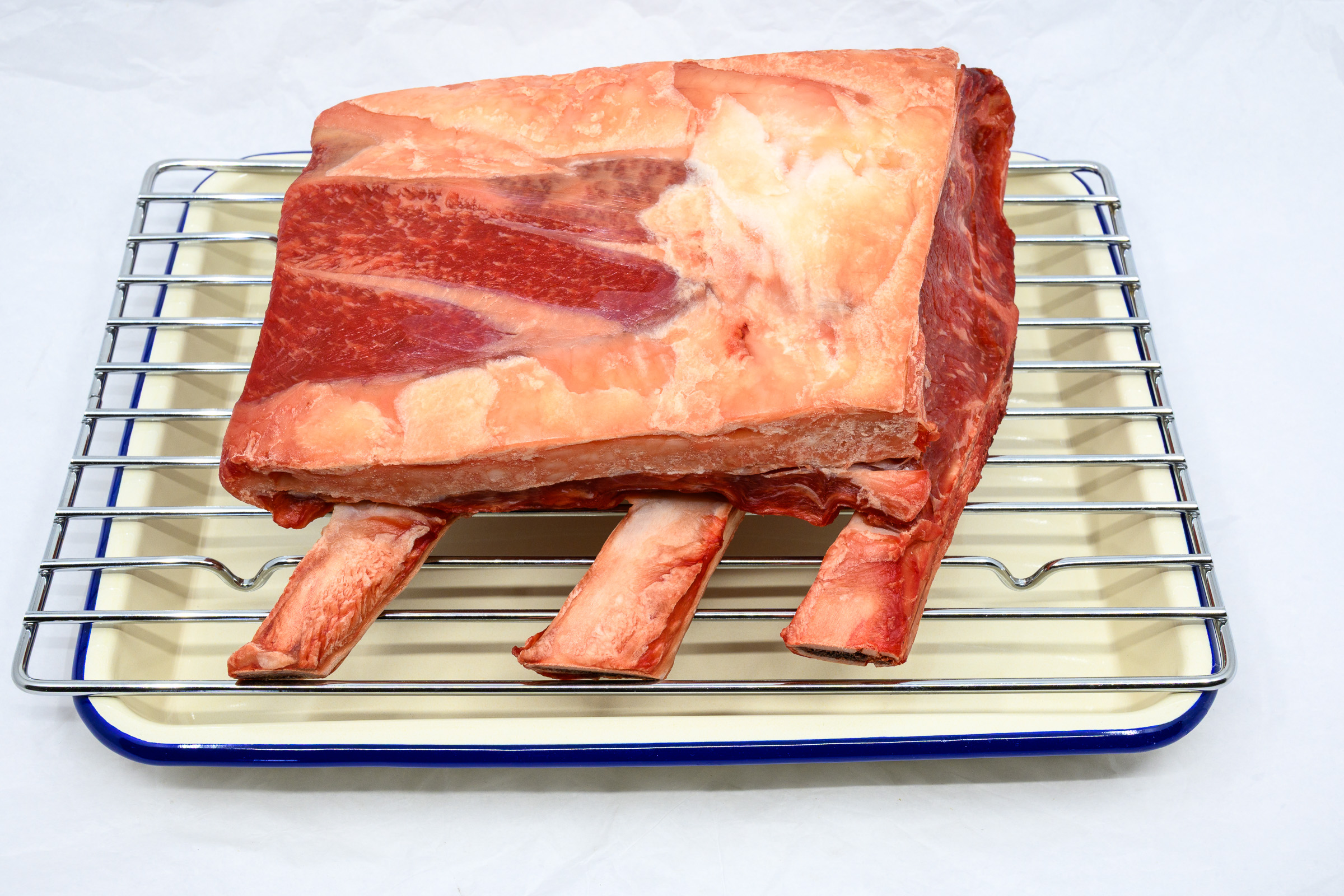
    Standing rib roast dry brined

    There’s nothing cheap or economical about a standing rib roast. It’s an expensive cut of meat. The muscles in a standing rib roast include the longissimus dorsi (the “eye” of the rib) and the spinalis dorsi (the marbled “cap” muscle), known for tenderness and flavour.

    A standing rib roast is usually a special occasion joint of meat. I’m using the long weekend as a reason! This weekend, four Australian jurisdictions will enjoy a gazetted public holiday tomorrow. The reason varies for each jurisdiction. I’ll be working, but I thought it was a good reason to cook something special. I’ll “celebrate” the long weekend virtually with team-mates in jurisdictions with the public holiday.

    This joint of meat will provide a plentiful bounty of leftover meat to enjoy during the week, especially cold cuts, while I’m in the office.

    What’s happening today?

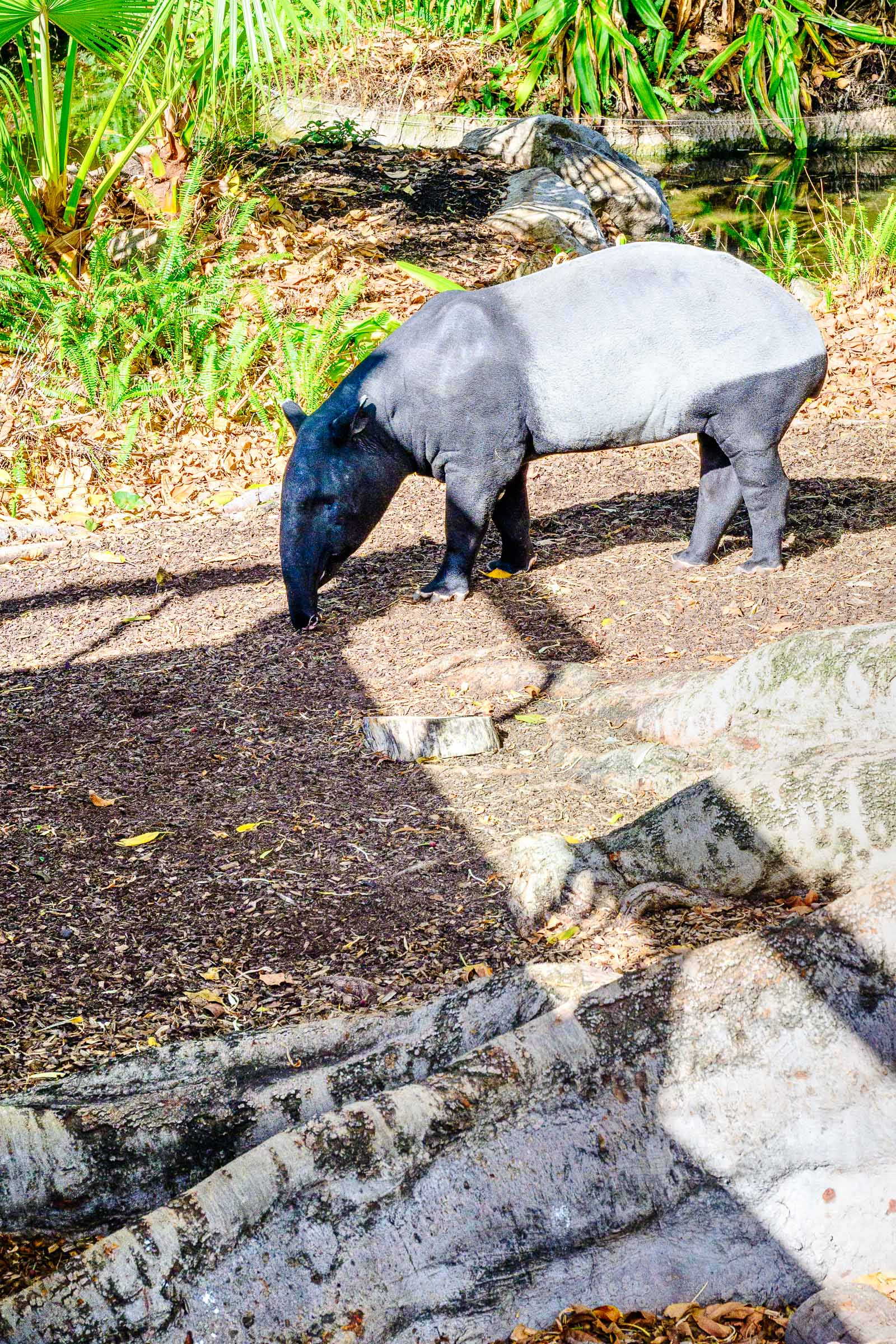
    I took a short trip to the zoölogical gardens and saw the white-cheeked gibbon out and about. Normally, this gibbon sits in its box atop a tree.

    As I mentioned in yesterday’s post, today the Dolphins are playing South Sydney in round one of the Telstra Premiership[iii] in the National Rugby League competition.

    Screenshot from MacBook from nrl.com of the Dolphins versus South Sydney game being played at Lang Park in Brisbane Sunday 8 March 2026.
    Screenshot from nrl.com of the Dolphins versus South Sydney game being played at Lang Park in Brisbane Sunday 8 March 2026.

    The first game of the season (win or lose) is another good reason to cook something nice. Something beefy seemed to make sense in my head.

    As I ate this meal, full time sounded as South Sydney had defeated the Dolphins.

    Recipe

    Ingredients

    • Standing rib roast (1.6 kg with the bones, at $AUD49.99/kg)
    • Leftover blue vein cheese and mustard sauce (cold)
    • Flaky salt
    • Freshly cracked black peppercorns

    Equipment

    • Benchtop oven
    • A wireless meat thermometer that is monitored with a smart device app
    • Weber Q+ barbecue grill with hood
    • Gas torch

    Instructions

    1. Dry-brine the meat overnight in the refrigerator, uncovered.
    2. Heat the oven to the lowest setting. The aim is to cook the meat gently.
    3. Insert the thermometer into the thickest part of the muscle meat, not touching any of the rib bones.
    4. Place the meat on a wire rack and suspend it over a baking tray to allow hot air to circulate above and below the roast.
    5. Keep the meat in the oven until the middle of the roast reaches about 54 °C.
    6. Take the meat out of the oven and allow it to rest on a bench at room temperature for about 30 minutes.
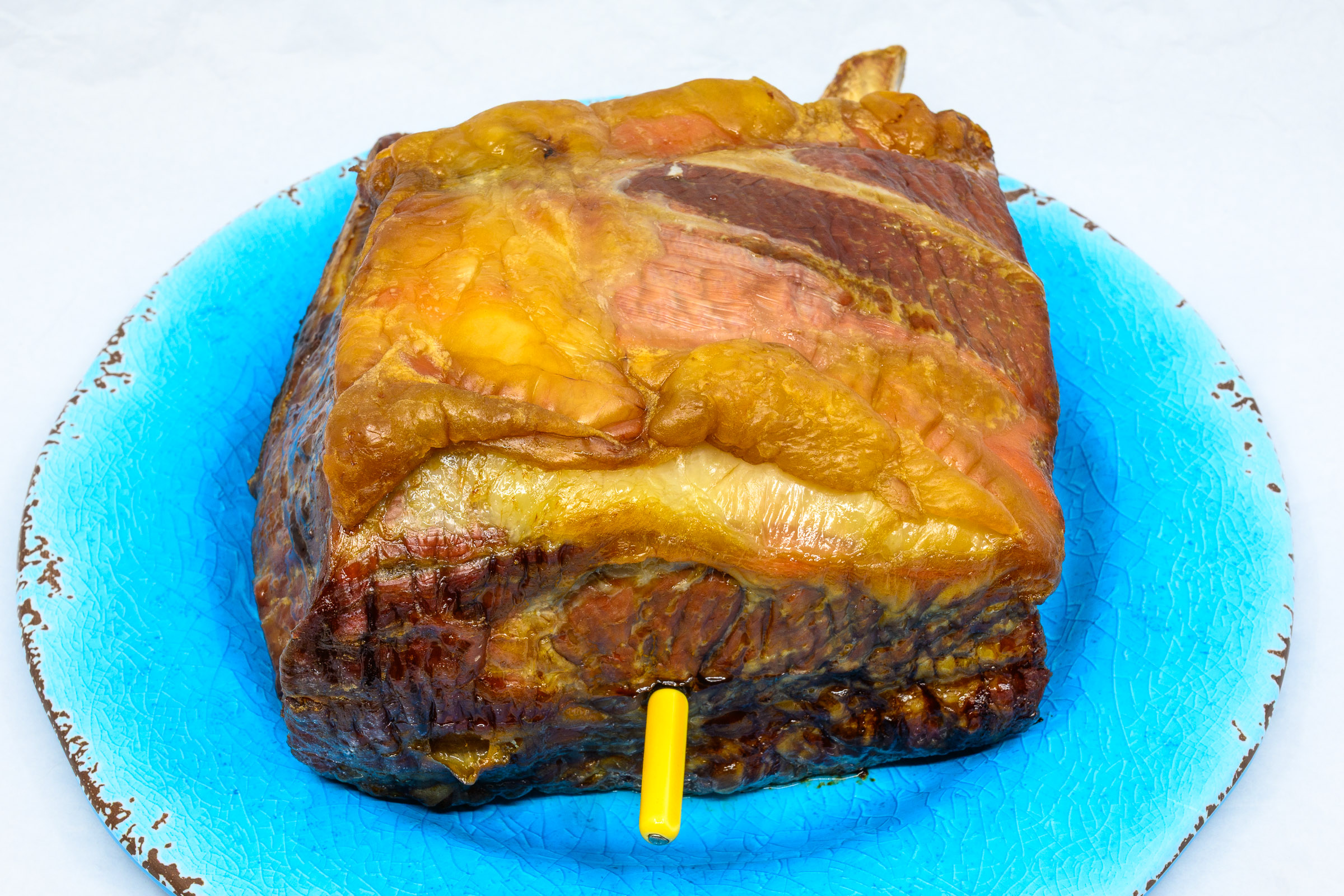
    7. Heat the Weber Q+ until the barbecue’s temperature dial reaches about 150 °C, then place the roast on the cast-iron grill and close the lid.
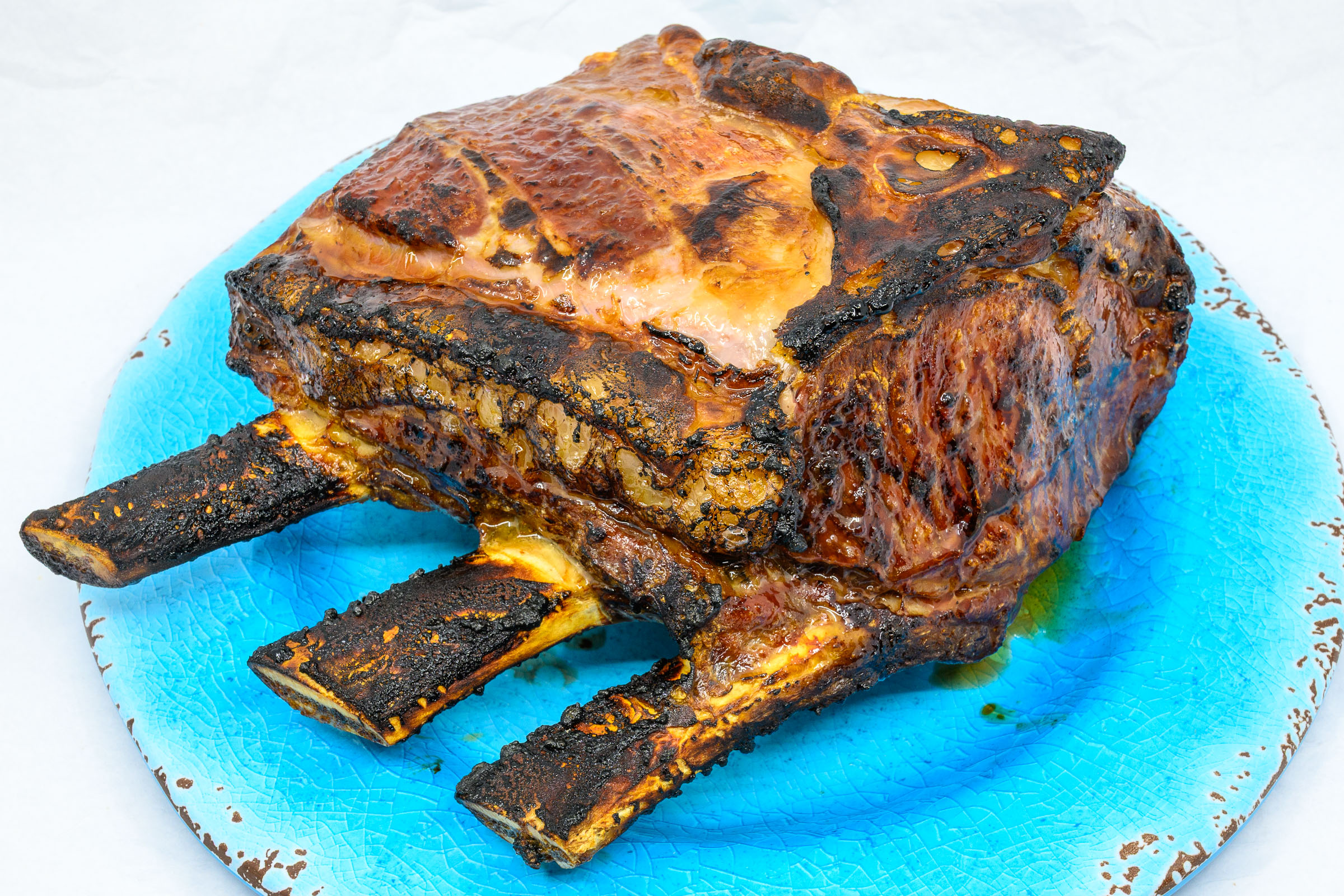
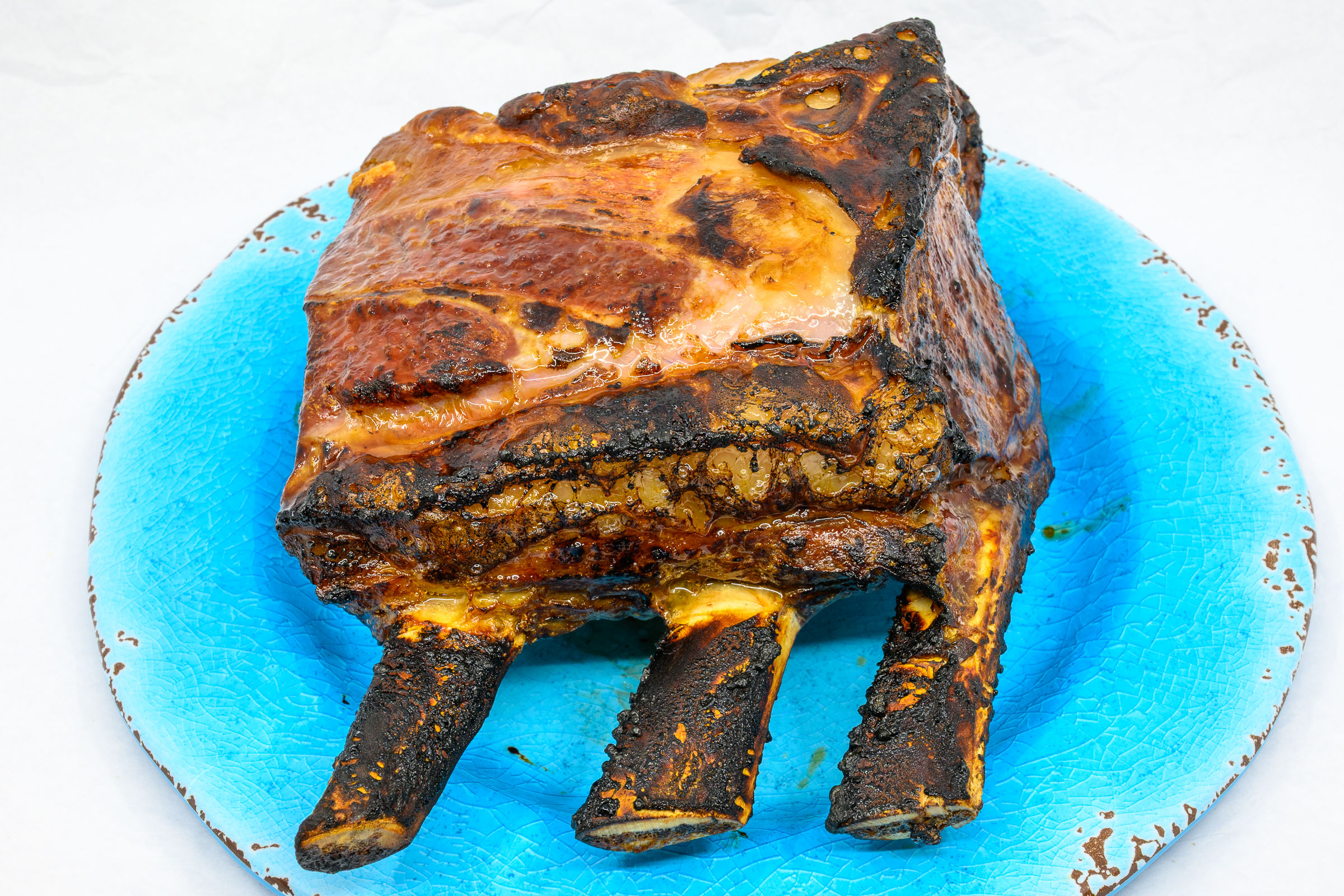
    8. Cook at high heat for about 10 minutes to caramelise the meat’s outer surface. Add a finishing caramelising touch with a gas torch.
    9. Put the roast on a cutting board and slice the meat with a sharp knife.
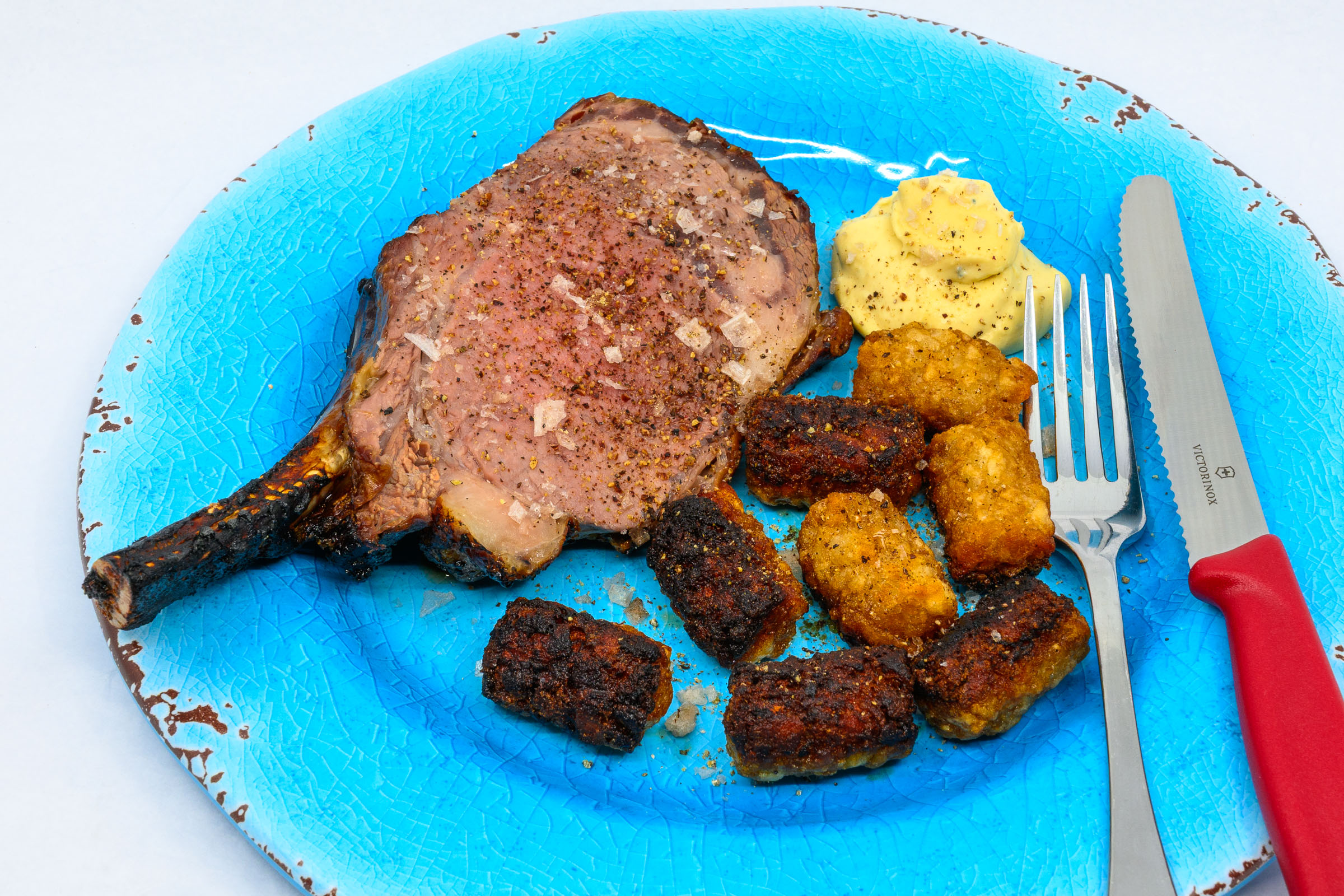
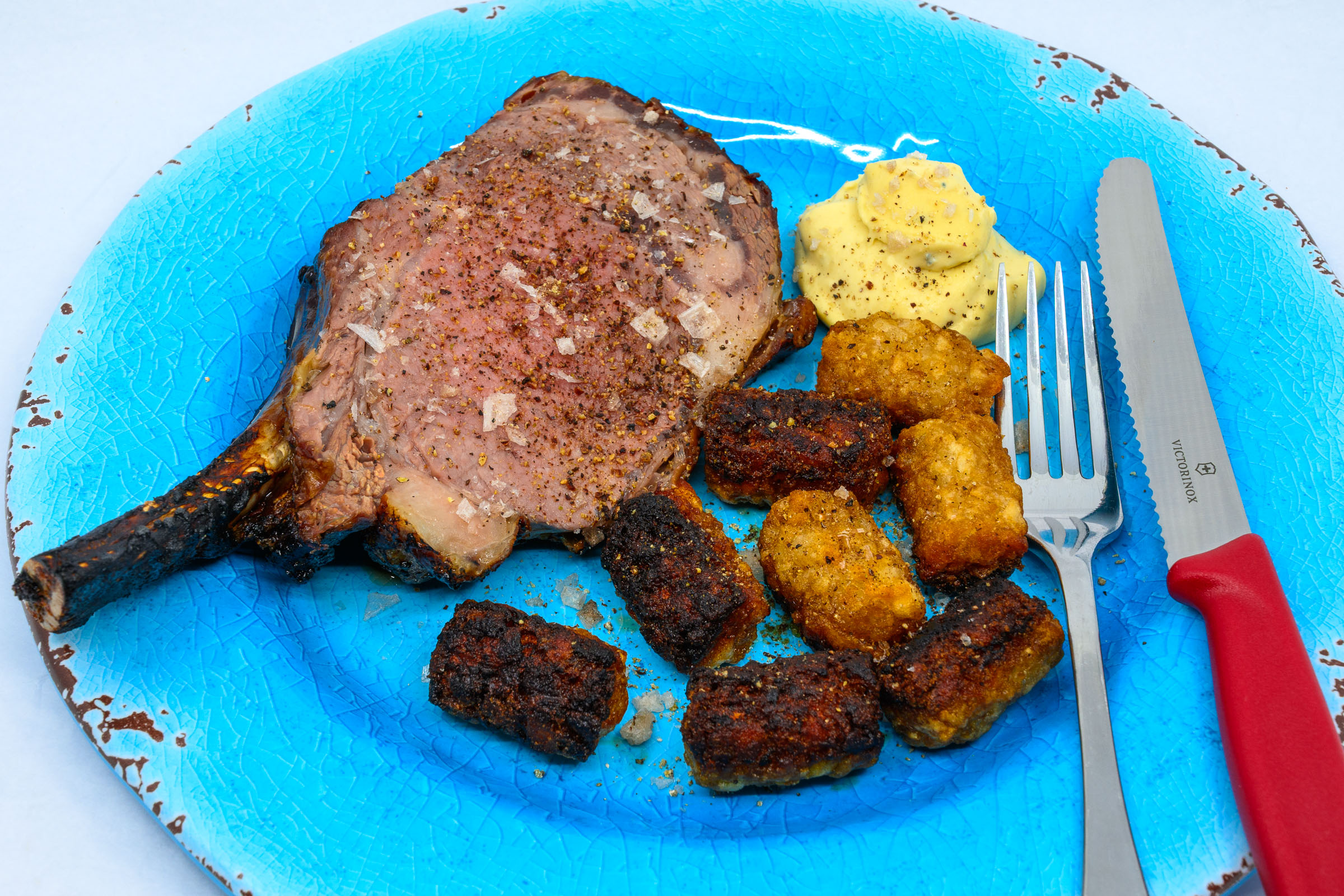
    10. Season the slice with flaky salt and freshly cracked pepper.
    11. Serve with the leftover cold blue vein cheese and mustard sauce from yesterday’s T-bone steak meal.
    12. I also tossed a few potato gems onto the cast-iron flat plate while the roast rested. The potato gems were fried in the leftover beef and pork fat, resulting in crispy gems.

    My thoughts about the meal

    The slice I ate tonight cost me about $AUD25. I reckon if I’d bought this in a restaurant, it would have set me back at least $AUD60, based on my recent dining-out experiences.

    I’m not a people person, and I don’t enjoy eating out, so a meal like this, one I can cook and enjoy, makes more sense.

    The meat was tender, and gnawing on it from the rib bone was very enjoyable.
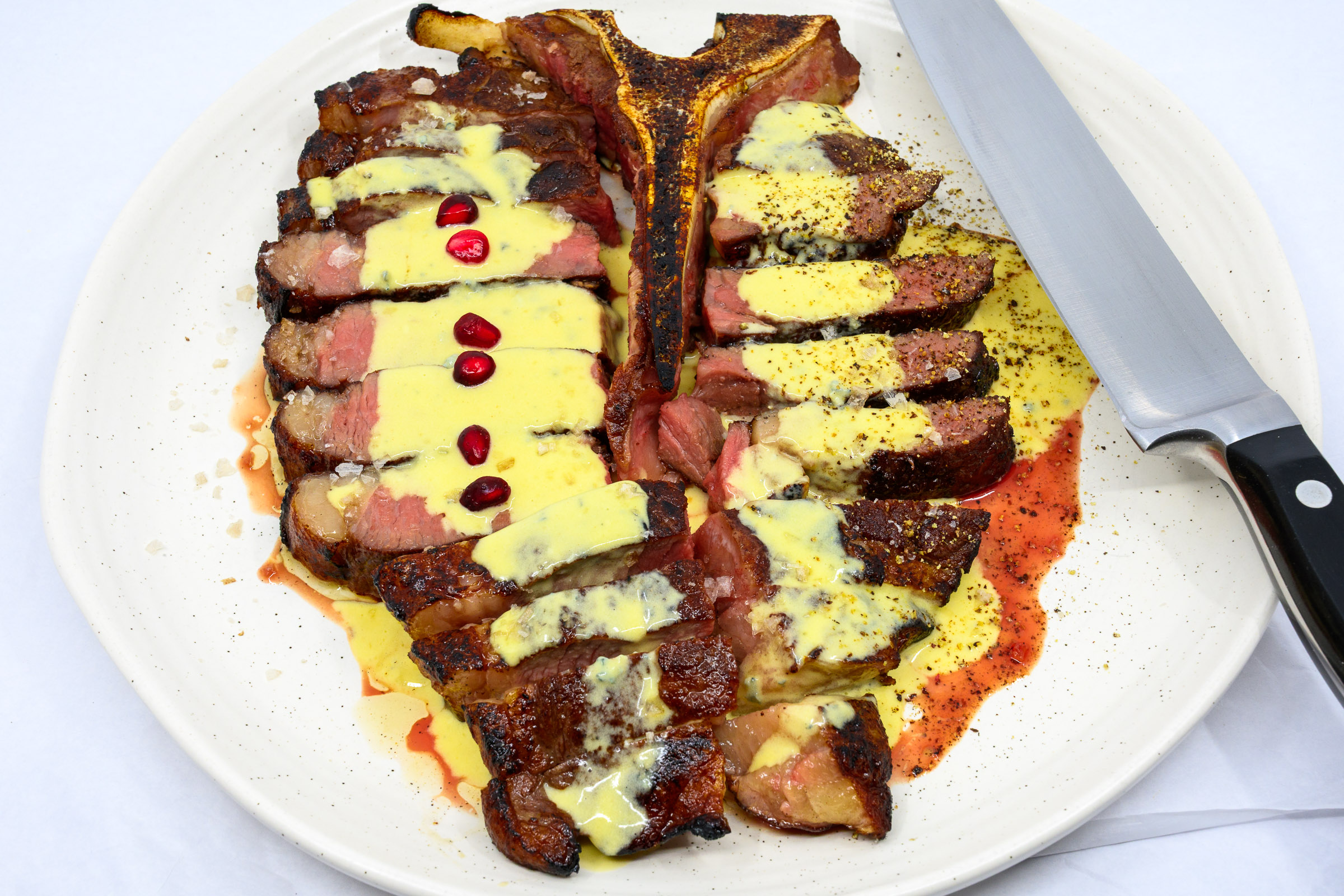
    The blue vein cheese and mustard notes from the cold sauce also added a flavour dimension.

    The leftover meat is going to fill me with joy this week.

    Photographs of the meal


    [i] A standing rib roast is a beef cut taken from the rib primal (usually ribs 6–12), known for its marbling, tenderness, and presentation. It is typically cooked “standing” on its rib bones, which act as a natural roasting rack and help keep the meat juicy.

    [ii] The extensor hallucis longus tendon is the long, thin tendon on the top of your foot that lifts (extends) your big toe. It is the visible, cord‑like structure that pops up when you raise your big toe toward your shin. It is the distal continuation of the extensor hallucis longus muscle, which sits along the front of the lower leg.

    [iii] The Telstra Premiership is the National Rugby League’s (NRL) main professional rugby league competition in Australia, named after its major sponsor, Telstra. It’s the top-tier men’s rugby league competition across Australia and New Zealand, featuring 17 clubs competing from late summer through early spring each year.

  • Autumn menu

    Autumn menu


    This post isn’t really about an autumn menu. I just needed a title for the post!

    I did a bit of travel this week and got to see some friends and eat out, too.

    Full length bathtub for a soak

    One of my friends I visited asked me about my current habitus[i] and approach to nutrition. She was interested in the fact that most of my food consumption is beef and lamb, and little else. I explained that, in many ways, it’s a restricted approach because it makes me feel better, and I no longer suffer from intestinal discomfort. My bowel movements are less frequent, and my stools are well-formed. I also no longer experience constant abdominal discomfort.

    I also explained that, from time to time, when I experiment and go beyond beef and lamb, I notice changes in how I feel and in my symptoms.

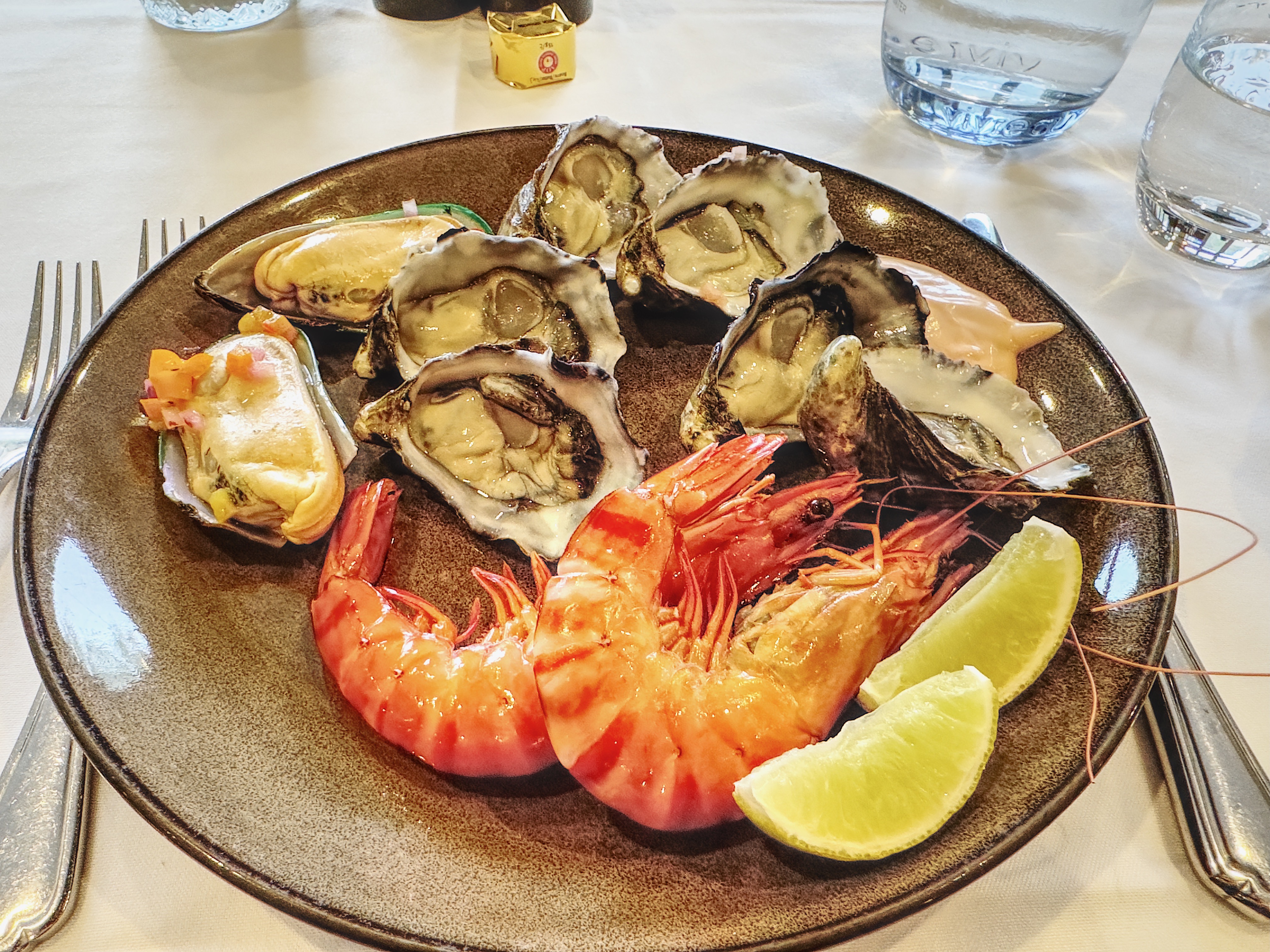
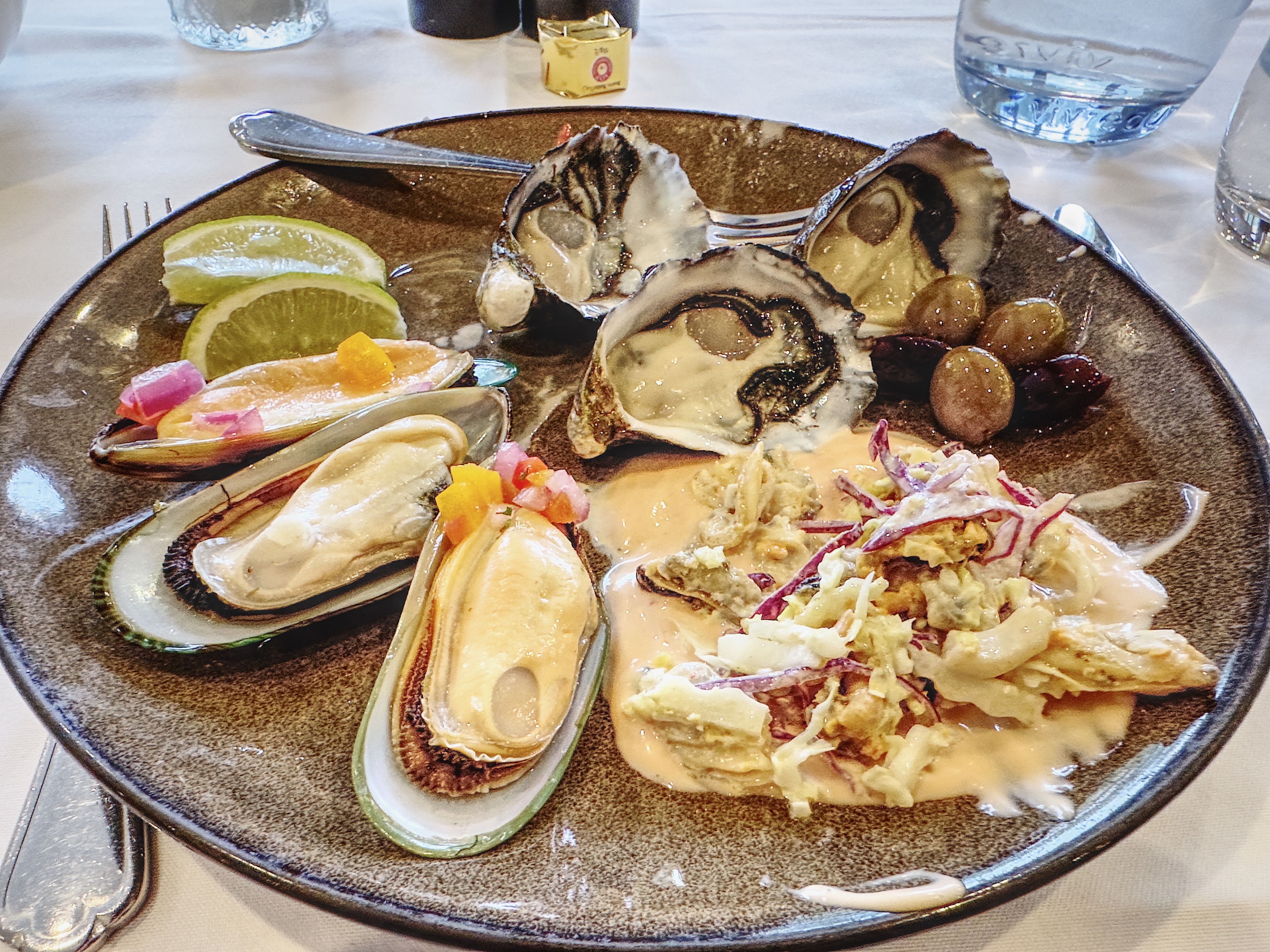
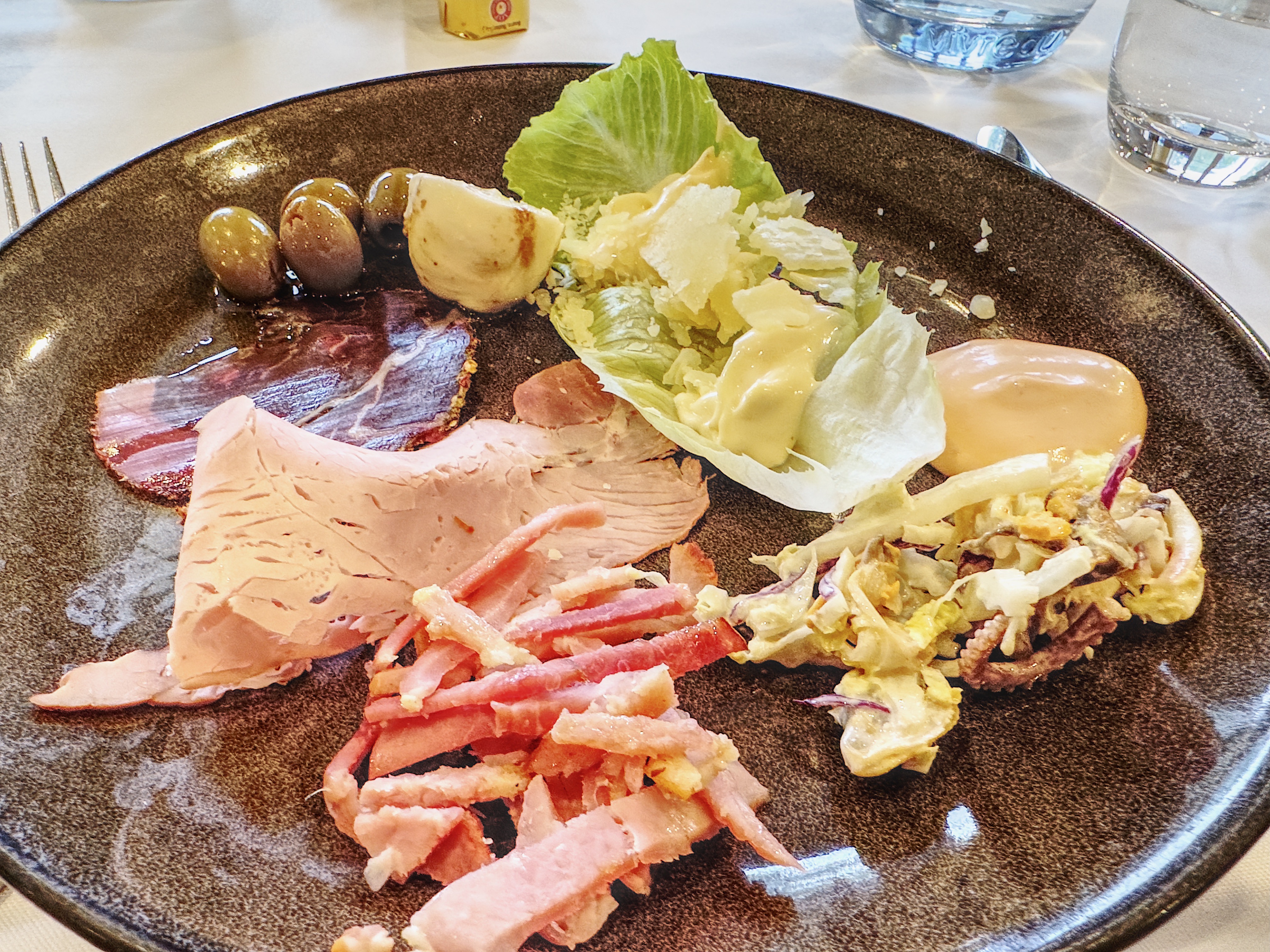
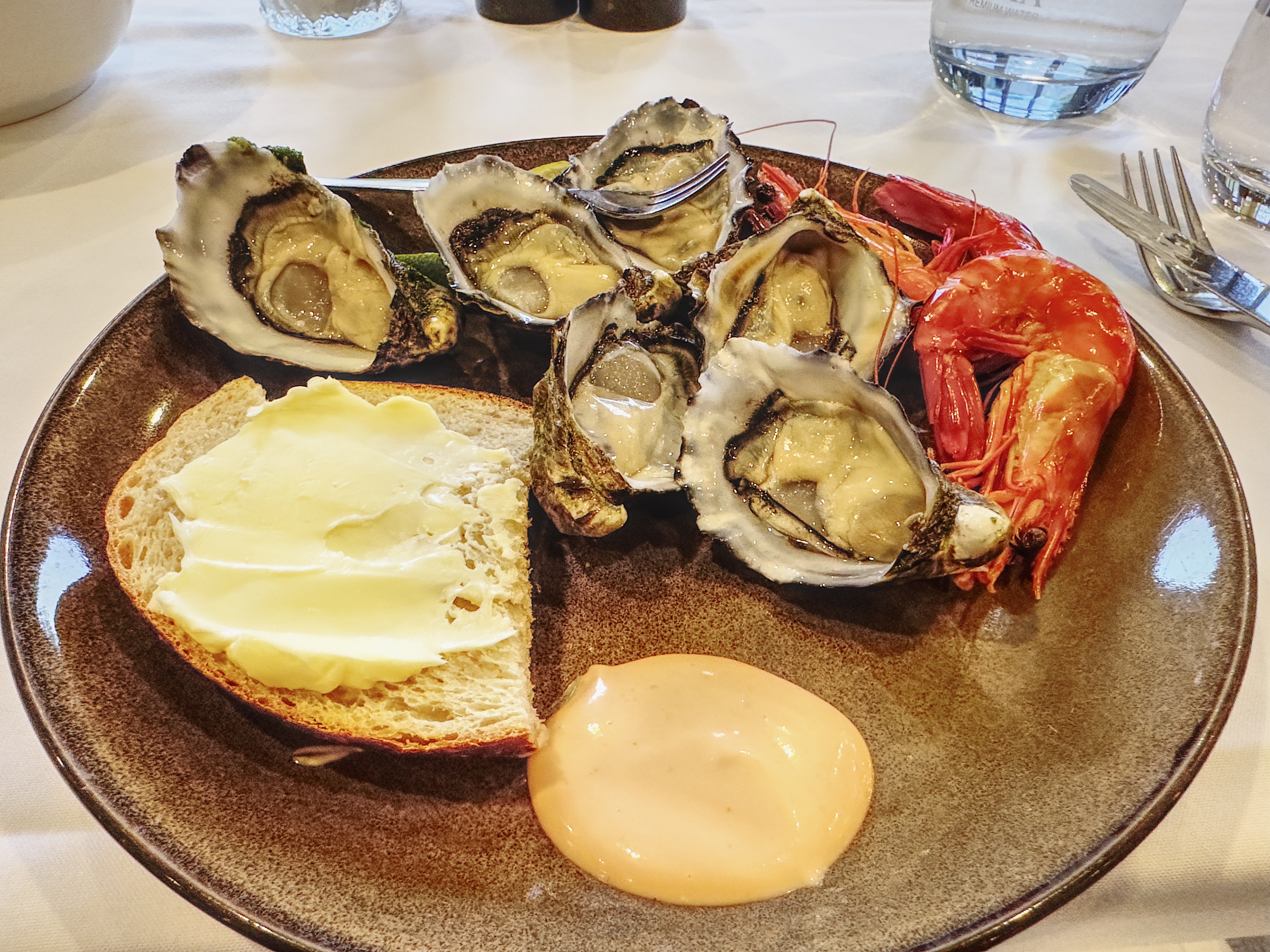
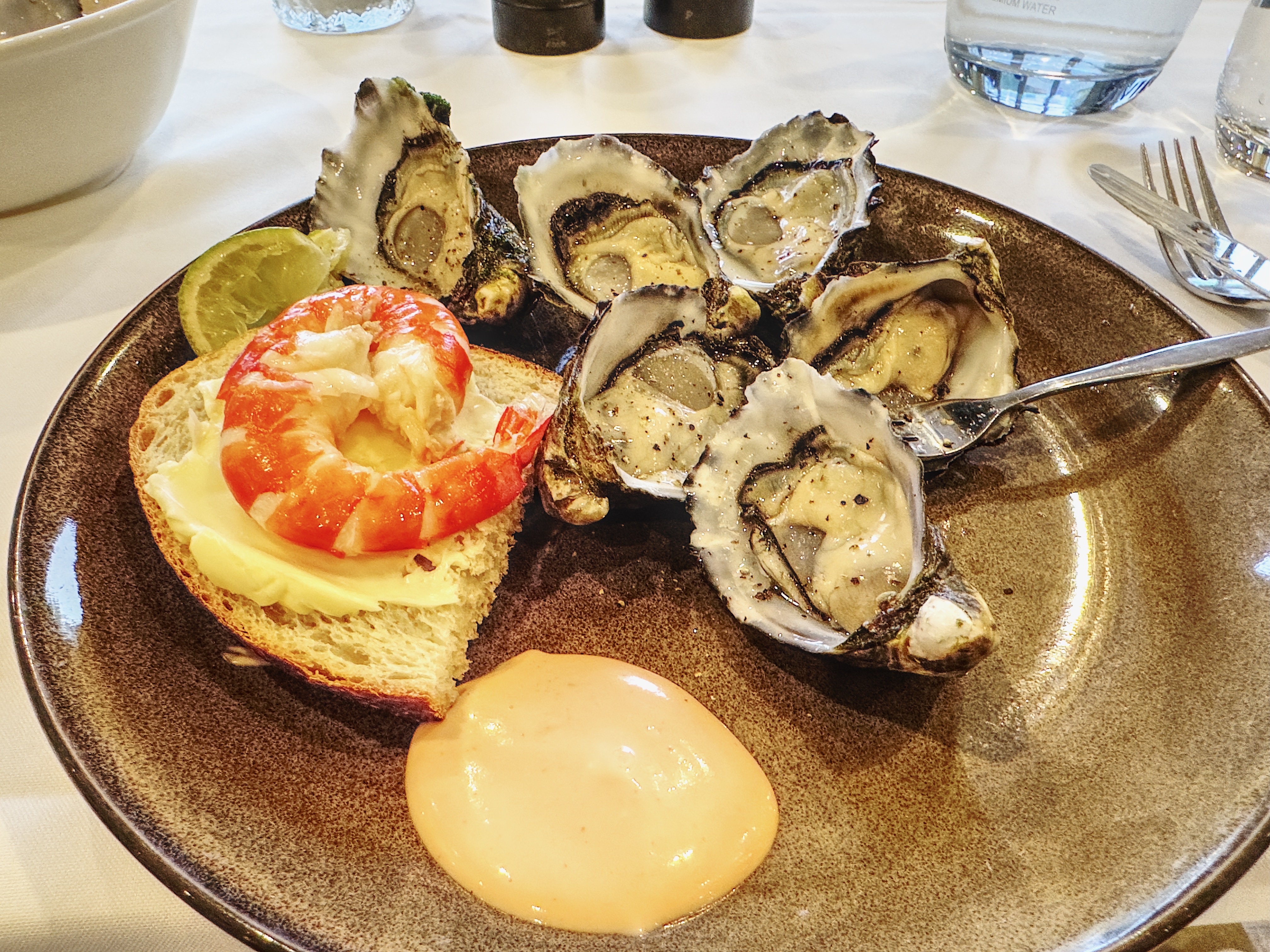
    While I was away, I found a restaurant that offered a buffet dinner with seafood constituting a good proportion of the fare. It’s been a while since I’ve enjoyed a meal of oysters, prawns, and mussels. I couldn’t resist enjoying an open prawn sandwich with a slice of sourdough bread and some French butter.

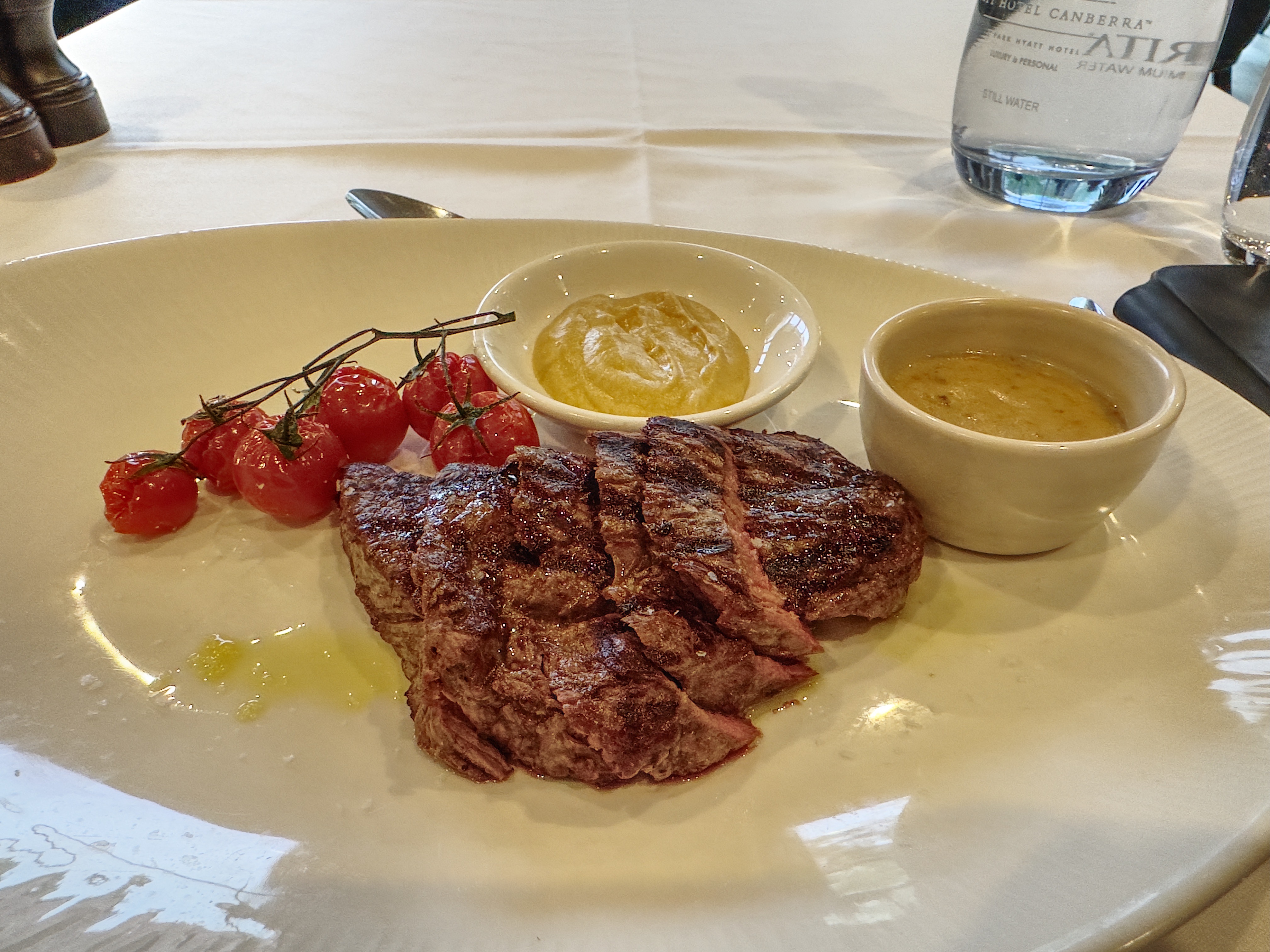
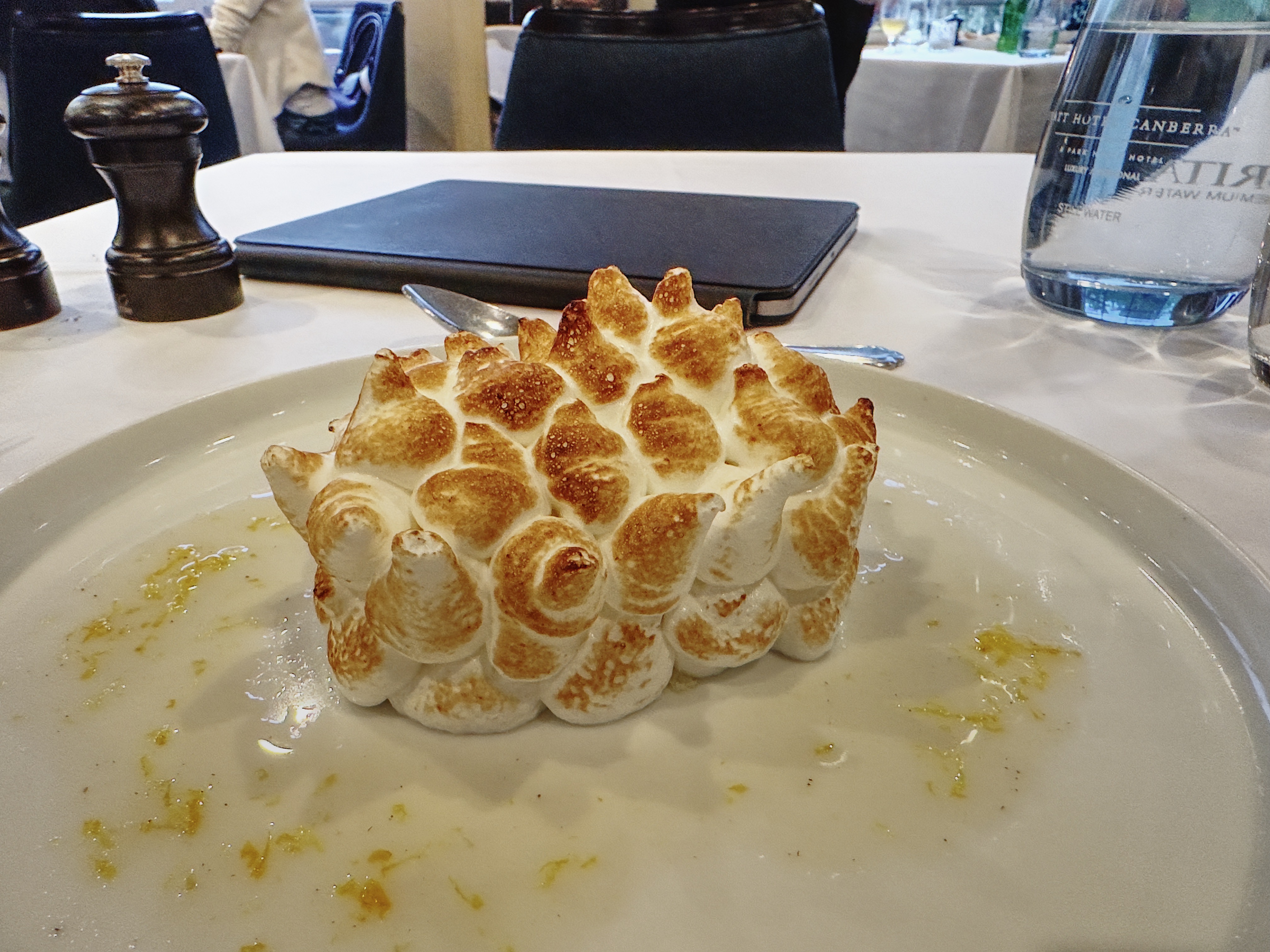
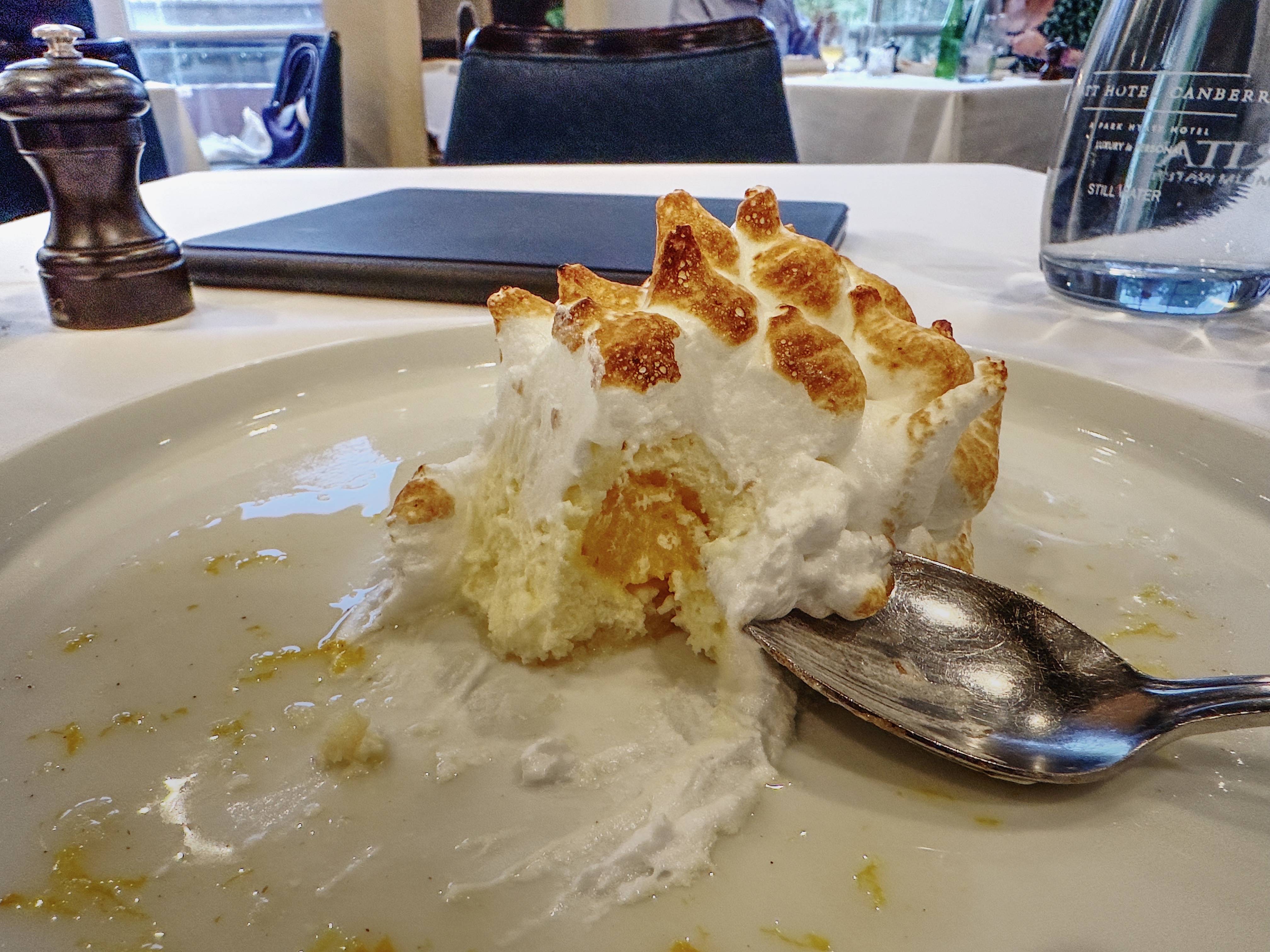
    On another night, I ate a rather tough piece of rump steak, followed by a passionfruit bombe Alaska[ii] cheesecake, which was most enjoyable.
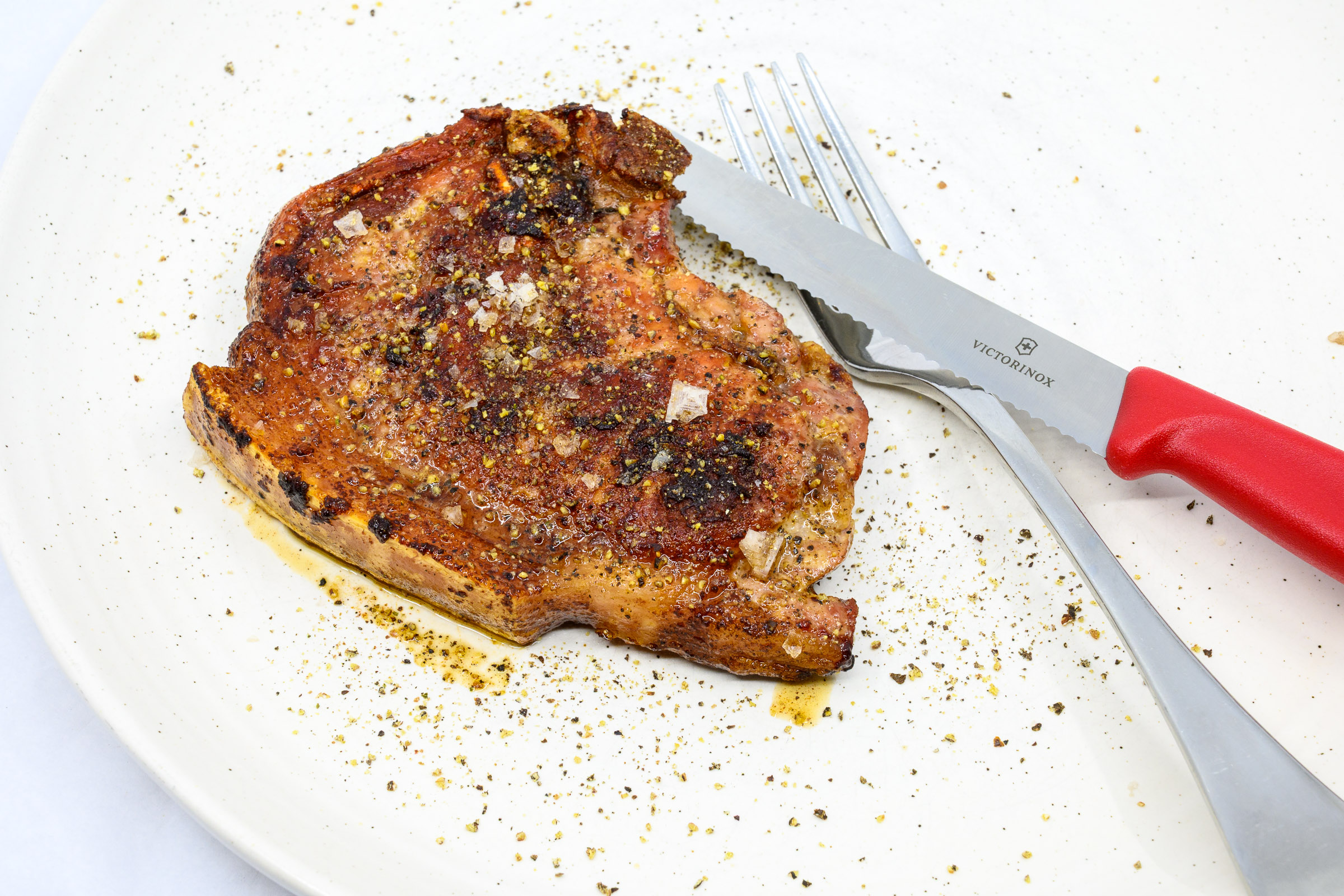
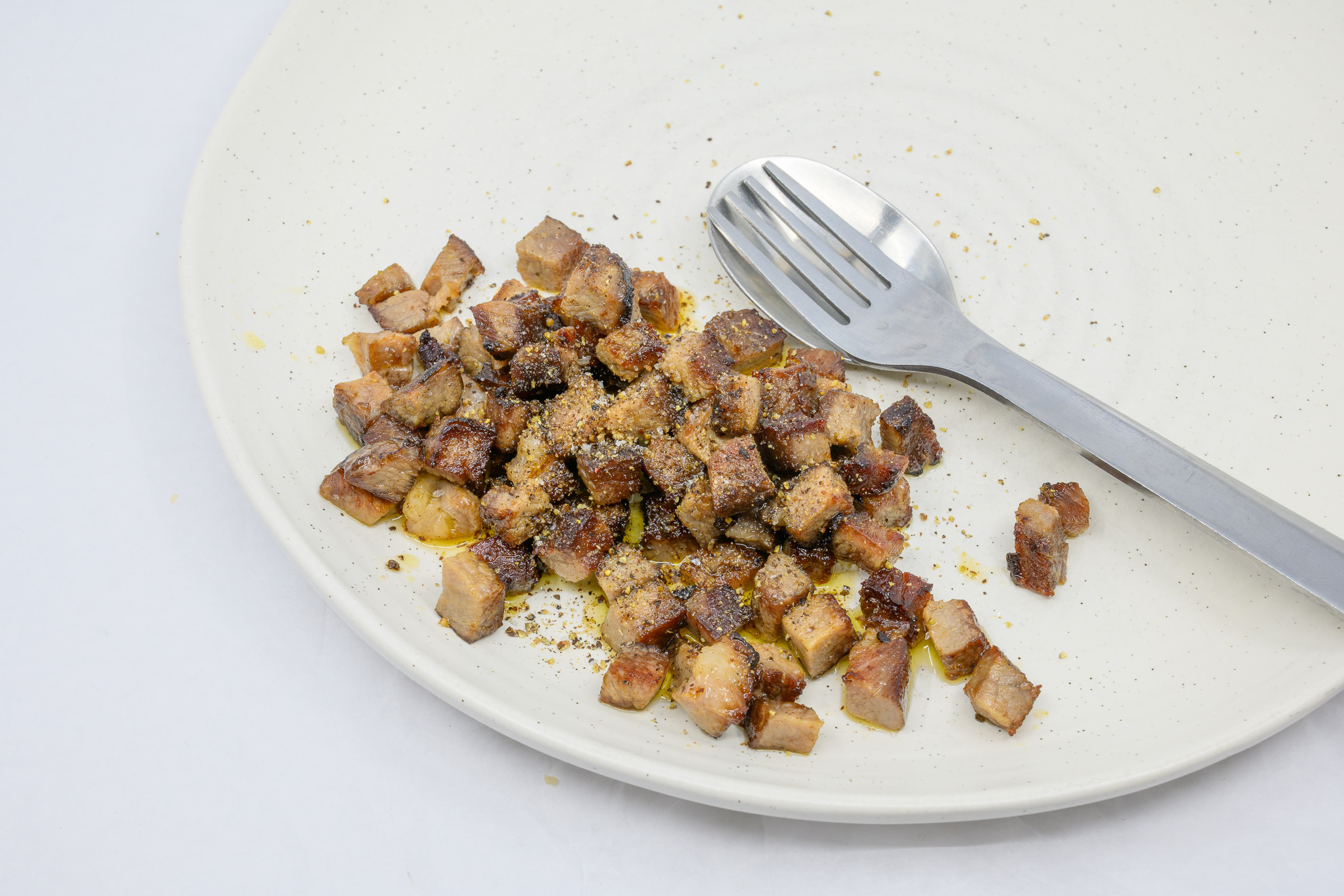
    To mix things up, I bought some pork chops and cooked one for today’s lunch.

    Pork chop

    As I was cooking it, the smell of pork fat had me drooling like a Pavlovian dog and mimicking Homer Simpson.

    What have I been listening to this week?

    I listened to an interview with Anthony Daniels, whose pen name is Theodore Dalrymple. He is well known as a medical practitioner (specialist psychiatrist) and author of the book Life at the Bottom, which compiles essays based on his interactions with thousands of patients, many of whom had attempted suicide and were victims or perpetrators of crime, particularly domestic abuse.
    The interview covers the dramatic increase in crime rates since the early 20th century, which cannot be explained by genetics or economic inequality but is linked to changes in social attitudes and mental states. Daniels contrasts past policing methods, emphasising the decline in respect for law enforcement and the weakening of punishment. He highlights lenient sentencing practices and media silence on actual prison time served, noting public support for harsher punishments despite elite disdain for such views. The erosion of social order and the rise of permissiveness are cited as contributors to increased violence and crime.
    The conversation touches on cultural influences such as the global spread of American rap culture, which Daniels finds repellent due to its violent and misogynistic content. They discuss the decline of social decorum, including the normalisation of vulgar language and informal dress, contrasting current trends with past societal norms of formality and refinement. Daniels reflects on the loss of intellectual and moral refinement in the working class and the impact of deindustrialisation and ideological permissiveness on these changes.

    The interview with Louise Perry examines the social, cultural, and psychological dimensions of poverty, crime, and societal dysfunction in contemporary Britain, as seen through the experiences and observations of Anthony Daniels.

    What have I been watching?

    Mission Impossible: Dead Reckoning (Part One)

    Ethan Hunt and his IMF team confront a rogue artificial intelligence known as the Entity, racing across the globe to prevent it from falling into the wrong hands. As shifting alliances and hidden motives complicate the mission, Ethan must navigate betrayal, relentless pursuit, and the moral cost of safeguarding humanity.

    What will I be watching?

    This weekend is the end of round one for the new National Rugby League season. Tomorrow the Dolphins play against South Sydney.

    I’m hoping the Dolphins win.

    Dolphins NRL Phins Up cushion and a cap

    Tonight’s meal

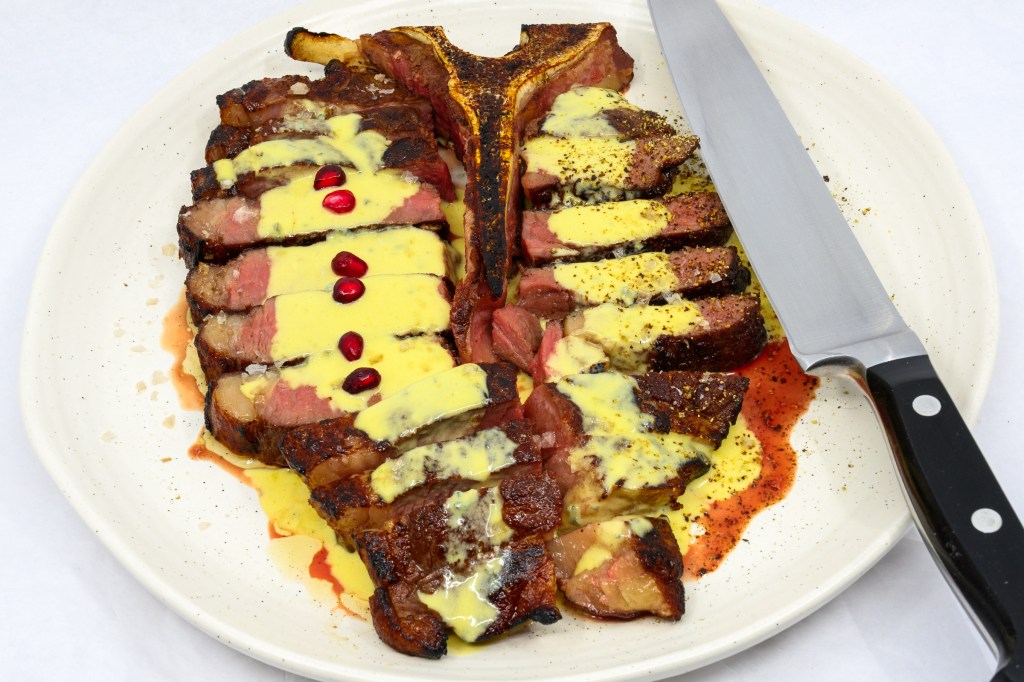
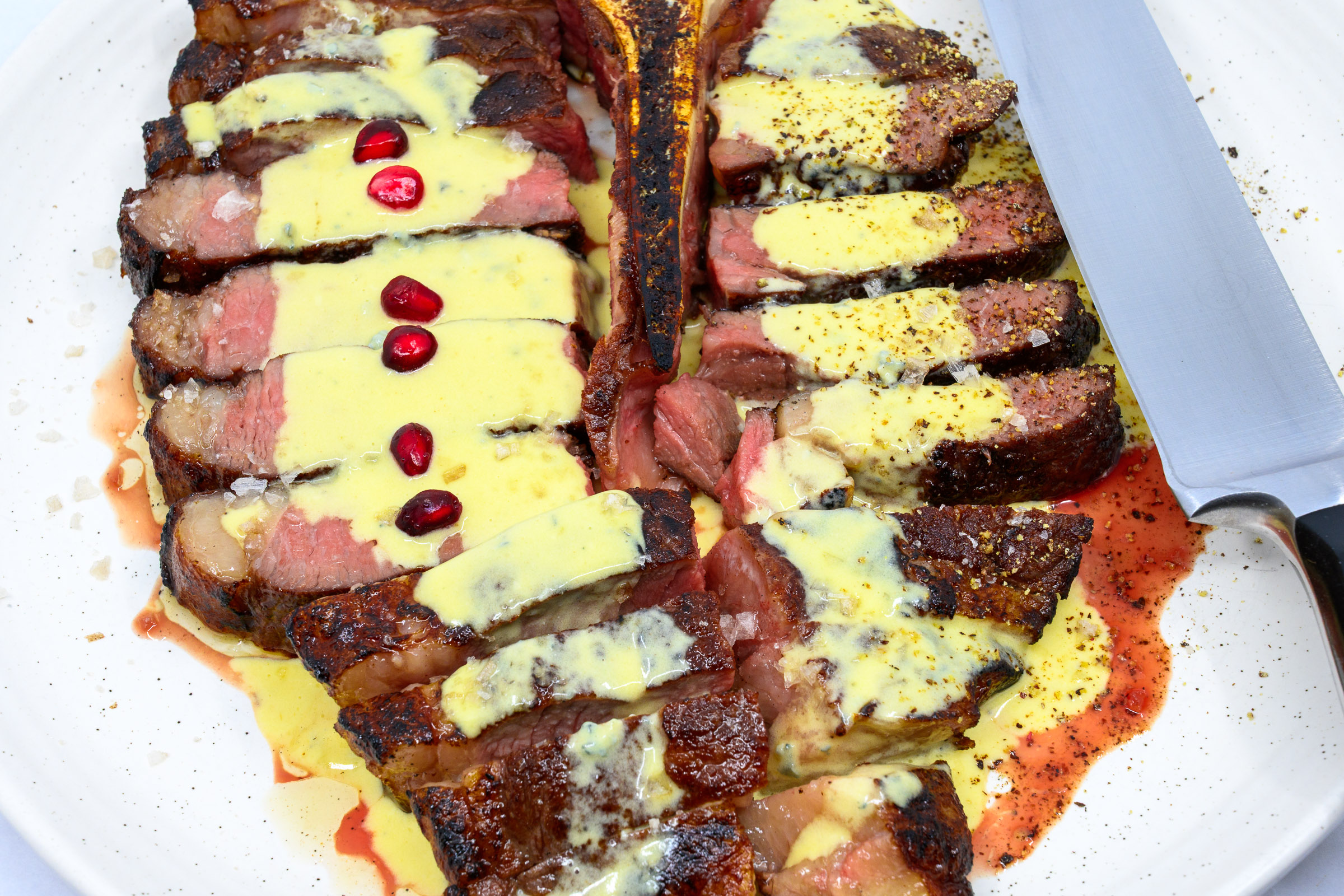
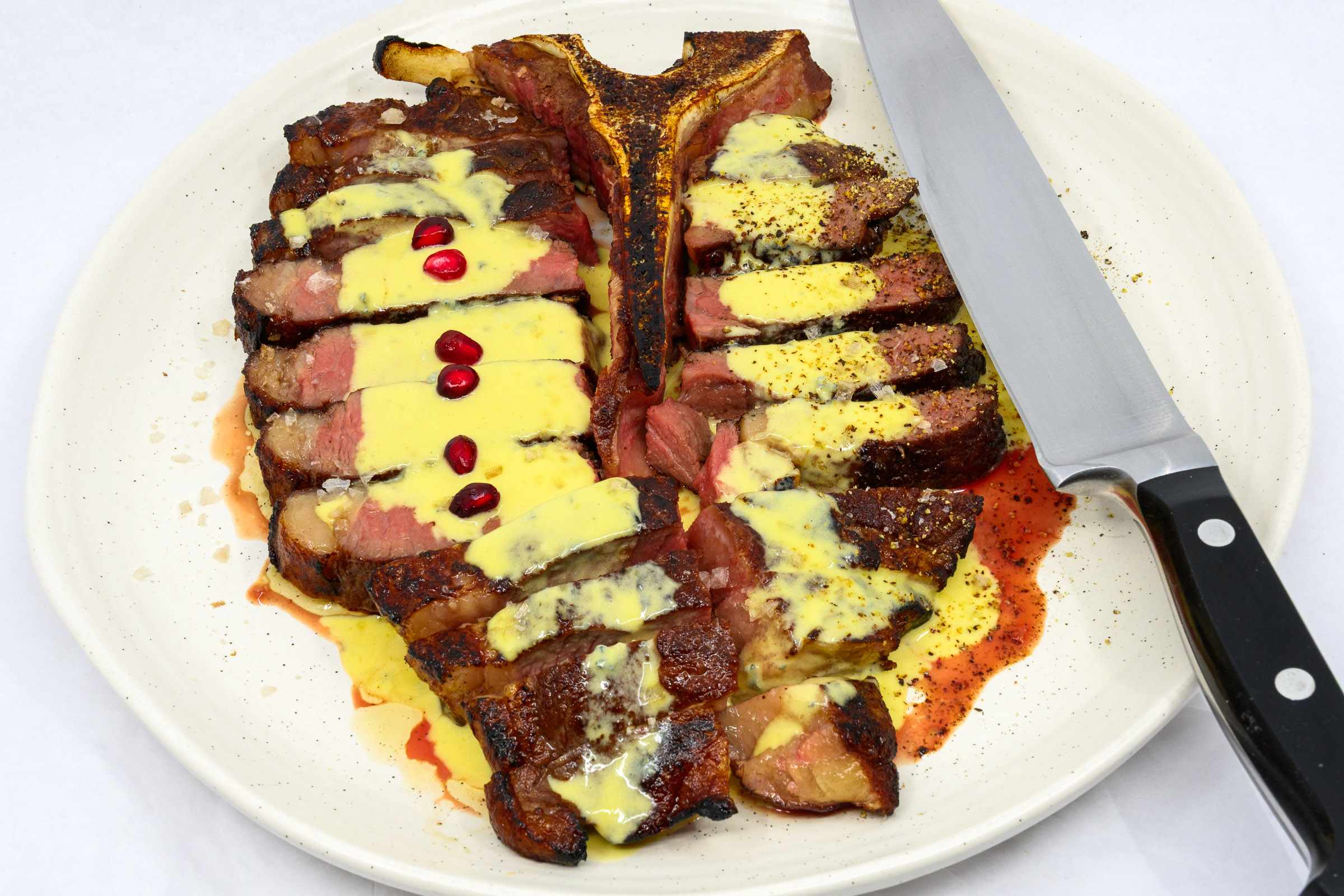
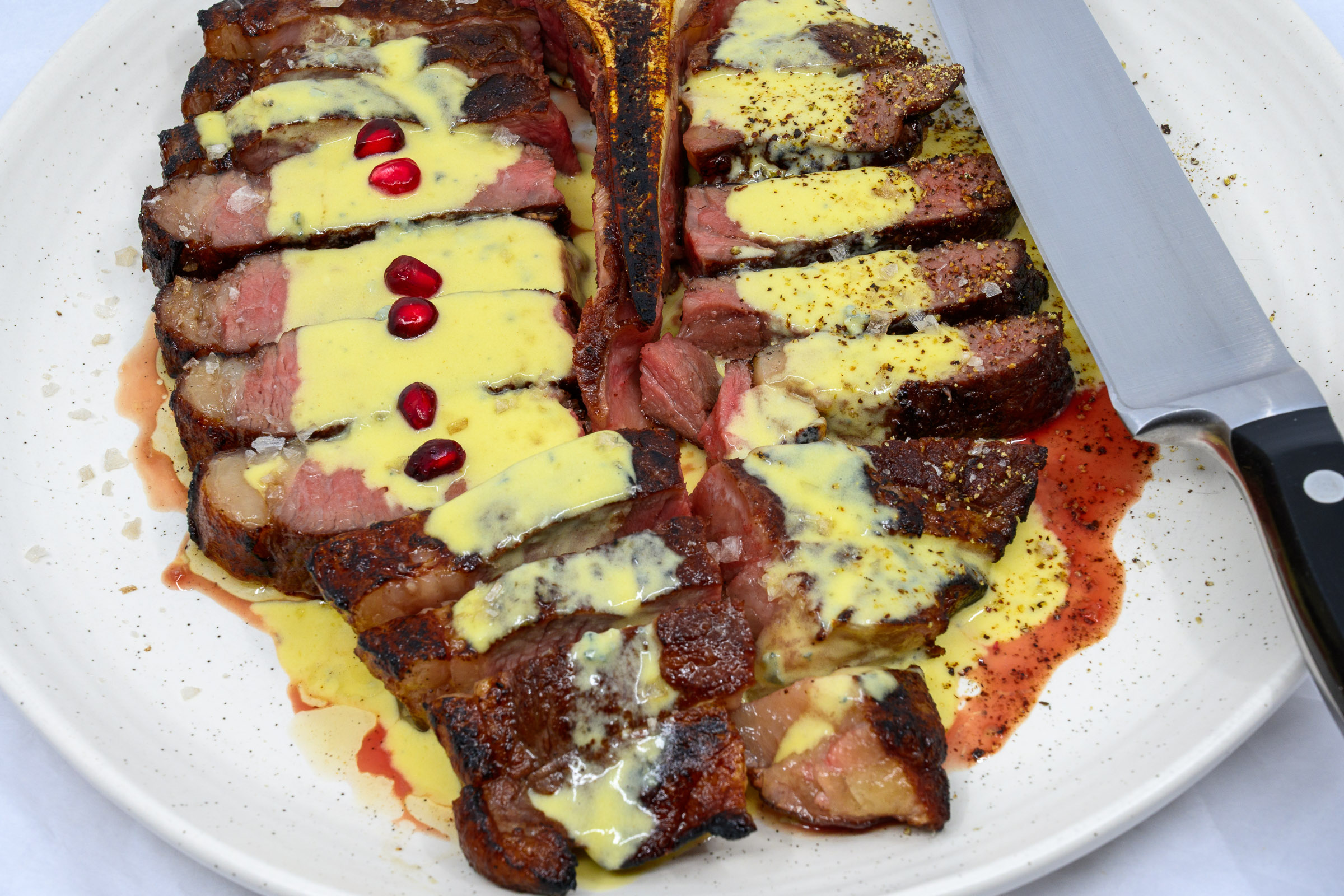
    T-bone steak with blue vein cheese and mustard sauce with pomegranate arils

    T-bone steak with blue vein cheese and mustard sauce with pomegranate arils

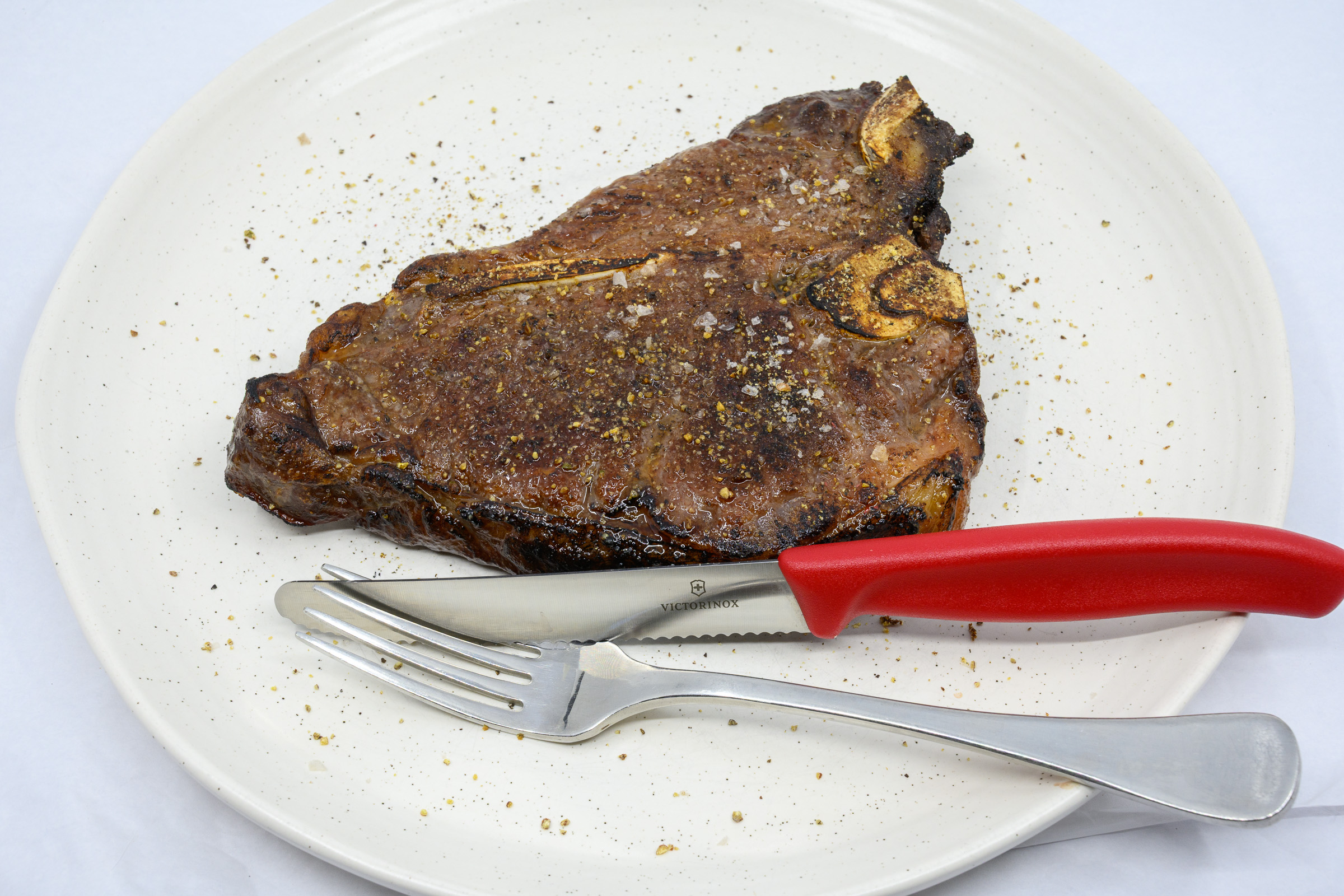
    Tonight’s meal was delicious. I cooked the steak in a water bath and then seared it on a barbecue cast-iron flat-top.

    T-bone steak with blue vein cheese and mustard sauce with pomegranate arils

    I made a sauce with blue vein cheese and mustard.

    T-bone steak with blue vein cheese and mustard sauce with pomegranate arils

    I added some pomegranate arils for a pop of colour.

    T-bone steak with blue vein cheese and mustard sauce with pomegranate arils

    What else have I eaten this week?

    I hope you enjoy your week ahead.


    [i] A person’s general constitution, especially physical build.

    [ii] A bombe Alaska is an old-school dessert that combines ice cream, cake, and toasted meringue into one showpiece.

  • Bad choices

    Bad choices


    It’s been a week punctuated by a couple of “bad food choices.”

    I’ve had a run of sleepless nights this week, and I’ve been feeling a bit foggy in the head. I know that poor sleep can affect mental cognition in ways similar to ethanol intoxication.

    The reasons for my sleepless nights are manifold; suffice it to say, I’m craving a night of quality sleep.

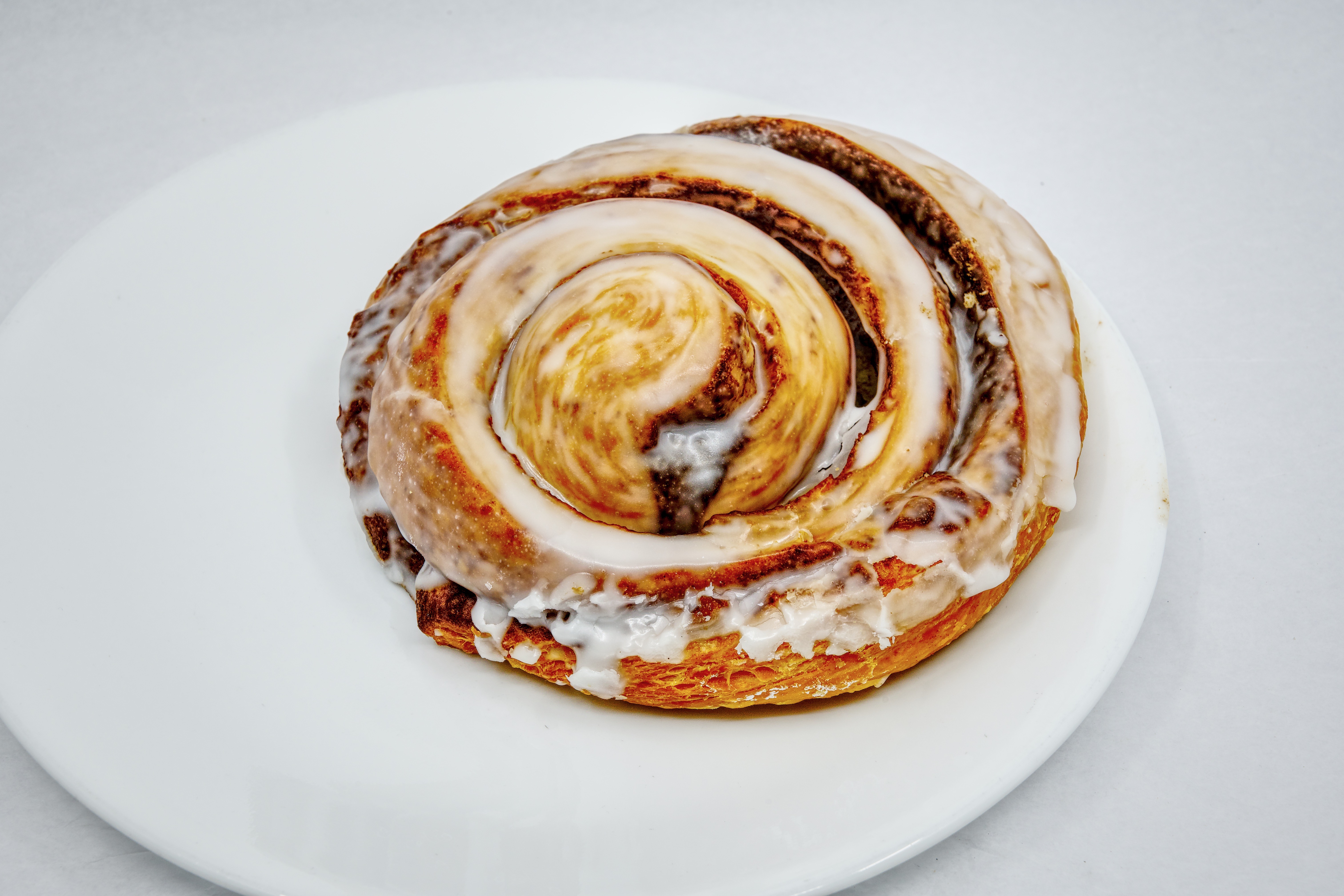
    On the mornings when I’ve felt most exhausted and like a zombie incapable of thinking clearly, I’ve turned to a carbohydrate-rich pastry.

    On Thursday, it was a cinnamon scroll, and today it was a cream-and-jam bun.

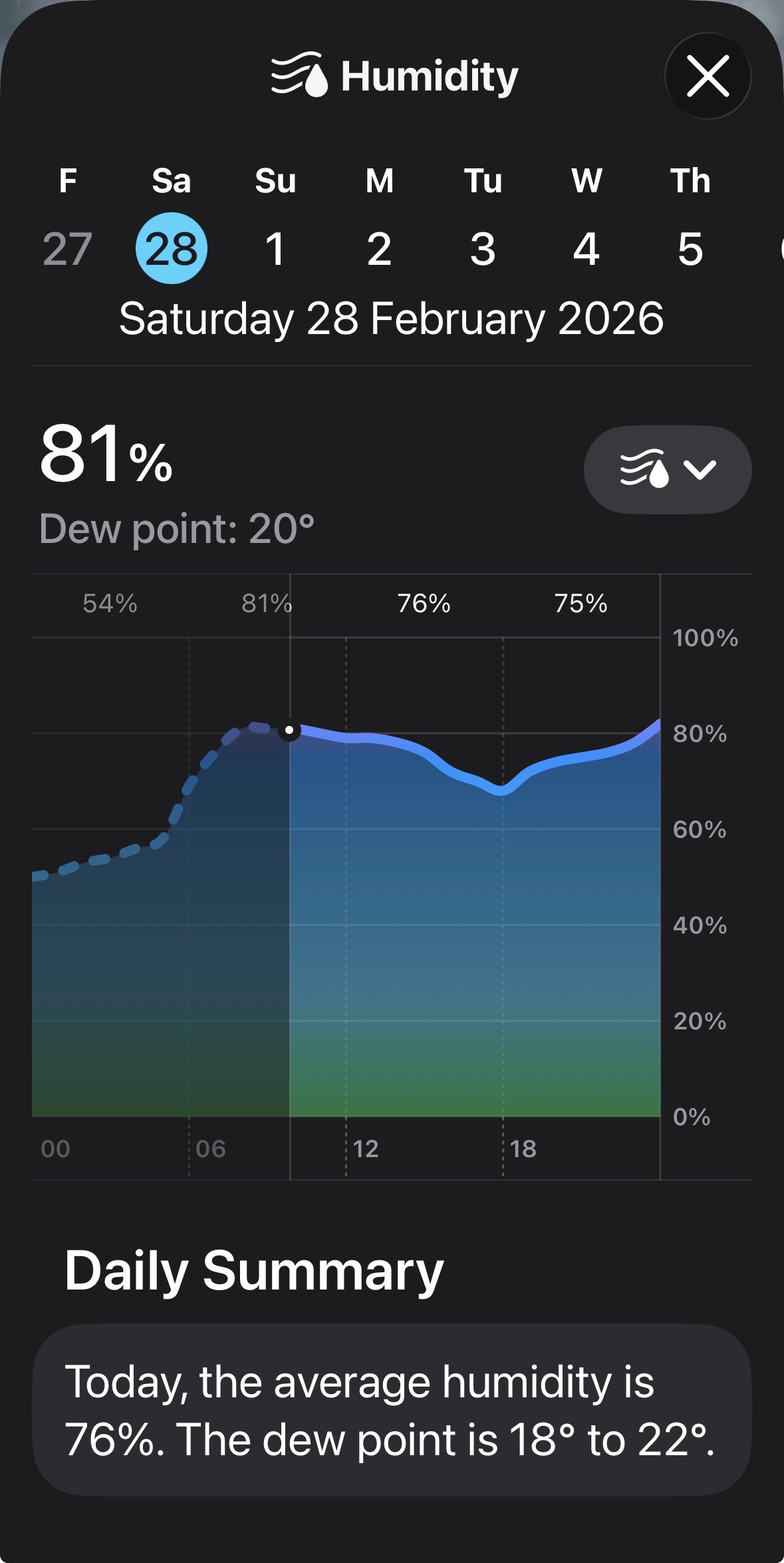
    On a high note, today has been glorious. It’s been drizzling all day, and the humidity is comfortable.

    A screenshot of my weather app with today's relative humidity
    #warmandmoist

    What have I been reading?

    In an unusual twist, I’m reading a book rather than listening to the audiobook. The audiobook will be released at some point, but I wanted to read it now.

    The New Dark Age: Why Liberals Must Win the Culture Wars[i] by Nigel Biggar. Nigel Biggar is a British Anglican priest, theologian, and ethicist known for his work at the intersection of Christian ethics, public life, and contentious historical questions.

    What have I been watching?

    Not much. I’ve been putting in extended hours. After dinner, I’ve been returning to work to complete tasks.

    Last night I watched an episode of Hawaii Five-0 before bed.

    What have I been eating?

    You mean apart from bakery goods?

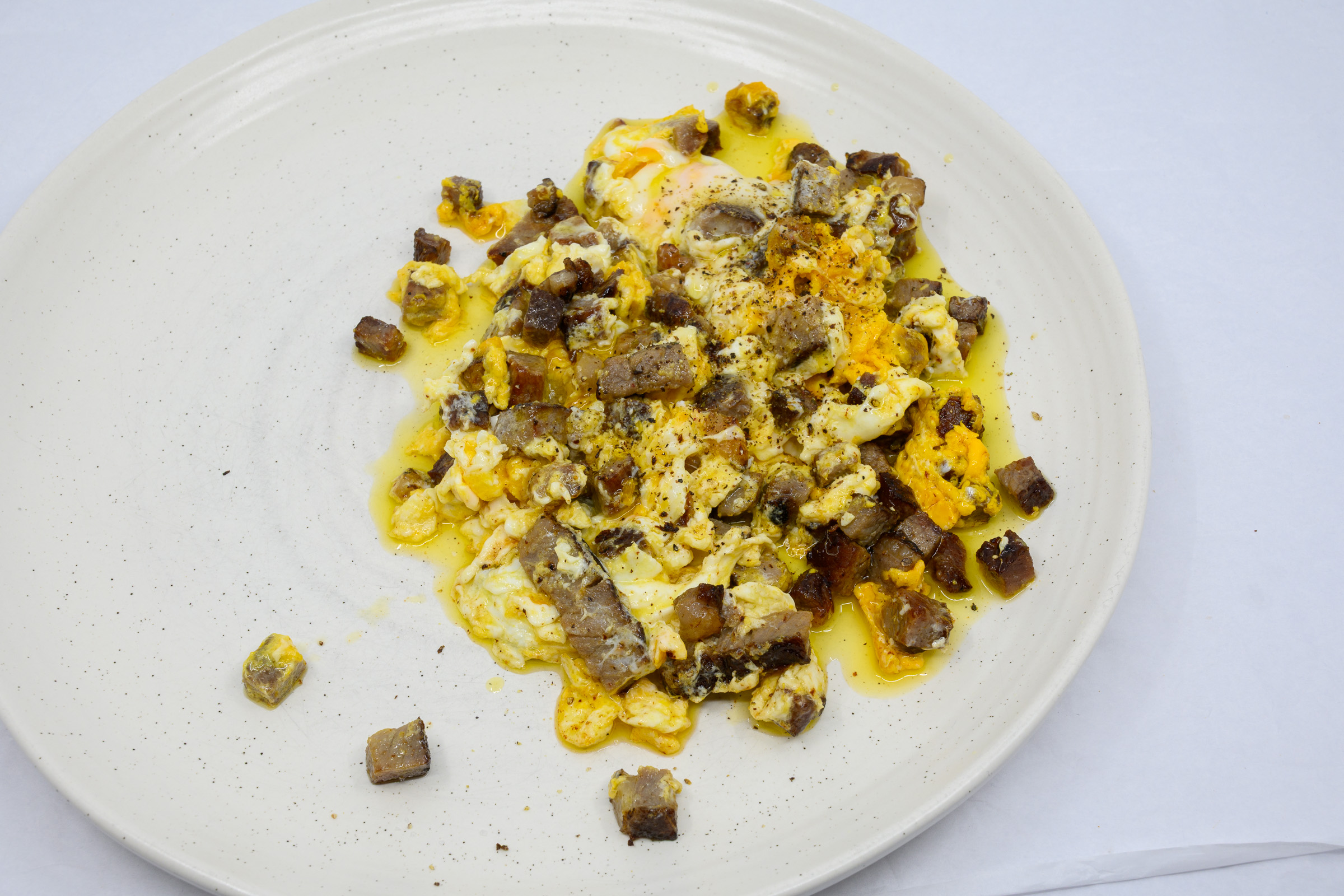
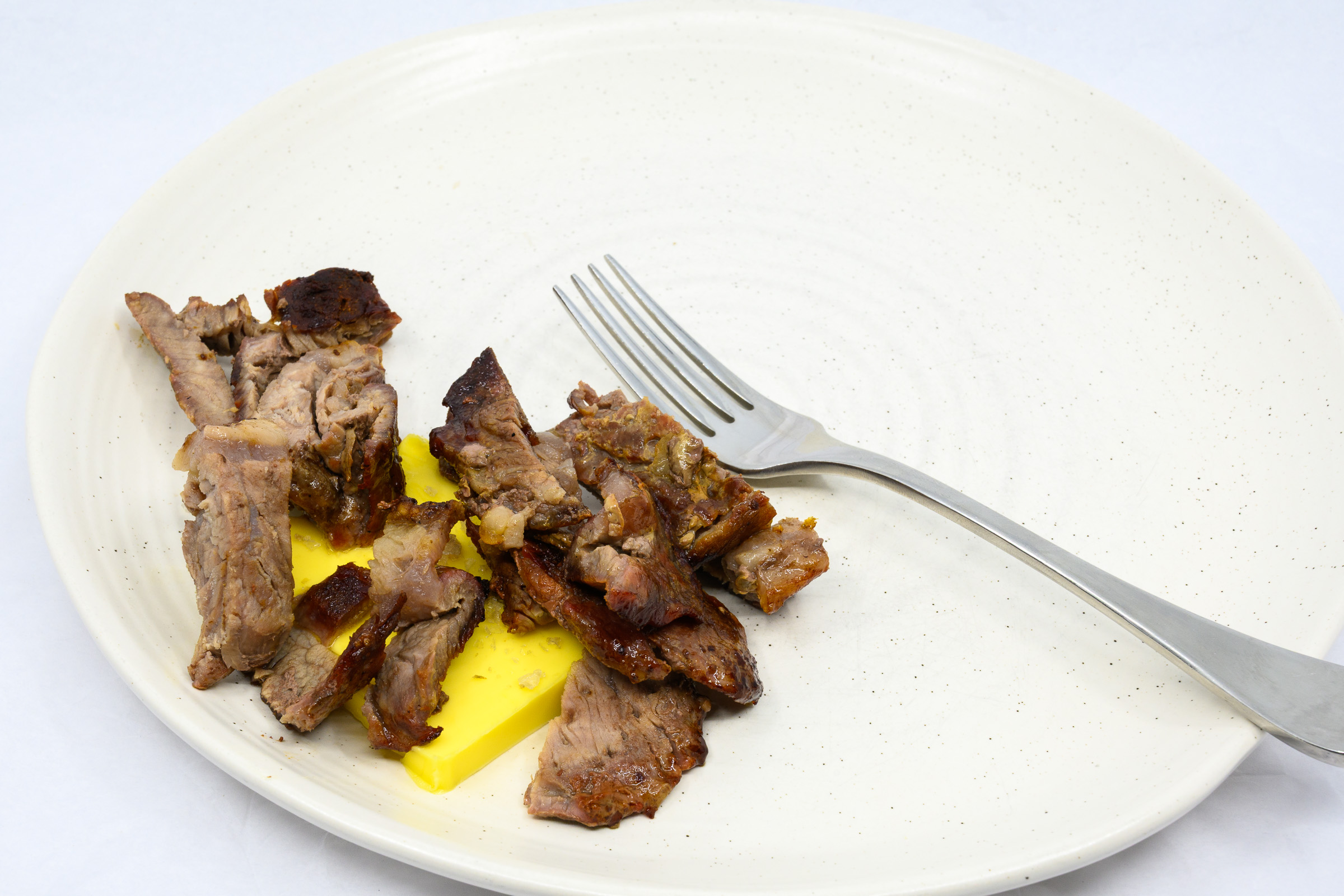
    Here’s a gallery of photographs.

    I hope you’ve had a good week.


    [i] The New Dark Age is an intervention into the contemporary “culture wars,” arguing that these conflicts are not trivial distractions but deep moral and political battles that shape the future of Western civilisation. Biggar challenges the claim that culture-war debates are superficial or manufactured. He insists instead that they concern questions such as:

    • the welfare and moral formation of children
    • How societies manage ethnic and cultural diversity
    • the nature of truth, civility, and public reasoning

    Biggar contends that unless liberals, understood in the classical sense of valuing free inquiry, civil disagreement, and intellectual honesty, actively resist these trends, the West risks sliding into a “new dark age.”

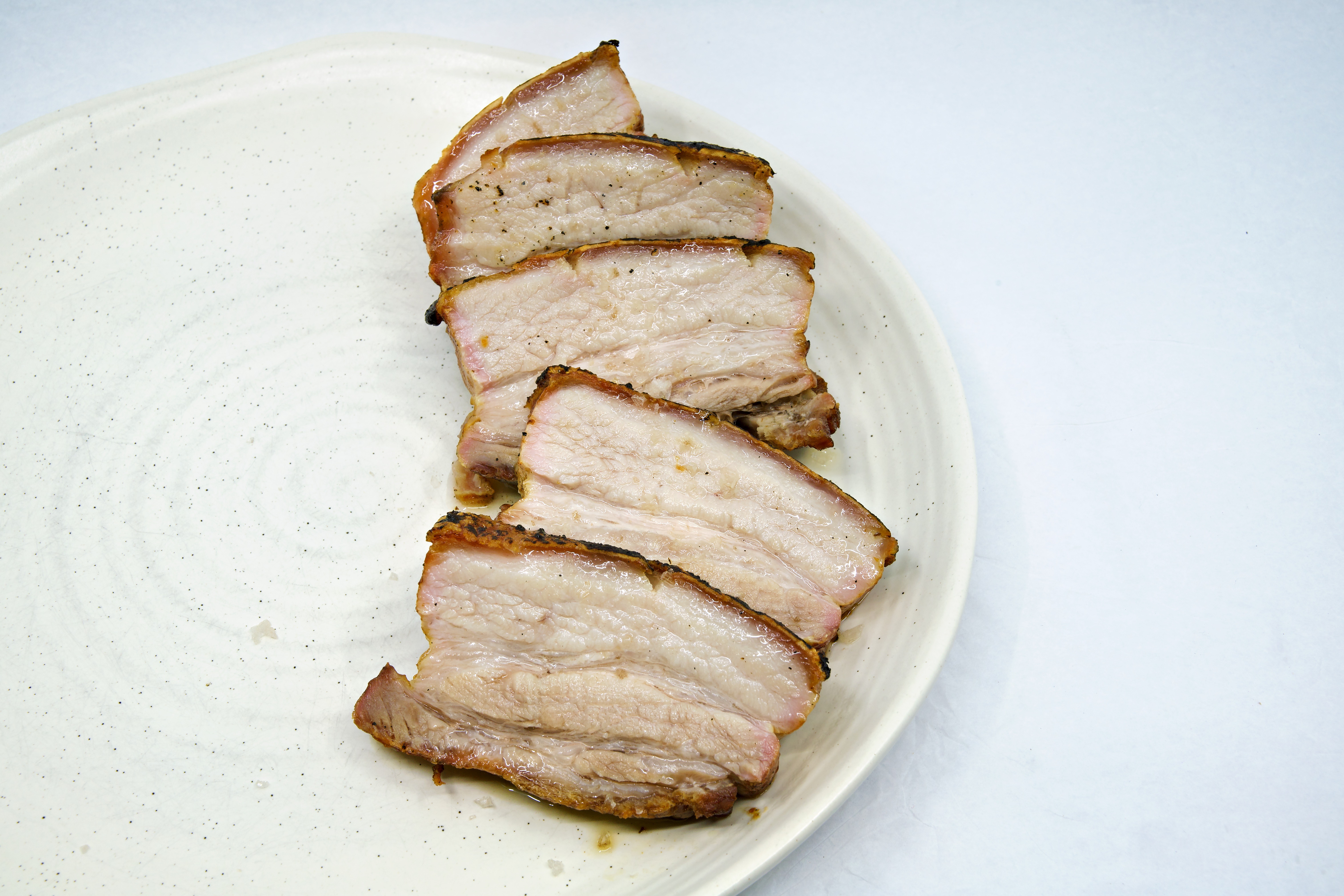
  • Barbecue pork belly

    Barbecue pork belly


    It’s been a challenging week. I’ve been surprised by some unexpected incidents and developments. I’m grateful for the people I work with who are superb humans.

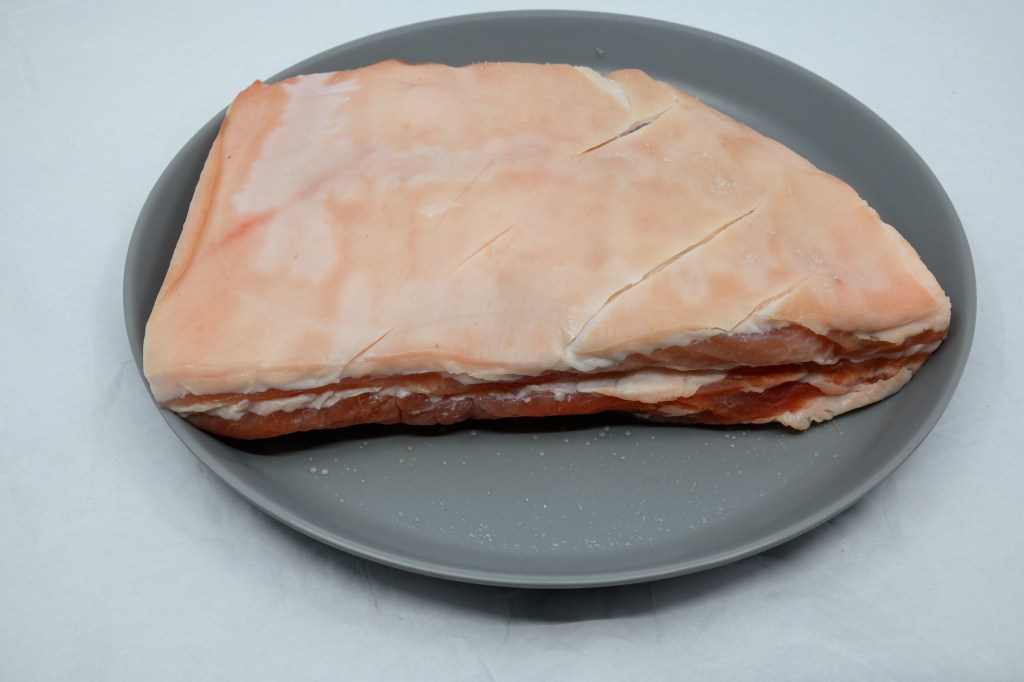
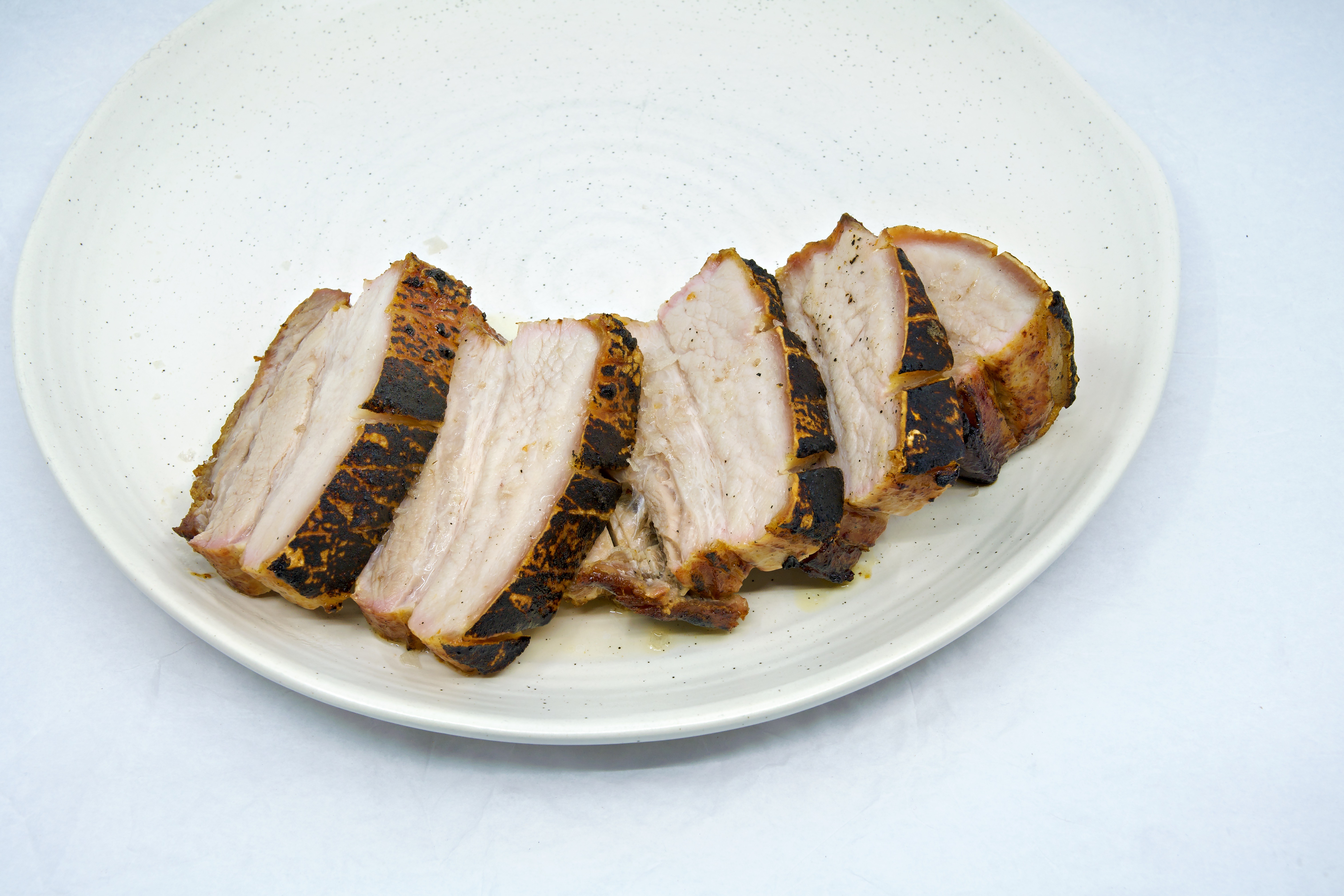
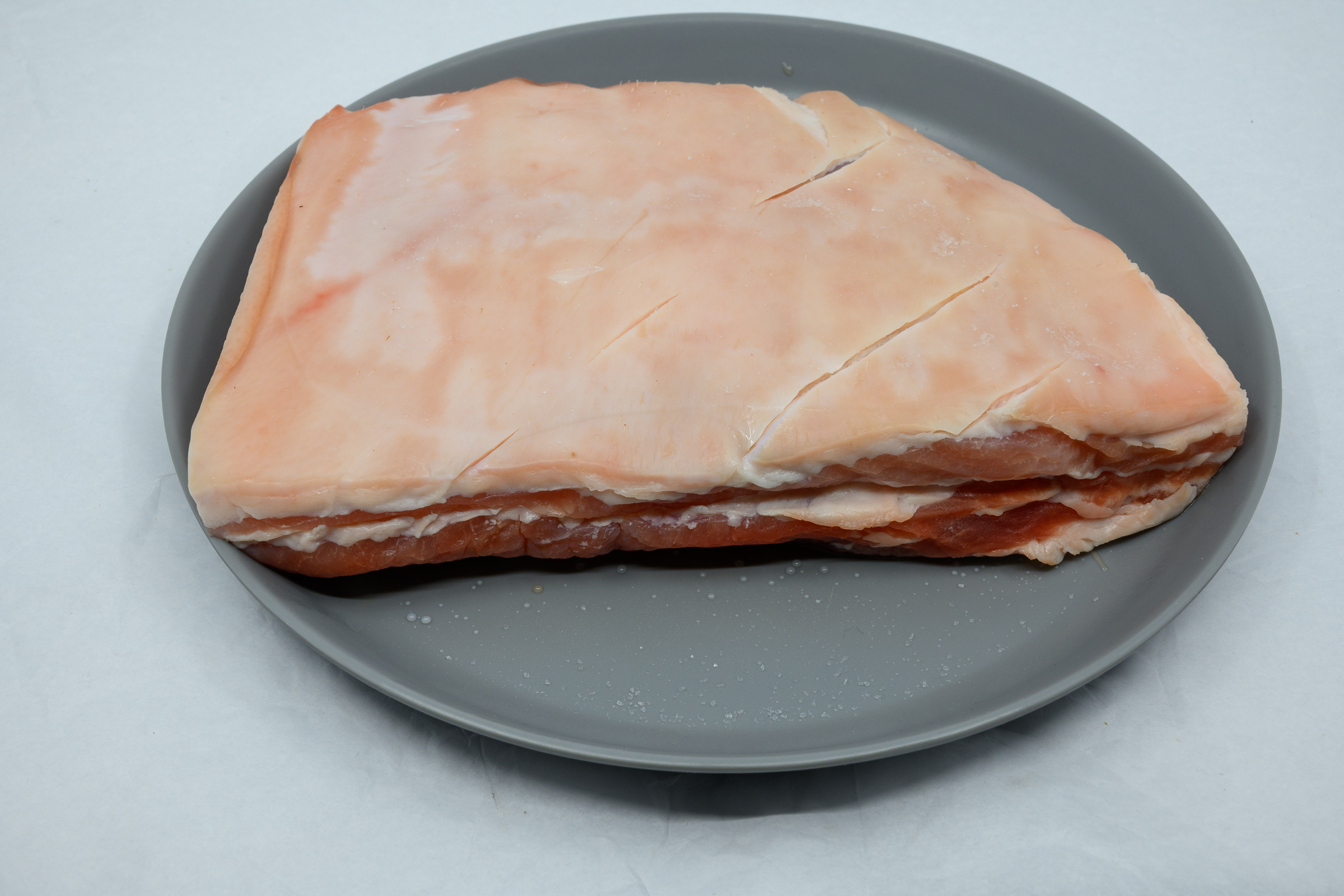
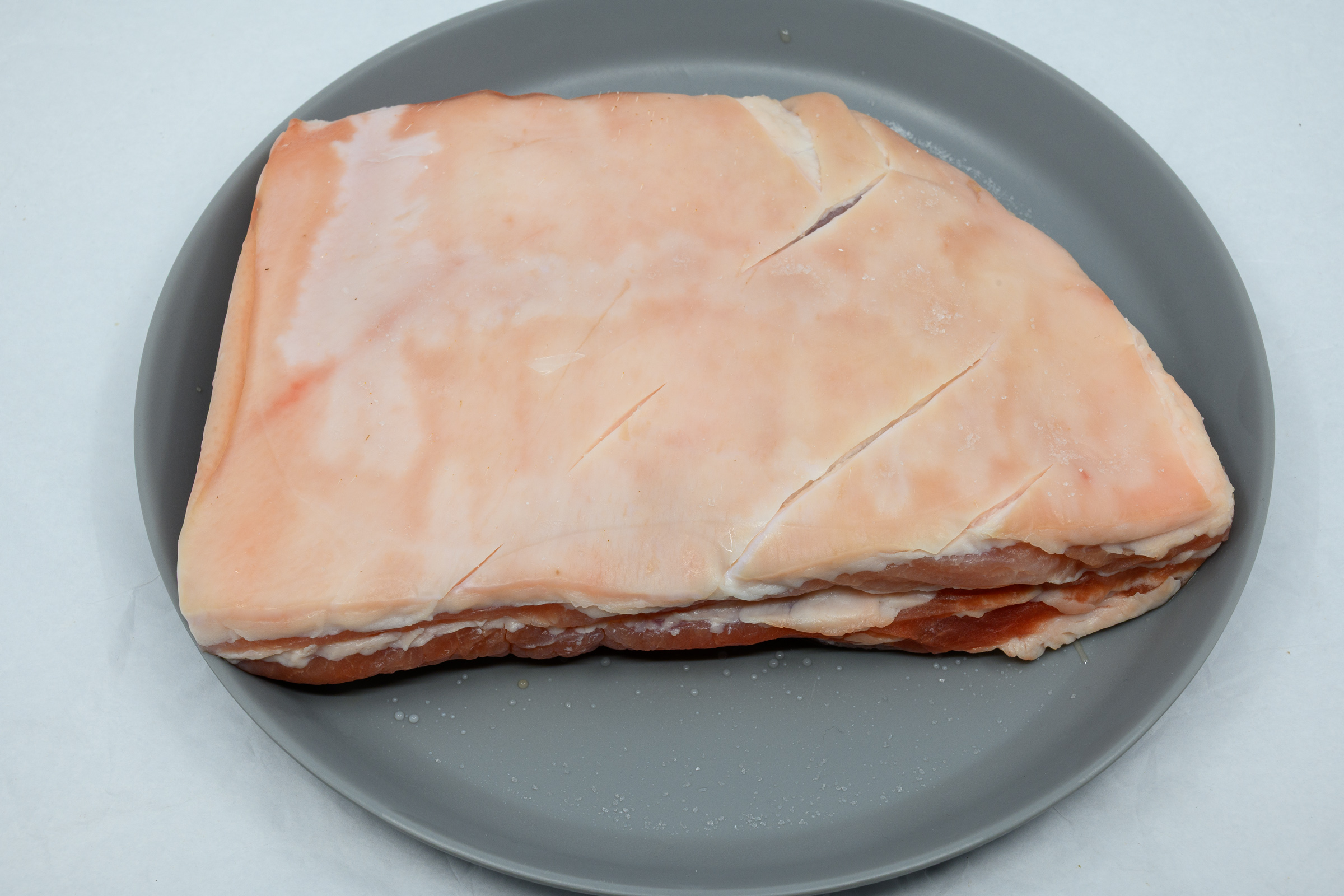
    I saw a piece of pork in the supermarket meat display, and it looked like it would make a good meal. The meat was pork belly, with a good layer of fat over the muscle.

    What have I been reading?

    Mean Streak[i] by Rick Morton[ii]

    A friend at work recommended this book. He’d read it over Christmas break and thought I might be interested[iii]. I finished it in a couple of days.

    What have I done?[iv] by Ben Elton[v]

    I heard Ben Elton on the “No Such Thing as a Fish” podcast when he was a guest because Anna is on maternity leave. Elton was spruiking his book[vi]. Because he’s helped create some of my favourite TV shows, I thought I’d listen to his autobiography (which is made better because he reads it).

    What have I been watching?

    Hawaii Five-0

    I’ve always enjoyed procedural law enforcement shows, and when you add surf, surfing, and the ocean into the mix, I’m completely hooked! It also has a fat man mentioning Spam from time to time, what could be better?

    The cast is replete with Australians.

    What have I been eating?

    I’ve been enjoying a good mix of beef and lamb.  The beef includes mostly mince, economy T-bone steaks and thinly cut scotch fillet (ribeye) steaks.  The lamb consists of economy lamb chops.

    Pork belly

    Ingredients

    • Pork belly
    • Salt

    Equipment

    • Barbecue grill (Weber Q+)

    Instructions

    1. Dry brine the pork belly overnight.
    2. Turn on the gas.
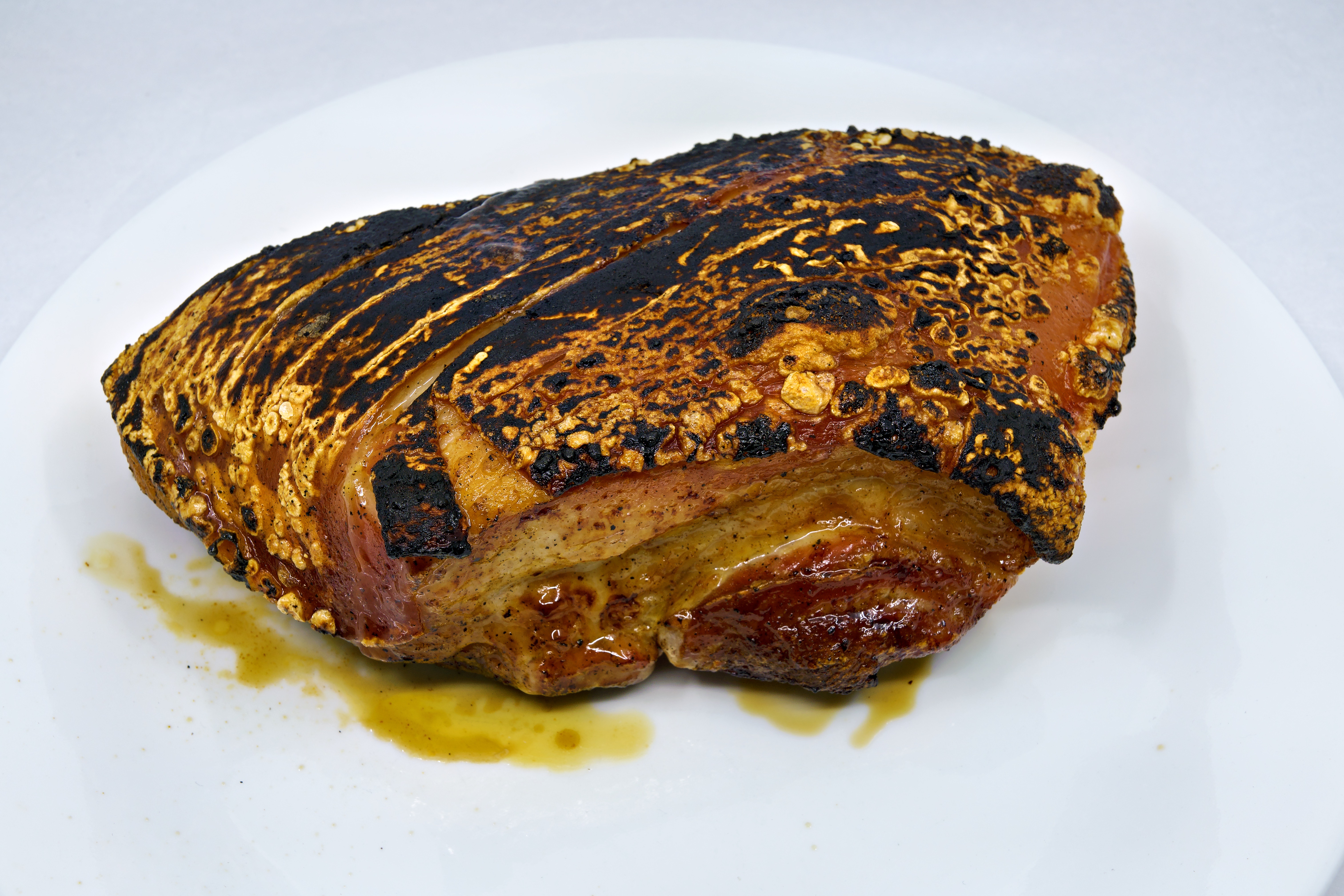
    3. Cook the pork until the skin becomes crackling.
    4. Slice and enjoy.

    Thoughts on the pork belly

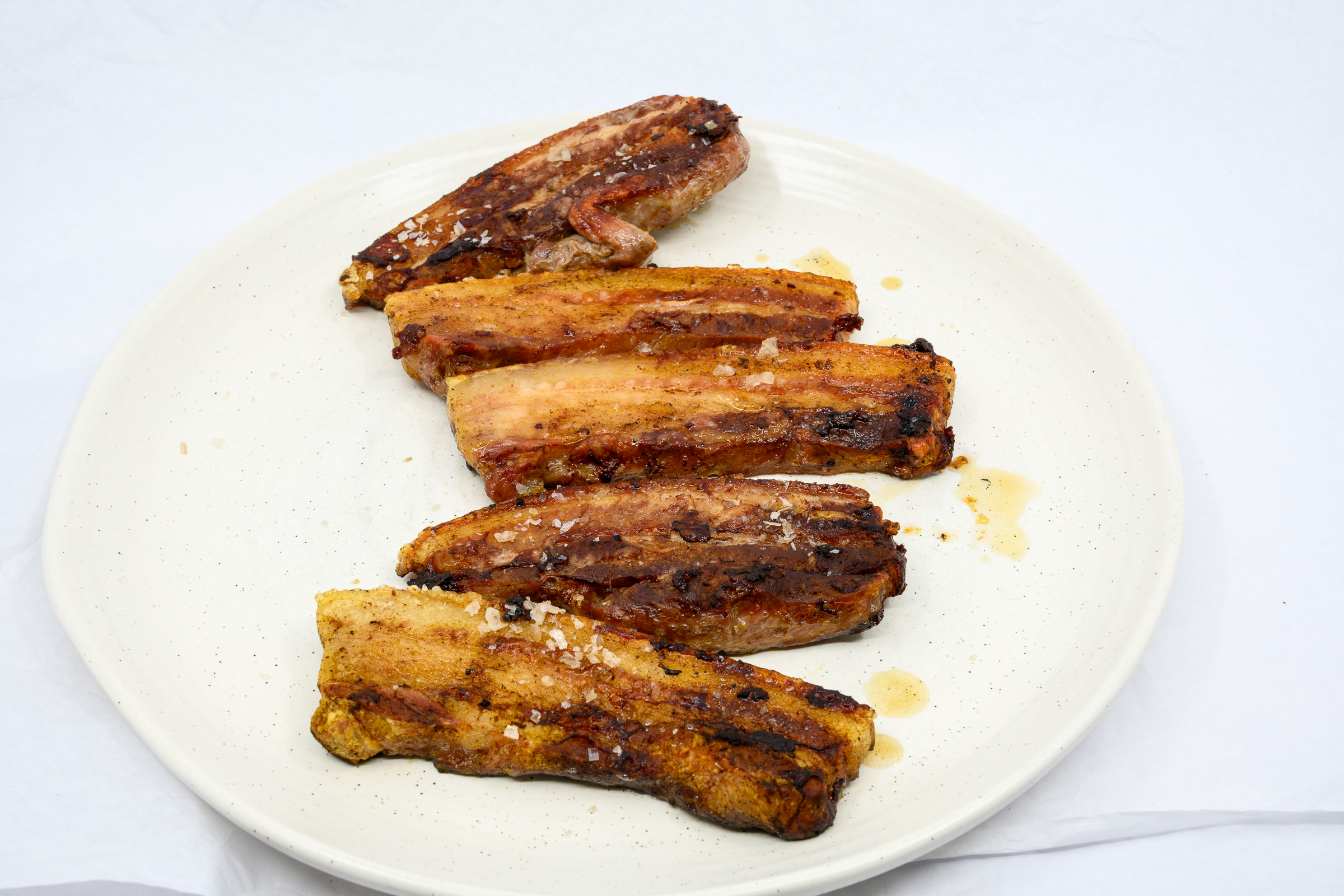
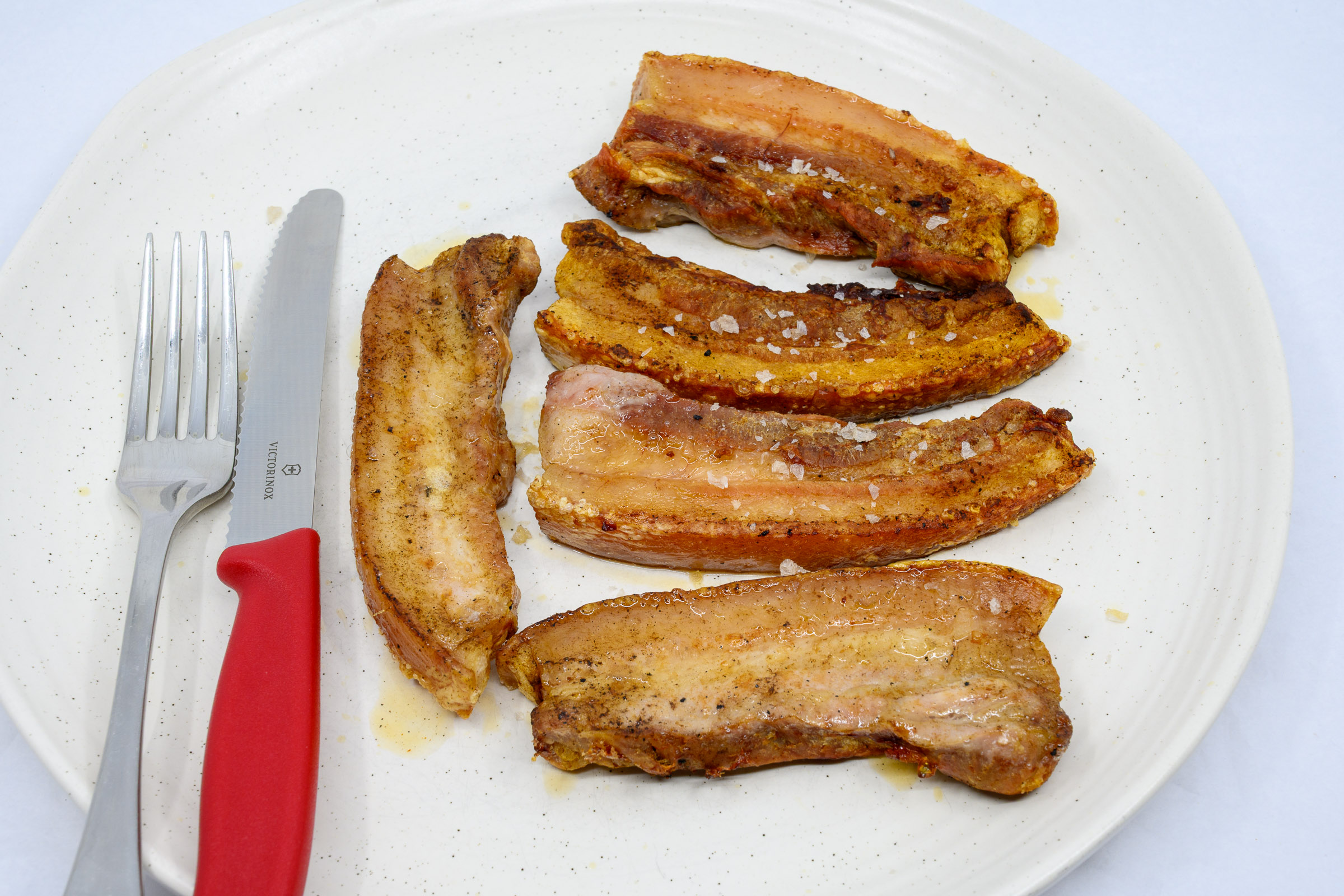
    The crackling could have been better, but the muscle flesh was moist and juicy. With just a gentle squeeze, the juices oozed out on my cutting board.

    The meat was nicely seasoned and tender. The meat was moist and juicy in my mouth, and the fat coated my lips just how I like.

    Photographs


    [i] Morton, Rick. 2024. Mean Streak. Gadigal Country, Australia: Fourth Estate.

    [ii] Rick Morton is an Australian journalist and author known for his deeply researched reporting on social policy, inequality, and government accountability. He has built a reputation for combining rigorous investigation with emotionally resonant storytelling.

    [iii] Mean Streak exposes the deliberate, systemic wrongdoing behind Australia’s Robodebt scheme, tracing how senior officials and politicians implemented and defended an unlawful, automated debt‑recovery program despite clear evidence of its inaccuracy and harm. It combines rigorous investigation with human stories to show the immense damage inflicted on vulnerable people and the institutional failures that allowed the scheme to persist.

    [iv] Elton, Ben. What Have I Done?: My Autobiography. Pan Macmillan, 2025.

    [v] Ben Elton is a major figure in British comedy and entertainment, known for shaping the landscape of alternative comedy in the 1980s and for an extraordinarily wide-ranging career. He is known for co-writing iconic sitcoms:

    The Young Ones (1982–84)

    Blackadder (series II–IV, 1986–89)

    Mr. Bean (contributor)

    [vi] What Have I Done? is Ben Elton’s energetic and candid autobiography, tracing his rise from the 1980s alternative‑comedy scene to becoming a prolific writer of sitcoms, novels, plays, and major stage musicals. It blends sharp humour with forthright reflections on creative triumphs, public criticism, and long‑running professional relationships, offering an unfiltered look at a career spent provoking, entertaining, and occasionally settling old scores.